

Costa Rica real estate scams: how to spot them before you pay a deposit
Most Costa Rica real estate scams involve forged documents, deposits paid to the wrong person or stolen titles, and you avoid them by checking documents at the source and using escrow.
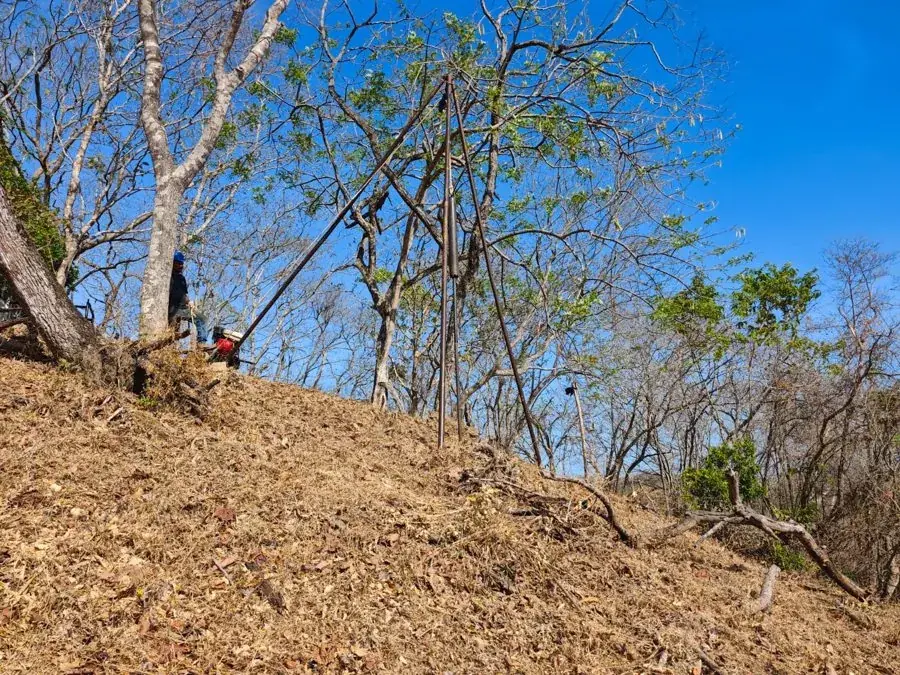
Most Costa Rica real estate scams follow a few patterns: forged documents, deposits paid to the wrong person, fake listings, stolen titles and builders who take money without a contract or CFIA registration. You protect yourself by checking every document at its source, keeping deposits in regulated escrow and hiring your own lawyer before any money moves. None of this is complicated, but it has to happen in the right order.
Someone came to us after paying a reservation deposit on a property that had no water letter. The seller had forged one. This guide covers the scams buyers and owners actually meet in Costa Rica, how to spot each one, what to do if it happens to you, and a checklist for buying land and hiring a builder safely.
This guide is general information, not legal advice. Have a Costa Rican attorney review your own purchase.
How common is property fraud in Costa Rica?
Fraud is the most reported crime in the country. The OIJ received 33,153 fraud complaints in 2025, up 8.9% on 2024, or about one every 16 minutes (Delfino, March 2026, citing the OIJ annual report). Most of that is phone and online fraud, but property fraud is part of it. Cases of registry fraud reported to prosecutors rose from 65 in 2022 to 122 in 2025 (Diario Extra, November 2026).
Some cases are large. In June 2024 the OIJ carried out raids against a group it linked to the irregular acquisition of as many as 300 properties, with 12 notaries implicated (Tico Times, June 2024). At the time, investigators had confirmed 25 properties and said the total could pass 100 (Teletica, June 2024). According to the OIJ, the group targeted properties that appeared to be unused. That does not mean buying in Costa Rica is unsafe. It means the checks below are worth doing every time.
Forged documents: water letters, land use and plans
A forged document is the simplest scam because it costs the seller almost nothing. The documents most worth faking are the ones that make a lot look buildable.
- Water letter (carta de disponibilidad de agua). Without a valid letter from AyA, the local ASADA or the municipal water system, a lot may be effectively unbuildable, so it should be in hand, current and in your favour before money moves (Tico Times, September 2026). Our water letter guide explains who issues it, and a separate guide covers how to check a water letter is real.
- Land use certificate (uso de suelo). It is issued by the municipality, so confirm it with the municipality itself, not with a copy the seller sends.
- Survey plan (plano catastrado) and title. The listed size or boundaries may not match the registered plan (AG Legal, July 2026). Pull the registry record yourself and have a licensed surveyor match the plan to the land (Tico Times, September 2026).
The rule is the same for every document: a copy from the seller or agent is a starting point, not proof. Ask the issuing office.
Reservation and deposit scams: who holds your money?
The initial deposit (señal de trato) is customarily about 10% of the price in Costa Rica, though it is negotiable. Under the Civil and Commercial Codes a deposit is presumed to be part of the price unless the parties clearly say otherwise, so handing over a deposit can mean the property is treated as already sold rather than reserved, even when an escrow company holds the money (Tico Times, April 2026). Your lawyer should make sure the agreement states clearly what the deposit is and when it is returned.
Use escrow. Escrow should go through a company registered with SUGEF, the financial regulator, and typically costs about 0.25% of the price or a flat fee near $1,000 (Tico Times, September 2026). Costa Rica has no regulation written specifically for escrow companies, so also ask whether the company is insured and keeps client funds in a separate account (Tico Times, April 2026). Funds should be released only after the deed is registered (AG Legal, July 2026).
| Payment request | Risk | Safer approach |
|---|---|---|
| Deposit straight to the seller | The money is out of your control before any checks are done | Deposit into SUGEF-registered escrow under a written agreement that says what the deposit is and when it is returned |
| Deposit to the agent's personal account | No regulated holder and no separate account | Escrow only, with release conditions written in the contract |
| New wiring instructions by email | Hacked email accounts send fake instructions that look real (Coldwell Banker Costa Rica) | Call your lawyer or escrow company on a number you already know |
| "Pay today or lose it" | Pressure to pay before a title search is a classic warning sign (AG Legal) | Walk away if the seller will not wait for due diligence |
In short: never pay a seller or agent directly before due diligence is done.
Fake and duplicate listings, and impersonation
Scammers copy real photos, addresses and descriptions, repost them as a cheaper "direct" deal, move the conversation to WhatsApp and ask for a deposit by SINPE or bank transfer. In one 2026 case the owner of a home in Playa Flamingo estimated that 10 to 12 people paid deposits on a fake listing of it (Tico Times, January 2026). That case was a rental, but the same method is used on property for sale. The OIJ reports that electronic fraud cases rose from 7,095 in 2024 to 10,027 in 2025 (Tico Times, January 2026).
Impersonation also happens with owners. Criminals have used fake ID cards to pose as the owner of a property, and some groups look for owners who are abroad (InSight Crime, April 2021). Confirm that the person selling matches the registered owner, and be cautious with anyone you have never met who will only deal remotely.
Title fraud and identity theft: protecting a property you own
Costa Rica's property titles are centralised in the Registro Nacional, and recorded documents are presumed valid unless a court decides otherwise, which is why a fraudulent transfer can take years to undo (InSight Crime, April 2021). Owners who live abroad and do not check on a lot for long periods are a common target.
Registro Nacional alerts (Alerta Registral)
The Registro Nacional's monitoring service is called Alerta Registral. It emails you when a document affecting your property enters the Registry's daily log (Diario), and it can also cover vehicles, boats and companies. You sign up online with an email account, and you do not have to be the owner, only to know the registry number. It is not free: it costs USD $15 per year for each asset monitored (GM Attorneys via Howler; El Observador, July 2024; Delfino, October 2026), so confirm the current price when you sign up. For an absent owner it is one of the cheapest protections available.
What the Registry can do after a fraud
Under Law 9602, now titled the Ley de Fortalecimiento de la Seguridad Registral del Registro Nacional after a December 2025 reform (Law 10830), the Registry can cancel entries made with fraudulent documents or place a blocking note (nota de bloqueo registral) that immobilises the record, once the fraud is shown with objective evidence (Bufete de Costa Rica). Affected owners can also request a fraud prevention note, which needs a written request, a criminal complaint (denuncia penal) and objective evidence of the fraud (Registro Nacional, nota de prevención por fraude inmobiliario). These are remedies after the fact. Costa Rica has no voluntary freeze an owner can put on a property in advance (Delfino, October 2026).
Are real estate agents licensed in Costa Rica?
No. Real estate brokerage has no specific licensing regime, and anyone can offer brokerage services without accreditation or minimum training (Delfino, June 2026; ECIJA, August 2025). Real estate associations are voluntary and have no public disciplinary powers. People who buy and sell real estate professionally must register with SUGEF under article 15 bis of Law 7786, but that rule exists to prevent money laundering, not to license agents (Delfino, June 2026).
Many agents are honest and helpful. Remember that an agent often represents the seller (ECIJA, August 2025), and that your protection comes from your own lawyer and escrow, not from a title on a business card.
Also see: Unpermitted construction in Costa Rica: the risks and how to legalize a house and Septic systems in Costa Rica: rules, percolation tests and sizing for a new home
Notary and power of attorney fraud
In Costa Rica a notary drafts and registers the deed. A notary must be a lawyer who has been a member of the Colegio de Abogados for at least two years, and the Dirección Nacional de Notariado oversees notarial work (Código Notarial, articles 3 and 22). The notary who handles the transfer does not protect the buyer, so hire your own attorney, separate from the seller's notary (AG Legal, July 2026). Ask your lawyer for their membership number and confirm with the Colegio de Abogados y Abogadas that they are active.
Powers of attorney are another weak point. Someone can sign for an absent owner with a power that is expired, forged or never properly registered (AG Legal, July 2026). If the seller is represented by a power of attorney, your lawyer should confirm it independently, with the notary who granted it and in the Registry, before you sign.
"Titled" beachfront that is really a concession
The first 200 metres inland from the high tide line belong to the state: the first 50 metres are public and the next 150 metres are a restricted zone where municipalities grant concessions, not title. A concession is a lease from the state, not ownership (Tico Times, September 2026). Selling concession land as titled property is one of the most common scams aimed at foreigners (AG Legal, July 2026). Before anything else, establish whether the seller holds title or a concession. Our maritime zone guide explains concessions and what can be built.
Builder and contractor scams
Construction fraud usually looks like a large upfront payment followed by little or no work. In April 2026 the OIJ detained a suspect it linked to 35 fraud cases since 2023 involving prefabricated houses offered online, in which buyers allegedly paid down payments and received no home (El Observador, April 2026). The warning signs are consistent:
- A big deposit before any plans or permits exist.
- No CFIA registration. National and foreign firms working in engineering and architecture must be registered with the CFIA (CFIA, Ley Orgánica article 52). The CFIA lists registered professionals and companies in its directory, and its registry department can be reached at dep.registro@cfia.cr or 2103-2290 (CFIA).
- No written contract, or a contract with no scope, schedule or payment terms. Our construction contract guide covers what to include.
- Talk of building without permits. The building permit checklist shows what a legal project needs.
For more on vetting a builder, see how to choose a home builder in Costa Rica.
What to do if you have been scammed
- Stop paying and stop signing until an attorney has reviewed the situation (AG Legal, July 2026).
- Keep everything: messages, contracts, receipts and transfer records. Contact your bank immediately and report any fake listing to the site that hosts it (Tico Times, January 2026).
- File a criminal complaint with the OIJ if fraud, forgery or identity misuse is involved (AG Legal, July 2026).
- Act at the Registro Nacional through your lawyer: ask about a fraud prevention note or cancellation of the fraudulent entry (Registro Nacional; Bufete de Costa Rica).
- Pursue civil remedies with your lawyer alongside the criminal case. Recovery is not guaranteed and can take time (AG Legal, July 2026).
Checklist: how to protect yourself before paying anything
- Hire your own Costa Rican attorney, separate from the seller's notary, and confirm they are an active member of the Colegio de Abogados y Abogadas.
- Pull the Registro Nacional record (folio real) and read the annotations for mortgages, liens, easements and litigation (Tico Times, September 2026). Review at least 10 years of ownership history (AG Legal, July 2026).
- Confirm the seller is the registered owner, and check any power of attorney independently.
- Check title or concession on anything near the beach.
- Get the water letter, land use certificate and plano confirmed by the offices that issued them.
- Keep every deposit in SUGEF-registered escrow, with written release conditions.
- Confirm wiring instructions by phone on a number you already have.
- Have the lot itself checked before you buy. Our guide to buying land in Costa Rica to build lists what to look at.
- Once you own, sign up for Alerta Registral.
How to work with a trusted, CFIA-registered builder
- Verify the CFIA registration yourself in the CFIA directory or with its registry department. Do not rely on a logo or a number on a website.
- Sign a written contract with scope, plans, schedule, price and payment terms before construction money moves.
- Tie payments to finished stages. As general advice, avoid paying far ahead of the work, and pay each instalment against a stage you or your representative can see is done.
- Get an independent view of the lot, the budget and the builder, especially if you are building from abroad.
How Decentra helps
Decentra Homes is a design-build custom home builder in Costa Rica, founded in 2020, with 50+ residential and commercial projects. Our design and construction are CFIA certified under SANYC Ingeniería, CFIA registration CC-10880, and we encourage you to check that registration with the CFIA yourself. Before you buy, our land and construction consulting is with a CFIA-licensed engineer and architect with 15 years of experience, at $200 per hour. Minimum construction budget $350,000 USD, before land (new builds). Message us on WhatsApp at +506 8733-2930 or through our contact page.