

Property due diligence in Costa Rica: who checks what before you buy land to build
Before you buy land to build in Costa Rica, split due diligence among your attorney, notary, surveyor, engineer or architect, an environmental consultant and yourself, and get each check in writing.
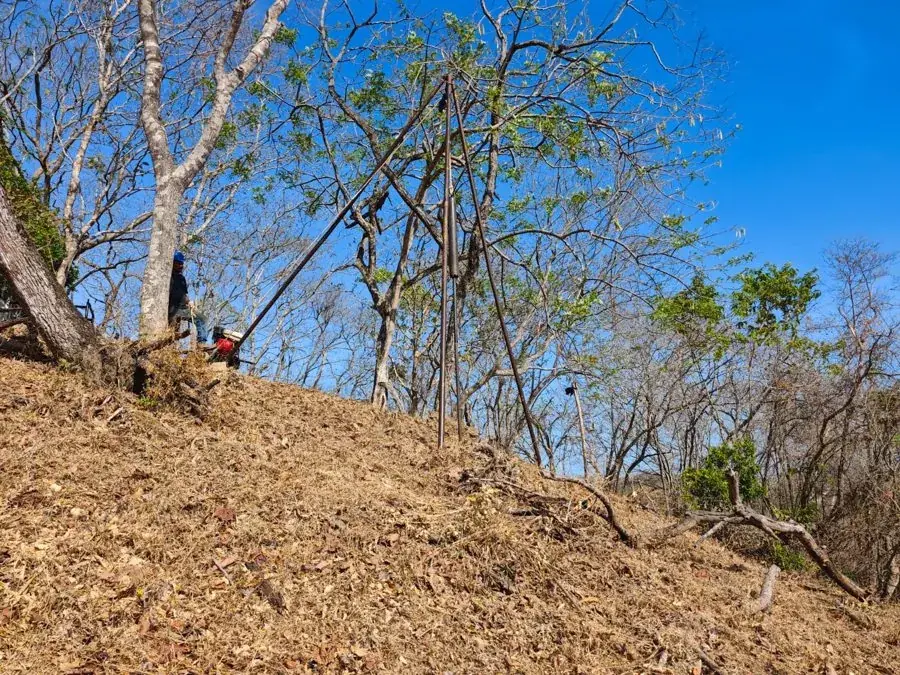
Property due diligence in Costa Rica is a team job, and no single professional checks everything. Your attorney checks title, liens, contracts and taxes; the notary studies the registry and records the deed; a licensed surveyor compares the plano catastrado with the land; an engineer or architect confirms what you can build given the land use, slope and soil; an environmental consultant checks rivers, forest, protected areas and SETENA; and you, the buyer, own the water letter, access, HOA rules and budget. Agree in writing who checks what before you sign an offer.
This guide is general information, not legal or tax advice. Confirm each point with your own attorney, notary and tax adviser.
It gives a who-does-what table, explains each role and what to get from them in writing, and links to our detailed guides instead of repeating them. For the full list of lot checks and who issues each document, start with buying land in Costa Rica to build.
Who checks what: the due diligence table
| Check | Lead | Also involved | What you should receive |
|---|---|---|---|
| Title and liens | Attorney | Notary | A written report on the folio real: owner, mortgages, liens, easements and annotations |
| Plano catastrado | Surveyor (agrimensor) | Attorney | A report comparing the registered plan with markers, fences and structures on the ground |
| Uso de suelo | Engineer or architect | Attorney; the municipality issues it | The land-use certificate and an opinion on what it lets you build |
| Water letter | Buyer | Attorney; AyA, ASADA or municipal system issues it | A letter for the exact lot, verified with the issuer |
| Access and easements | Attorney | Surveyor; buyer | Proof of legal access, with a registered easement where the road crosses other land |
| Maritime zone | Attorney | Surveyor; municipality | Confirmation of title or concession, and the distance from the high-tide line |
| Slope and soil | Engineer | Surveyor | A topographic survey and a soil study with foundation advice |
| Protected areas and SETENA | Environmental consultant | Engineer | A map of rivers, springs, forest and protected areas, and a SETENA screening |
| HOA or condominium | Attorney | Buyer; architect | A review of the reglamento and the administrator's payment certificate |
| Taxes and closing costs | Attorney | Notary; tax adviser | Municipal tax certification and an estimate of transfer tax and fees |
The attorney: title, liens, contracts and taxes
Hire an attorney who represents you alone, not the seller, the listing agent or the developer (Tico Times, September 2026). Their core jobs:
- Title. Review the folio real at the Registro Nacional and every annotation on it, get municipal tax certifications, and, if you are buying the shares of a company that owns the lot, review the company too (Tico Times, September 2026). What the registry record shows is set out in our guide to buying land.
- Conditions. Write the checks in this guide into the offer as conditions, with a deadline, before the deposit becomes non-refundable.
- Fraud. Check identities, powers of attorney and documents; our guide to real estate scams in Costa Rica lists the warning signs.
Ask for a written title report, not a verbal all-clear.
The notary: registry study, deed and registration
In Costa Rica the notary is a lawyer with public faith, not a witness stamp. Under the Código Notarial, Law 7764, a notary must hold a law degree with postgraduate training in notarial and registry law (article 3). The notary has public faith in what they certify (article 31), and their duties include carrying out registry studies and handling the registration of the documents they authorize (article 34). Only a notary can draft and register a transfer, and notary fees are generally 1 to 2 percent of the price, plus VAT on the fee (Tico Times, September 2026).
The notary's registry study does not replace your attorney's review. Ask the notary whom they act for and when the deed will be filed with the registry, and hold the purchase money with an escrow agent registered with SUGEF (Tico Times, September 2026).
The surveyor (agrimensor): plano catastrado vs the land
Surveying requires a licence under Law 4294. The licence is issued through the CFIA, the CFIA oversees the profession, and licensed surveyors have public faith in their survey work (Law 4294, articles 2, 9 and 12). Hire your own surveyor to:
- Walk the boundaries and compare markers, fences, driveways and structures with the registered plan.
- Flag encroachments, missing markers and any difference in area.
- Prepare a topographic survey if you plan to build, which your engineer needs for the design.
A boundary check is not expensive: one RE/MAX brokerage quotes about $300 to $400, depending on the size of the property (RE/MAX brokerage blog, figures as of August 2024). Allow time if a new or corrected plan must be registered: the Colegio de Ingenieros Topógrafos said in August 2026 that some cadastral procedures at the Registro Nacional were taking more than four months (Delfino, August 2026). More in our guide to the topographic survey in Costa Rica.
The engineer or architect: can you build what you want?
Only active members of the CFIA may practice engineering or architecture, and engineering and architecture work must be carried out under the responsibility of members (Ley Orgánica del CFIA, Law 3663, articles 9 and 12, as quoted by the CFIA). Before you buy, have one check:
- Land use. The uso de suelo from the municipality, and whether the house, guest house and pool you want fit within its coverage, height and setback limits.
- Slope and soil. Earthwork, retaining walls, drainage and foundations. A soil study is done by a geotechnical engineer, and one brokerage quotes about $800 and up (RE/MAX brokerage blog, figures as of August 2024). See our guide to the soil study in Costa Rica.
- Hazards. The CNE hazard map for the canton (Tico Times, September 2026).
- Services. Water, wastewater, power and truck access. The CFIA's APC permit platform asks for proof of water availability, wastewater disposal arrangements and the cadastral plan, so gaps here stop the permit (CFIA).
- A test fit. A quick concept design that shows the house you want fits on the lot.
The environmental consultant: rivers, forest, protected areas and SETENA
- Water setbacks. Forest Law 7575, article 33, protects a 100 m radius around permanent springs and strips of 10 m to 50 m along rivers and streams, depending on whether the land is urban or rural and flat or steep (Delfino, February 2026). The consultant maps these on the lot so you can see what is left to build on.
- SETENA. Construction under 500 m² needs no environmental impact evaluation; 500 to 1,000 m² needs a D1-C form only in an environmentally fragile area; over 1,000 m² needs a D1 form. Earthworks follow similar thresholds in cubic meters (SETENA).
- Protected areas and buffers. These can carry their own building limits on coverage, height and lighting, as the regulation for the buffer zone of the Ostional refuge near Nosara does (Delfino, June 2026). Ask SINAC and the municipality whether the lot is inside one.
On many single-family lots your engineer can screen these points. Bring in an environmental consultant when there is forest, a stream, a spring or a protected area on or near the lot.
The maritime zone: title or concession?
Along both coasts, the 200 m strip measured from the ordinary high-tide line is the maritime zone: a 50 m public zone and a 150 m restricted zone, and mangroves are public zone whatever their size (Law 6043, articles 9 to 11). Your attorney confirms whether you are buying titled land or a municipal concession, and your surveyor confirms the distance from the high-tide line. A foreigner cannot hold a majority interest in a concession without five years of legal residency (Tico Times, September 2026). Details are in our guide to building in the maritime zone.
The water letter: the check you own
Without a water availability letter there is no building permit, so treat it as your job to chase and your attorney's job to verify. Get the letter for the exact lot before money moves (Tico Times, September 2026), then confirm it directly with the issuing ASADA, AyA or municipal system. How the letter works is in our water letter guide, and how to spot a fake one is in how to verify a water letter.
Access and easements
If the road to your lot crosses someone else's land, you need a legal right of way, which your attorney checks in the registry and your surveyor shows on the plan. Then check the road yourself. Buyer guides advise seeing the property in the rainy season as well as the dry season and testing the road, drainage and slopes in heavy rain (CostaRicaLaw.com, September 2024; Osa Tropical Properties, October 2026), because a road that works in March may not take a concrete truck in October.
HOA and condominium rules
If the lot is in a condominium, your attorney should obtain the registered reglamento and its amendments. When a unit is sold, the seller must give the notary a certificate from the administrator showing its fee payments, and a buyer can become jointly liable for certified arrears (Law 7933, article 21). Your architect should then check the community's design guidelines against the house you want.
Taxes and closing costs to confirm
This is your attorney's job, with a tax adviser where your situation needs one. Ask for a written estimate before you sign the offer, not at closing. The Tico Times (September 2026) puts the transfer tax at 1.5%, assessed on the higher of the declared price or the registered fiscal value, and total closing costs at roughly 3.5% to 5% of the price for a straightforward residential purchase. The line-by-line breakdown and the ongoing property tax are in our guide to buying land in Costa Rica to build; ask your tax adviser whether the luxury home tax will apply once the house is built.
When to do each check
- Before an offer: a registry search, the water provider and its status, the maritime zone and protected areas on a map, and the HOA documents if there are any.
- In the offer: each check as a written condition with a deadline, and the deposit held in escrow.
- During the due diligence period: the boundary and topographic survey, the soil study, the engineer's test fit, the uso de suelo, the environmental screening and verification of the water letter.
- Before closing: an updated registry check, municipal tax certifications, the administrator's certificate if it is a condominium, and the final deed.
- After closing: confirm the deed has been registered in your name or your company's.
How Decentra helps before you buy
Decentra Homes is a design-build custom home builder in Costa Rica, founded in 2020 and CFIA-licensed under SANYC Ingeniería (CFIA registration CC-10880). We do not replace your attorney or notary. We cover the building side of due diligence, with lot selection and pre-purchase checks through construction consulting with a CFIA-licensed engineer and architect with 15 years of experience, at $200 per hour. We build in concrete first, and in hybrid and steel frame. Minimum construction budget $350,000 USD, before land (new builds).
Send us the listing and the plano catastrado on WhatsApp at +506 8733-2930, or visit our showroom in Altos de Flamingo, Playa Flamingo, by appointment.