

Unpermitted construction in Costa Rica: the risks and how to legalize a house
What counts as unpermitted construction in Costa Rica, the fines, closure and demolition the Ley de Construcciones allows, and the steps to legalize a house.
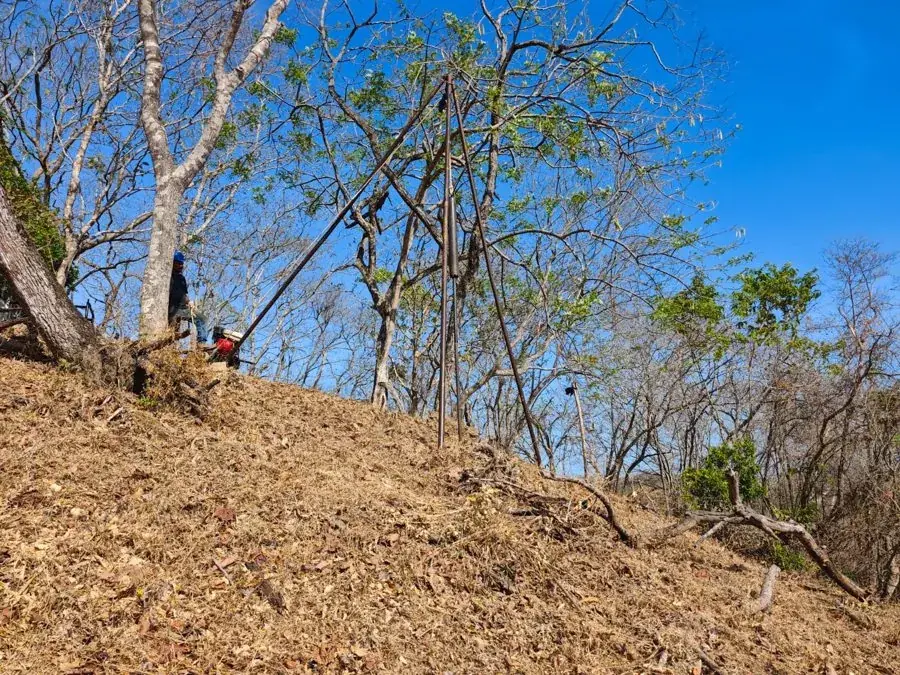
Unpermitted construction in Costa Rica is building work done without a municipal license, under an expired license or in a way that departs from the approved plans. Under the Ley de Construcciones (Law 833), the municipality can fine the owner, close the building, order it vacated and order defective parts demolished at the owner's cost. Many houses can be legalized by having a CFIA-registered professional draw as-built plans, registering them with the CFIA and getting the municipal permit after the fact, but work that breaks zoning, setbacks or the maritime zone rules may never be legal.
This guide explains what counts as unpermitted, what the law and recent cases show about fines and demolition, how unpermitted work affects a sale, insurance, financing and new permits, and the steps to legalize a house. It is general information, not legal advice. Verify each point with a Costa Rican attorney and with the municipality where the property sits.
What counts as unpermitted construction in Costa Rica?
Article 74 of the Ley de Construcciones requires every construction work in the country's towns, permanent or temporary, to be carried out with a license from the municipality. Article 89 lists the infractions, and several go beyond having no permit at all:
- Building without a prior license where one is required.
- Building under a license that has expired.
- Building something that changes the approved project, partly or completely.
- Occupying or using a building before notifying the municipality that the work is finished.
- Ignoring municipal orders to modify, suspend or destroy work, or obstructing municipal inspectors.
(Ley de Construcciones, Arts. 74 and 89, as reproduced by CostaRicaLaw and Bufete de Costa Rica.)
Small jobs are not exempt from the license. Since the 2017 reform (Law 9482), anyone can do repairs, remodels, extensions and other minor works worth up to ten base salaries without a professional's signature, but they still need a municipal license. Work that modifies the structural, electrical or mechanical systems and puts occupants at risk does not count as minor. If new minor permits are requested for the same property within 12 months and the municipality finds a larger project is being split to avoid controls, it can refuse the new permit (Law 9482, Art. 83 bis). Typical examples of unpermitted work on houses for sale are a closed-in terrace, a second floor, a guest casita or a pool added years after the original permit.
How common is building without a permit in Costa Rica?
Common, and more so on the coast. In 2025 the CFIA inspected 5,934 works nationally and 20% of them had no municipal license on site. In Guanacaste inspectors visited 1,124 works, and 28% of them, 319 works, had no municipal license; in Puntarenas the share was 21%, 216 of 1,052. Housing made up 81% of the works inspected nationally, and 16% of the housing works had no permit (CFIA, Informe de obras sin permiso 2025). The CFIA estimates that municipalities missed about ₡580 million in permit tax that year (CR Hoy, June 2026).
The CFIA sends its findings to the local government concerned (CFIA, Informe de obras sin permiso 2025), so an unpermitted house is not invisible just because nobody has knocked yet. Nationally, 47% of the unpermitted works were at the main structure stage when inspectors found them (CFIA, Informe de obras sin permiso 2025; El Observador, June 2026).
Fines, closure and demolition: what the Ley de Construcciones says
The law gives the municipality a set of sanctions and a step-by-step procedure for buildings finished without a license.
| Article | What it provides |
|---|---|
| 88 | The municipality can sanction breaches of the law, with fines, closure, vacating and destruction of the work among the sanctions |
| 90 | A fine can never exceed the economic loss to the municipality from the license fee that was not collected |
| 92 | Fines and other penalties can be imposed on the owner, the responsible engineer, the contractor or anyone else who breaks the rules |
| 93 | When a building is finished without a license or an approved project, the municipality opens a record and gives the owner a non-extendable 30 days to comply, by presenting the project and the license application |
| 94 | If the owner does not comply, a new record is opened and a final deadline is set after hearing the owner |
| 95 | Once the project is presented and accepted, the municipality checks that the work matches it and meets the law, with whatever tests are needed |
| 96 | If no project is presented or the ordered changes are not made, the municipality orders the defective parts destroyed, or destroys them at the owner's cost. It will not authorize use of the building, and if the building is in use, it fines the owner and orders it vacated and closed |
Source: Ley de Construcciones No. 833, as reproduced by CostaRicaLaw and Bufete de Costa Rica (legislative update to November 2024). The reproduced text notes that Article 98, on repeat offenses, was declared unconstitutional by the Sala Constitucional in vote 5963-94. Check the current official text on SINALEVI before relying on any article.
Read together, Articles 93 to 96 give the owner a chance to present the project before destruction is ordered. Article 93 addresses the owner (propietario), so ask your lawyer how that applies to a buyer who did not build the work. A bill in the Legislative Assembly (file 23.212) proposed a dedicated urban regularization procedure in the Ley de Construcciones; ask your lawyer whether any such reform has passed.
Real cases: when municipalities and courts act
- Desamparados, Alajuela (2026). A bullring built without permits in a mainly residential area was demolished in February 2026 after a process of more than ten years. The municipality said the zoning plan did not allow the use, so the structure could not be legalized, and the Tribunal Contencioso Administrativo had confirmed the demolition in resolution 179-2019 (El Observador, February 2026).
- Santa Ana (2024). The municipality announced it would regularize unpermitted works and demolish where owners did not comply, after notifying them, completing the sanctioning process including appeals and giving a deadline. It cited Articles 10, 12 and 24 of the Ley de Construcciones for encroachment on public roads and protected areas, setbacks and building without permits (Delfino, August 2024).
- Alajuela, Sala Constitucional (2015). In vote 9004-15 the Sala Constitucional ordered the mayor of Alajuela to demolish, within 15 days of notice, a house occupying a public walkway (alameda) in Urbanización El Erizo, finding that the municipality had known about the problem and failed to act (El Mundo, July 2015). Public land cannot be privately owned, so legalization was never an option.
- Barva, Heredia (2025). Neighbors reported that work continued on a three-story building after the municipality placed closure seals in 2023, and the municipality described repeated visits and notification efforts (CR Hoy, February 2025). A closure order does not end the matter by itself.
- The coast (2025). The Municipality of Santa Cruz demolished five structures in the 50 meter public zone at Playa Avellanas, citing a court ruling (Tico Times, August 2025), and Golfito demolished several buildings in Pavones that lacked valid concessions (Tico Times, June 2025). Coastal cases follow their own law; see our maritime zone guide.
Also see: Septic systems in Costa Rica: rules, percolation tests and sizing for a new home and Squatters in Costa Rica: how to protect an empty lot
How unpermitted work affects a sale, insurance, financing and new permits
No single rule covers these effects, so treat each one as something to check for the specific property.
Selling
Expect a careful buyer's lawyer or inspector to compare what stands on the land with the permits and registered plans, and to ask for a lower price, an escrow holdback or legalization before closing. Under Article 96 the municipality will not authorize use of a building that was never brought into compliance, which is hard to explain to a buyer.
Financing
Ask each lender how it treats unpermitted areas. The lender MUCAP, for example, lists the construction permits among the documents to deliver before it formalizes its construction financing (MUCAP). A buyer's bank may also send its own appraiser, which can bring problems to light late in a purchase (Tico Times, March 2017).
Insurance
Ask the insurer, in writing, whether unpermitted parts of the house are covered and whether they could affect a claim on the rest. Do not assume they are covered.
New permits
If you plan to renovate, add a pool or build a second house on the lot, ask the municipality early whether it will process a new permit while unpermitted work stands on the property. Legalizing first is usually the cleaner path. Our renovations page covers work on existing homes.
How to legalize an unpermitted house in Costa Rica
Municipalities name and run this process differently, so start by asking yours how it handles a work already built without a license. The steps below follow the law and the CFIA's rules.
- Get a legal and zoning check first. Your lawyer reviews the title, the cadastral plan and any municipal notices. A land-use certificate (uso de suelo) shows whether zoning allows the use, height and lot coverage you have. If it does not, take advice before you spend money on plans.
- Survey what exists. A CFIA professional measures the building as it stands. The CFIA's consulting regulation lists the survey of existing works (levantamiento de obras existentes) as a technical study paid by the owner, separate from professional fees (CFIA, Reglamento para la Contratación de Servicios de Consultoría, Art. 8).
- Assess the structure and systems. The engineer checks the structure against the Seismic Code, and the electrical and plumbing systems against their codes, and may need openings or tests. Article 95 lets the municipality verify the work with the tests it needs.
- Draw as-built plans and any corrections. The plans show the building as it was actually built, plus any remedial work. Only CFIA-registered engineers and architects can authorize license applications, and they must supervise the work they authorized (Law 9482, Art. 83).
- Register the plans with the CFIA through its digital platform and assemble the permit file. The documents are largely the same as for a new build; our building permit checklist lists each one and who issues it.
- Apply to the municipality and pay. Expect the permit tax that was never paid and possibly a fine, which Article 90 caps at the uncollected fee. Confirm the amount with the municipality.
- Do any remedial work under the permit, with a responsible professional and a bitácora, and let the municipality verify the result.
- Keep the file. Store the permit, the registered plans and the closed logbook with your title documents. A future buyer's lawyer will ask for them.
When a house cannot be legalized
- Zoning does not allow the use or the size, as in the Desamparados case.
- The building sits inside a river or spring protection setback; the INVU distances are set out in our permit checklist.
- It stands on public land, such as a road, a public walkway or the 50 meter public zone of the coast.
- It crosses onto a neighbor's land.
- The structure cannot be made safe at a reasonable cost.
In these cases the realistic options are to remove or reduce the work, or to price the risk into any purchase. Ask your lawyer and engineer for that answer in writing.
Buying a house with unpermitted additions
- Ask the seller for the permits and registered plans for every structure, and confirm them with the municipality.
- Have a CFIA professional compare the plans with what was built and estimate the cost of legalization.
- Make the purchase conditional on that review, and agree with your lawyer whether the seller legalizes before closing or part of the price is held in escrow.
- Ask the municipality whether there is any open notice or closure order on the property.
Forged permits and other document fraud are covered in our guide to Costa Rica real estate scams.
How Decentra Homes can help with an unpermitted house
Since 2020 we have designed and built as a custom home builder in Costa Rica, with design and construction CFIA certified under SANYC Ingeniería (CFIA registration CC-10880). Before you buy a house with additions, or before you start legalizing one, our construction consulting can review the property, the plans and the budget with a CFIA-licensed engineer and architect with 15 years of experience, at $200 per hour. Legal questions stay with your attorney. Message us on WhatsApp or through our contact page.