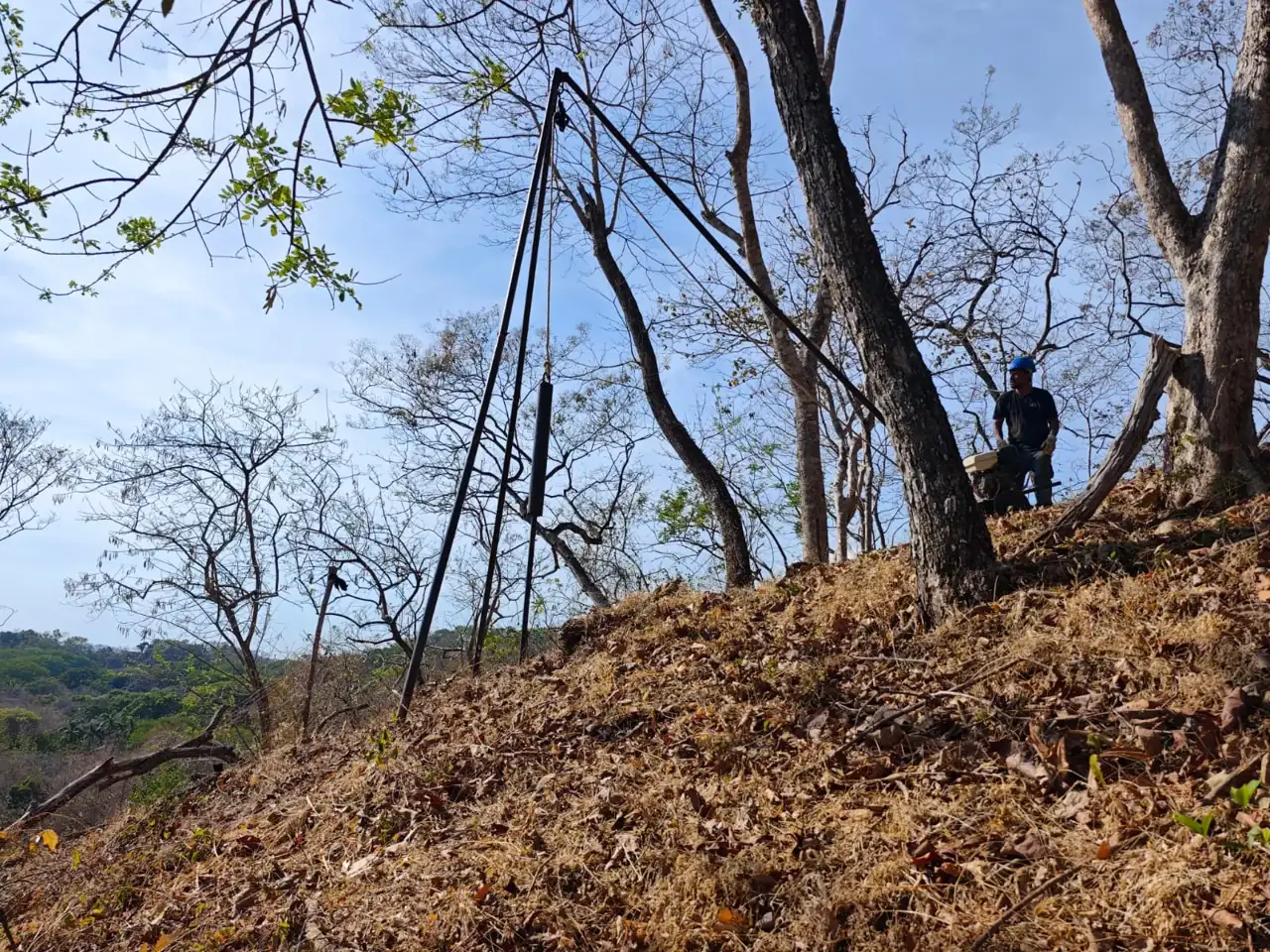
Topographic survey and land survey in Costa Rica
A topographic survey maps the levels, slopes, trees and boundaries of a lot, so a house can be designed and priced on real ground. It is a different document from the plano catastrado, the registered survey map, and both are the work of a surveyor licensed through the CFIA. We order and review them through our land consulting, before you buy.
Minimum construction budget $350,000 USD, before land
Plano catastrado or topographic survey: what is the difference?
Buyers often hear both terms on the same day, and they are not the same document.
The plano catastrado is the registered survey map of the lot. It shows the boundaries, the total area, the shape of the parcel, road frontage or access, reference points and the neighbouring properties. Legally, the area on the title at the National Registry and the area on the registered survey map have to be the same, and the map should carry the Cadastre's stamp.
A topographic survey (levantamiento topográfico) is a design survey. It measures the levels and features of the land so an architect can place the house, the driveway and the pool, and so the earthworks can be priced. A topographic survey does not by itself define legal boundaries, which is why we check it against the plano catastrado.
| Plano catastrado | Topographic survey | |
|---|---|---|
| Purpose | Legal record of boundaries and area | Design and pricing of the build |
| Shows | Boundaries, area, access, neighbours | Contours, spot levels, trees, features, slopes |
| Registered | Yes, with the Cadastre at the Registro Nacional | No, it goes to the architect and engineer |
| Needed for | Buying, transfer, mortgage, building permit | Architectural design, foundations, earthworks budget |
In Spanish, topografía covers both kinds of work, so ask your surveyor which one you are paying for.
Who can do a land survey in Costa Rica?
Only a licensed professional. Under Law 4294, practising topography or land surveying (agrimensura) requires a licence issued through the CFIA, the federated college of engineers and architects, which also oversees the profession. Their professional body is the Colegio de Ingenieros Topógrafos de Costa Rica.
The law separates two kinds of work:
- Agrimensura: boundary traverses, area calculations, subdividing land, land descriptions for deeds and horizontal plans.
- Topografía: all of the above plus levelling, profiles, earthwork calculations and setting out construction.
A licensed surveyor has public faith (fe pública) when acting as a land surveyor, which is why the registered plan carries weight. Survey plans are now filed online through the CFIA's APT platform for the CFIA and the Cadastre, and must be georeferenced to the national CRTM05 system.
One practical rule from buyers' guides: use a surveyor who knows the area but is not the one the seller used. Fences move over the years, and an independent check is the only way to know the paper matches the ground.
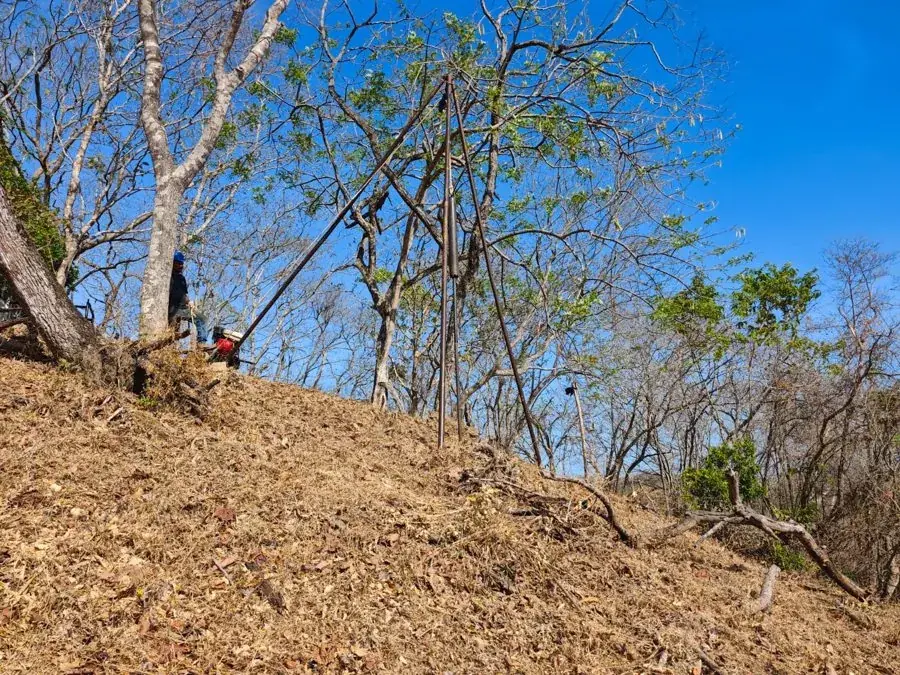
What you get from a topographic survey
We set the scope with our architect so the survey answers design questions, not just boundary questions. A typical package for a home site includes:
- Boundary check: markers found on site and compared with the plano catastrado, with any differences noted.
- Contours: at an interval suited to the slope. One survey industry guide suggests 0.5 m for residential sites and 0.25 m for detailed design.
- Spot levels: at the corners, the access point, the road edge and the likely house platform.
- Trees: position, trunk diameter and canopy, so the design can keep the ones worth keeping.
- Existing features: fences, walls, culverts, poles, meters, structures and drainage lines.
- Access: the road level at the entrance and the line a driveway can take.
- Watercourses and setbacks: streams, springs and the lines that limit where you can build.
- Slope map: the parts of the lot that are steeper than the thresholds that matter for design.
- Files: a DWG drawing for the architect and a PDF, in national coordinates.
- Our notes: where the house fits, what earthworks it implies and what to check next.
Why slope matters on a Costa Rica lot
Slope decides foundations, retaining walls, drainage and the length of the driveway. A view lot can look simple in photos and still need a lot of concrete underground.
Some rules turn on it directly. The Municipality of Esparza's urbanization rules, for example, ask for a slope stability study on land steeper than 30 percent and treat that land as reforestation area, not building area. The CFIA's Código Geotécnico de Taludes y Laderas, approved in 2015, sets minimum requirements for designing cut and fill slopes and building on natural hillsides.
Water adds limits too. Under article 33 of the Forestry Law, the protection strip along a river or stream is 15 m in rural areas and 10 m in urban areas where the land is flat, and 50 m where the terrain is broken. Springs carry a 100 m radius. The survey has to show the watercourse and the ground around it, so these lines can be drawn correctly.
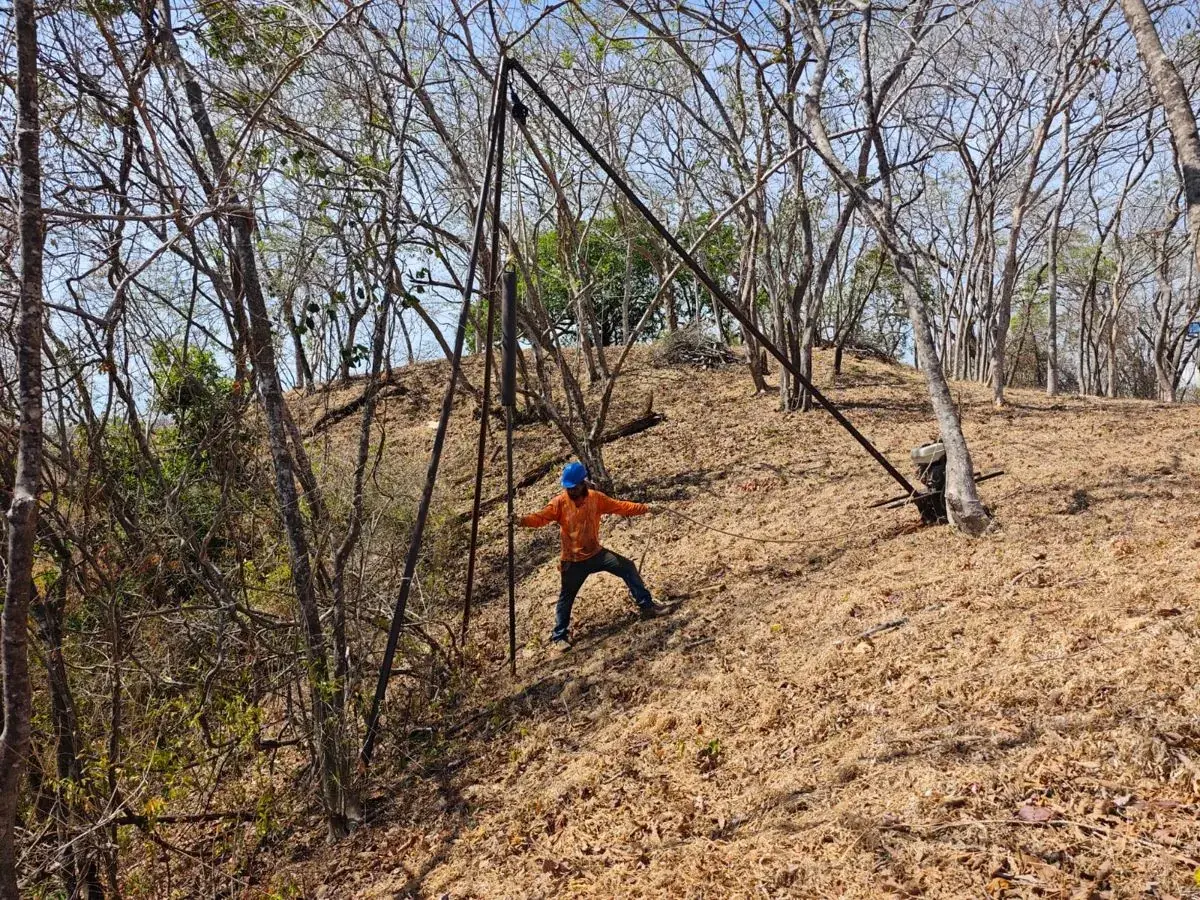
Setbacks, access and the maritime zone
A good survey shows the buildable area, not just the lot. We ask for these lines on the drawing where they apply:
- Maritime zone: the 200 m strip inland from the high tide line. The first 50 m is public and nothing can be built there. The next 150 m is the restricted zone, held by concession, not title.
- Rivers and streams: the protection strip, and INVU's river alignment (alineamiento fluvial) when the lot borders a watercourse.
- National roads: the MOPT alignment when the lot faces a national route.
- Municipal setbacks: front, side and rear setbacks from the land-use certificate.
- Access: whether the road or easement on the plan is the one people actually use.
How the survey process works, step by step
- Send us the listing and the plano catastrado. We compare the registered plan with the title and flag obvious problems before anyone travels.
- Site visit and scope. We walk the lot with you, or for you on video, and agree what the survey must show.
- Field survey. A licensed surveyor finds the markers and measures levels, trees and features. Time on site depends on lot size, slope and vegetation, and we confirm it with the quote.
- Drawings. The surveyor delivers the contour plan as DWG and PDF.
- Review with the architect. We test the house platform, driveway and earthworks against the survey and give you our notes.
- Plan corrections, if needed. If a new or corrected plano catastrado must be registered, it is filed online. The Registro Nacional said in 2024 that its plan review stays within 8 days under its regulation. The surveyors' college said the same year that a plan was taking at least two months, and in August 2026 it said some cadastral procedures were taking over four months. We plan for it before closing.
Topographic survey by region
These are typical considerations we look for in each region, not hard data. Every lot is surveyed on its own.
| Region | Typical ground and slope | What the survey must catch |
|---|---|---|
| Guanacaste coast | Dry forest hillsides above the beaches, flatter land near estuaries | Steep view platforms, seasonal drainage lines, maritime zone line |
| Nicoya Peninsula | Coastal ridges and beach flats; liquefaction features were reported at several Nicoya beaches after the 2012 earthquake | Ridge access, river mouths and the maritime zone line |
| Central Pacific | Steep coastal hills behind narrow beaches | Cut and fill on driveways, streams crossing the lot, road alignment |
| South Pacific | Steep, wet hillsides with dense vegetation | Tree positions, stream setbacks on broken terrain, real access road |
| Central Valley | Ridges and valley slopes; ridge and slope failures were observed near Alajuela in 2012 | Slopes near the house, existing walls, drainage |
| Caribbean | Low, wet coastal plain and rolling hills inland | Levels for flood risk, drainage outfalls, river alignment |
How it fits with design and permits
The survey is the first drawing in the design set. Our CFIA-licensed architect places the house on it in architectural design, and the structural engineer uses it with the soil study to set the foundations.
For the permit, the municipality asks for the plano catastrado with the plans, the land-use certificate and the water letter. We handle that file in permits and water letters, and the water letter guide explains why water comes first.
If you are still choosing land, our checklist for buying land to build covers the full list. If you already own the lot, see building on your own land.
Cost and how it is paid
We quote each survey per lot, because size, slope, vegetation and access change the work. We do not publish a fixed price.
The survey is ordered through our land consulting. If you go ahead and build with us, the consulting fee is credited to your construction. Topographic surveys, soil studies and other studies are paid separately and are not credited.
Minimum construction budget $350,000 USD, before land. Decentra's minimum project budget is $350,000 USD in construction, before land. Surveys and soil studies are sold as part of our land consulting, before you buy.
For what the build itself costs per square metre, see our cost to build guide. To send us a lot, write on WhatsApp at +506 8733-2930 or to info@decentrahomes.com.
Sources: Osa Tropical Properties: Why survey verification matters when buying land in Costa Rica (May 2026); Tico Times: How to buy property in Costa Rica, 20 essential tips (Dec 2021); CostaRicaLaw.com: The importance of an independent property survey (Dec 2022); Ley 4294, Ley para el Ejercicio de la Topografía y la Agrimensura; El Mundo CR: Inscripción de planos de topografía y agrimensura se realizará solo digitalmente, CFIA (Nov 2015); Registro Nacional and IGN: Guía de Georreferenciación (Jul 2025); Delfino: Colegio de Topógrafos alerta sobre atrasos en el Registro Inmobiliario (Sep 2024); Delfino: Colegio de Topógrafos vuelve a alertar por atrasos en Registro Nacional (Aug 2026); Topografía Urbana: Planos catastrados; Mapserve: Topographical survey AutoCAD files, what you should receive (Mar 2026); Municipalidad de Esparza: Reglamento, artículo 80 (SCIJ); CFIA: Código Geotécnico de Taludes y Laderas de Costa Rica (2015, SCIJ); Delfino: Las áreas de protección de los cuerpos de agua, Ley Forestal art. 33 (Feb 2026); Tico Times: The Costa Rica maritime zone and concession property (Oct 2022); Municipalidad de Puriscal: Requisitos permisos obras mayores 2026; GEER: Geotechnical aspects of the Sept. 5, 2012 M7.6 Samara, Costa Rica earthquake (Jan 2013).
Google reviews
“We have had a great experience with Decentra. Their follow up skills are impeccable and they are a one stop shop for all phases of your build.”
“I engaged with Sean and the owner Sergio to obtain building costs for a residential project I was considering in the mountains of the Central Valley. I found them to be very welcoming, informative, accommodating…”
Topographic survey questions
What is the difference between a plano catastrado and a topographic survey?
The plano catastrado is the registered survey map that fixes the legal boundaries and area of the lot. A topographic survey maps levels, slopes, trees and features for design. You need the first to buy and permit, and the second to design and price the house.
Who can do a land survey in Costa Rica?
Only a surveyor licensed through the CFIA under Law 4294. Licensed surveyors have public faith when acting as land surveyors, and they file survey plans online for registration with the Cadastre.
Do I need a topographic survey before buying land in Costa Rica?
It is not a legal requirement to buy, but on a sloped or wooded lot it is the only way to know where the house fits and what the earthworks will cost. We order it before you sign.
How long does it take to register a plano catastrado?
The Registro Nacional said in 2024 that its plan review stays within 8 days under its regulation. The surveyors' college reported at least two months in 2024 and over four months for some procedures in August 2026, so plan for delays.
What happens if the plano catastrado does not match the land?
A licensed surveyor walks the boundaries and finds the markers. Small differences can often be corrected with a new registered plan, which is best done before closing and before design.
Is the survey cost credited if I build with Decentra?
No. Our consulting fee is credited to your construction if you build with us, but topographic surveys, soil studies and other studies are paid separately and are not credited.
Everything we do
Take the full turnkey package, or bring us in for one stage.
- Land and construction consultingLot checks, surveys, soil studies and water letters before you buy
- Architectural designA CFIA-licensed architect, 3D renders and construction plans
- Permits and water lettersCFIA plans, municipal permits and water availability
- Soil studiesGeotechnical tests for safe foundations
- Luxury custom homesTurnkey construction, from foundations to furniture
- Concrete, hybrid or steelConcrete block, poured concrete, hybrid and steel frame
- Pools and outdoor livingInfinity pools, terraces and outdoor kitchens
- Renovations and additionsKitchens, bathrooms, joinery and full remodels
- Commercial and multi-unitHospitality, retail and multi-unit buildings
- Cost to build in Costa RicaPer square meter prices, fees and permits for 2026
Tell us about your project
The fastest way to reach us is WhatsApp. Or send the form and we reply within one business day.
Minimum construction budget for new builds $350,000 USD, before land
Message us on WhatsApp- +506 8733-2930
- Phone
- +1 503-994-8017
- Showroom
- Altos de Flamingo, Playa Flamingo, Guanacaste, Costa Rica, by appointment
- Licensing
- CFIA certified under SIM SRL