

Building permit requirements in Costa Rica: the document checklist, step by step
A Costa Rica building permit needs a land-use certificate, plano catastrado, title certification, water letter, CFIA plans filed through APC, an INS policy and a 1% municipal fee.
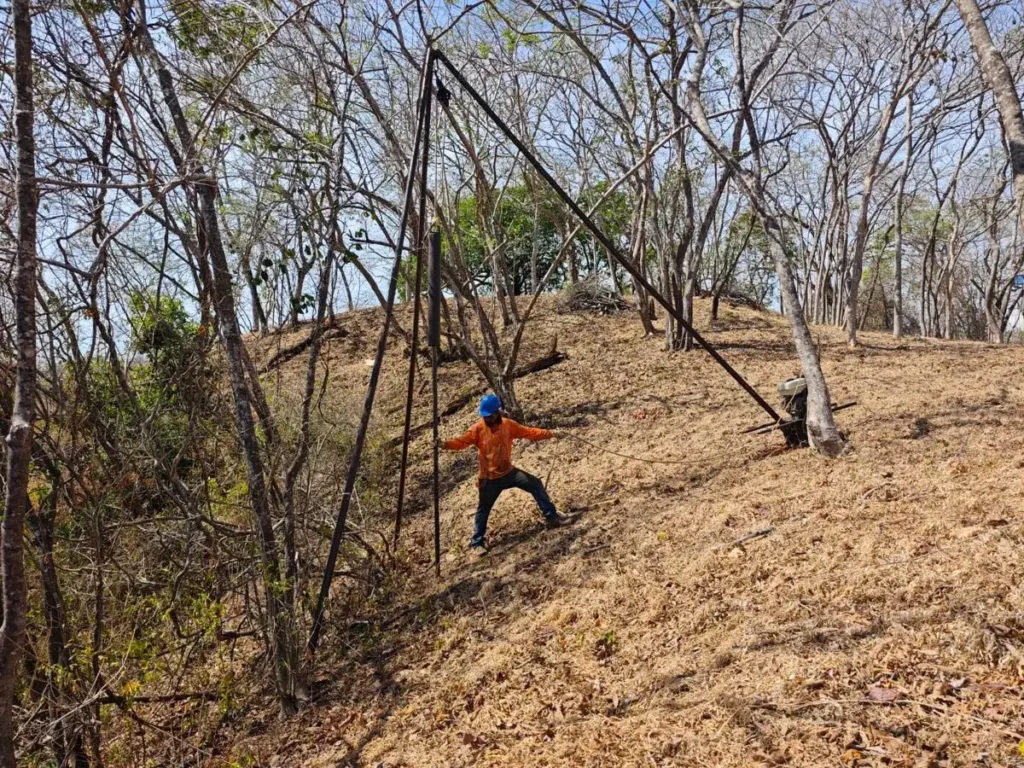
To get a building permit in Costa Rica you need a land-use certificate (uso de suelo), the registered cadastral plan (plano catastrado), a registry certification of the title, a water availability letter, plans registered with the CFIA through its APC platform, an INS workers' risk policy and payment of the municipal permit fee, which is 1% of the construction value. Lots on a national road, near a river or in a sensitive area also need alignments and sometimes SETENA environmental viability. The municipality where the lot sits issues the permit, and the details vary from one municipality to the next.
This guide is a working checklist: each document, who issues it, when you need it and the order in which a typical custom home file comes together, from the first land check to the final logbook entry. It is general information, not legal advice; confirm the current list with the municipality that covers your lot.
What documents do you need for a building permit in Costa Rica?
The table below combines the requirement lists published by the municipalities of Escazú, Puriscal and Paraíso, the CFIA's APC documentary requirements and checklists published by Howler. Most municipalities ask for the same core documents, then add their own.
| Document | Who issues it | When it is needed |
|---|---|---|
| Land-use certificate (certificado de uso de suelo) | The municipality | Always, before design |
| Cadastral plan (plano catastrado), visado by the municipality where required | Catastro Nacional, with the municipal visado | Always |
| Registry certification of the title (certificación literal or informe registral) | Registro Nacional | Always |
| Owner's ID, and for a company a certificate of legal standing (personería jurídica) | Registro Nacional for the personería | Always; Escazú asks for a personería no older than three months |
| Proof that municipal taxes and services are paid up | The municipality | Always |
| CCSS good standing | CCSS (social security) | Asked for by many municipalities, including Paraíso |
| Water availability letter, or a certification of active service for an existing connection | AyA, the local ASADA or a municipal water system | Always |
| Electricity availability letter | ICE or the local electricity provider | Commonly requested |
| Wastewater disposal (septic and infiltration test, or sewer availability) | Your engineer; the sewer operator where a network exists | Always, through APC |
| Ministry of Health sworn declaration for the plans | Filed through APC | Always for a home |
| Alignments (MOPT, INVU river, springs, power lines, railway) | MOPT, INVU and other agencies | Only where the lot is affected |
| Storm drainage outlet permit (desfogue pluvial) | The municipality | Larger projects; thresholds vary by municipality |
| SETENA environmental viability | SETENA | Depending on size and location |
| Construction plans registered with CFIA, including the electrical plan | CFIA-registered professionals, through APC | Always |
| INS workers' risk policy (póliza de riesgos del trabajo) | Instituto Nacional de Seguros | After approval, before the permit fee is paid |
| Municipal permit fee | The municipality | Last step before the permit is issued |
If the lot has several owners, municipalities ask for the consent of all of them; Escazú asks for an authenticated authorisation and Paraíso wants it authenticated by a lawyer. If someone other than the owner files, expect an authorisation form and a special power of attorney.
The building permit process in Costa Rica, step by step
The order below follows the sequence described by Diario Extra (2026) and the municipal lists above. Some steps run in parallel, but the first three decide whether the rest are worth paying for.
1. Get the land-use certificate
The uso de suelo confirms what the zoning allows on the lot: the type of building, the number of floors and the maximum lot coverage under the local zoning plan (plan regulador) (Diario Extra, 2026). Escazú states that anyone applying for a major works permit must obtain it first. In Sarapiquí, for example, the request needs the form, ID, a registry report and a certified full-size copy of the plano, costs ₡1,959 and is resolved in 15 calendar days (Municipality of Sarapiquí, 2026). Fees, timing and validity vary, so check with the municipality that covers your lot.
2. Pull the title and the cadastral plan
The certificación literal shows the property's characteristics, owner, liens and annotations, and can be bought online through RNP Digital and downloaded immediately (Registro Nacional, 2025). Check that the owner, the area and the plano number match the plano catastrado, and look for mortgages, easements and annotations that could block a permit. Diario Extra (2026) describes this as part of the legal due diligence on the land. If you are still buying, read our guide to buying land in Costa Rica to build before you commit.
3. Get water and electricity availability
No water letter, no permit. The letter comes from AyA, the ASADA or a municipal system, depending on who serves the lot. Where a service is already installed, Puriscal accepts a certification of active client that names the construction activity and the plano number, plus the water concession if the source is a spring (Municipality of Puriscal, 2026). Our water letter guide covers how to request it and how long it lasts. Electricity availability comes from ICE or the local provider (Howler).
4. Request the alignments that apply
Alignments fix the minimum distance between your building and a road, river or other feature. They change the buildable footprint, so get them before the design is final. The next section explains which ones you may need.
5. Design the house and register the plans with CFIA through APC
Plans must be prepared by professionals registered with the Colegio Federado de Ingenieros y de Arquitectos (CFIA) and filed through APC, where they are checked against the seismic code, the electrical code and other technical rules (Diario Extra, 2026). The CFIA's APC requirements for the Ministry of Health include the sworn declaration, water availability, wastewater disposal and the plano catastrado, plus any alignments (CFIA APC). For wastewater, see our septic system guide. APC-Requisitos, the module that moved permit requirements online, was launched in February 2019 (Delfino, 2022), and some municipalities, such as Paraíso, now accept permit requests only through it (Municipality of Paraíso, 2023).
6. Check whether SETENA applies
Most single-family homes do not need SETENA environmental viability. SETENA's own FAQ says projects with less than 1,000 m² of construction, and earthworks of 1,000 m³ or less, need no environmental assessment, except that works of 500 to 1,000 m² (or 500 to 1,000 m³ of earthworks) in an environmentally fragile area need a D1-C form (SETENA FAQ). Municipal lists do not always match: Puriscal lists SETENA for constructions over 1,000 m² and when specified, while Escazú's published list still names works over 500 m² or earthworks over 200 m³. Ask your municipality whether it wants a SETENA resolution or proof that the project falls outside SETENA's scope. Our SETENA guide explains the current rules.
7. Municipal review, INS policy and the permit fee
The municipality reviews the file. Once the project is approved in APC, the INS workers' risk policy is requested; Escazú notes that APC notifies the responsible professional when to request it and that the policy must be shown before the construction tax is paid. You then pay the permit fee and receive the permit number (Howler).
8. Post the permit and open the logbook
Post the permit where it is visible on site (Howler). Under the CFIA's digital logbook rules, the director of works places the project's QR code on site using the permit printed from APC, and the opening entry records the permit number, the start date and the required studies (CFIA, Reglamento de la Bitácora Digital, Arts. 8 and 11).
9. Inspections and completion
During construction, the director of works, the inspector and the person responsible for execution log every site visit in the digital logbook, on the day or within three calendar days (Art. 12). At the end, the final entry confirms delivery of the as-built plans, that the electrical and electromechanical systems work, the final area and cost, and the owner's acceptance; each professional closes their participation within 30 calendar days, and the logbook is then closed (Art. 21). Changes that need a modified permit must be registered with CFIA and processed again (Art. 19). Whether the municipality carries out its own final inspection or issues a completion or occupancy document varies, so check with the municipality before you plan your move-in date.
Alignments: MOPT, INVU, rivers and other setbacks
The CFIA's APC list names alignments for national roads and MOPT road projects, municipal streets, airport zones, watercourses, spring protection zones, railways and ICE high-voltage lines. Paraíso's list adds the agencies: MOPT for national highways, INVU for rivers, lakes and streams, INCOFER for railways, ICE or JASEC for power lines, MINAE for wells, springs and wetlands and RECOPE for pipelines (Municipality of Paraíso, 2023).
The INVU river alignment is the one coastal and jungle lots meet most often. INVU's protocol under the Forestry Law (Ley Forestal 7575) sets these protection distances:
| Feature | Protection distance |
|---|---|
| River or stream, urban area, flat terrain | 10 m from each bank |
| River or stream, rural area, flat terrain | 15 m from each bank |
| River or stream on steep terrain (average slope over 40%) | 50 m |
| Permanent spring | 100 m radius |
| Lakes and state-built reservoirs | 50 m |
Source: INVU, Protocolo para el Ordenamiento de Alineamientos Fluviales (2020).
The request needs the plano catastrado showing the watercourses that affect the property. INVU must resolve it within 15 business days, and the alignment is valid for 24 months (INVU, 2020). On a hillside lot the 50 m rule can remove a large part of the buildable area, so get the alignment before you finalise the purchase or the design.
How much does a building permit cost in Costa Rica?
The municipal construction permit fee is a 1% tax on the value of the building (Q Costa Rica, 2020), calculated on the value the CFIA assigns to the project in APC (Howler). On a home with $500,000 of construction, that is about $5,000.
The INS workers' risk policy is a separate payment. One guide puts it at about 1.17% of the assessed construction value (Howler); INS sets the actual premium, so ask for a quote for your project. Professional design fees follow the CFIA fee schedule, and design and plans typically run about 5.5% to 6% of construction value; our architect cost guide explains how that is calculated. Studies such as the topographic survey and soil study, and the water and alignment requests, are paid on top.
How long does a building permit take in Costa Rica?
There is no single national timeline. Published figures give a sense of each stage:
- Land-use certificate: 15 calendar days in Sarapiquí (Municipality of Sarapiquí, 2026). Check with your municipality.
- INVU river alignment: 15 business days by protocol (INVU, 2020).
- CFIA registration in APC: about 24 hours once the file is complete, and municipal approval a minimum of 30 days, according to one Howler guide. Municipal times vary widely, so ask your municipality.
- Water letter: varies by provider; a new well or spring concession takes far longer.
Incomplete files, rather than the review itself, cause most delays. A missing signature, an expired document or a plano that does not match the registry sends the file back.
What happens if you build without a permit?
Building without a permit is common, and it is risky. CFIA inspections found that the share of works without a municipal permit rose in Guanacaste from 26% in 2023 to 33% in 2024, and in Puntarenas from 26% to 38% (El Observador, March 2025). Owners face fines, and demolition is possible where the work has construction defects (Q Costa Rica, 2020). An unpermitted house is also harder to insure, finance or sell, because the paper trail a buyer's lawyer looks for is missing.
Checklist: before you file
- Owner name, area and plano number match across the registry certification, the plano and the land-use certificate.
- The water letter names the right property and is still valid.
- Every alignment that applies is in hand, and the design respects it.
- Municipal taxes, services and CCSS are up to date.
- A company owner has a recent personería, and all co-owners have signed their consent.
- You know whether SETENA applies and whether the municipality wants the resolution or proof of exemption in the file.
- You have asked the municipality for its current requirement list. If in doubt, check with the municipality.
How Decentra Homes helps with your building permit
Decentra Homes is a design-build custom home builder in Costa Rica, founded in 2020, with 50+ residential and commercial projects. Design and construction are CFIA certified under SANYC Ingeniería (CFIA registration CC-10880), with CFIA-licensed architect Sergio Cerceño. Our permits and water letters service covers the file. If you want a lot or a permit file reviewed before you commit, consulting is $200 per hour with a CFIA-licensed engineer and architect with 15 years of experience. Minimum construction budget $350,000 USD, before land. Message us on WhatsApp +506 8733-2930 or through our contact page.