Soil study and geotechnical study in Costa Rica
A soil study (estudio de suelos) tells the structural engineer what the ground can carry, so the foundation can be designed and priced before you buy. In Costa Rica it is done with drilled borings and Standard Penetration Tests, lab classification and a written report, to meet the CFIA's foundation and seismic codes. We order it through our land consulting, and you get the report before you sign.
Minimum construction budget $350,000 USD, before land
What is a soil study in Costa Rica?
A soil study, or geotechnical study, is a professional analysis of the ground combining field work and lab work. In Costa Rica it is called an estudio de suelos.
It shows what the ground is made of, how deep each layer goes, how hard and strong it is, whether there is rock and where the groundwater sits. The engineer uses that to choose the foundation type, check how many floors the ground can carry and avoid surprises that cost money once the excavator is on site.
The Tecnológico de Costa Rica lists one more use that matters to buyers: deciding whether a site suits the project before you buy it.
When is a soil study required for a building permit?
Most municipal checklists for a single home do not list a soil study as a separate item. Puriscal's 2026 list for major works, for example, asks for CFIA plans, the land-use certificate, the title report, the plano catastrado, the water letter and the INS policy.
The requirement comes through the engineering. Plans are reviewed for compliance with the Código Sísmico, and the CFIA's Código de Cimentaciones sets the minimum requirements for exploring the ground and for designing and building foundations. The structural engineer who signs the plans needs real soil data to meet them.
For larger projects the study is written into the rules. Desamparados asks urban projects for a soil study, slope stability, infiltration capacity and hydrogeology as applicable. Esparza's urbanization rules ask for a soil study that sets the foundation design, and a slope stability study on land steeper than 30 percent.
A septic system can also need an infiltration test, and some soil labs offer it with the study.
How the SPT test works
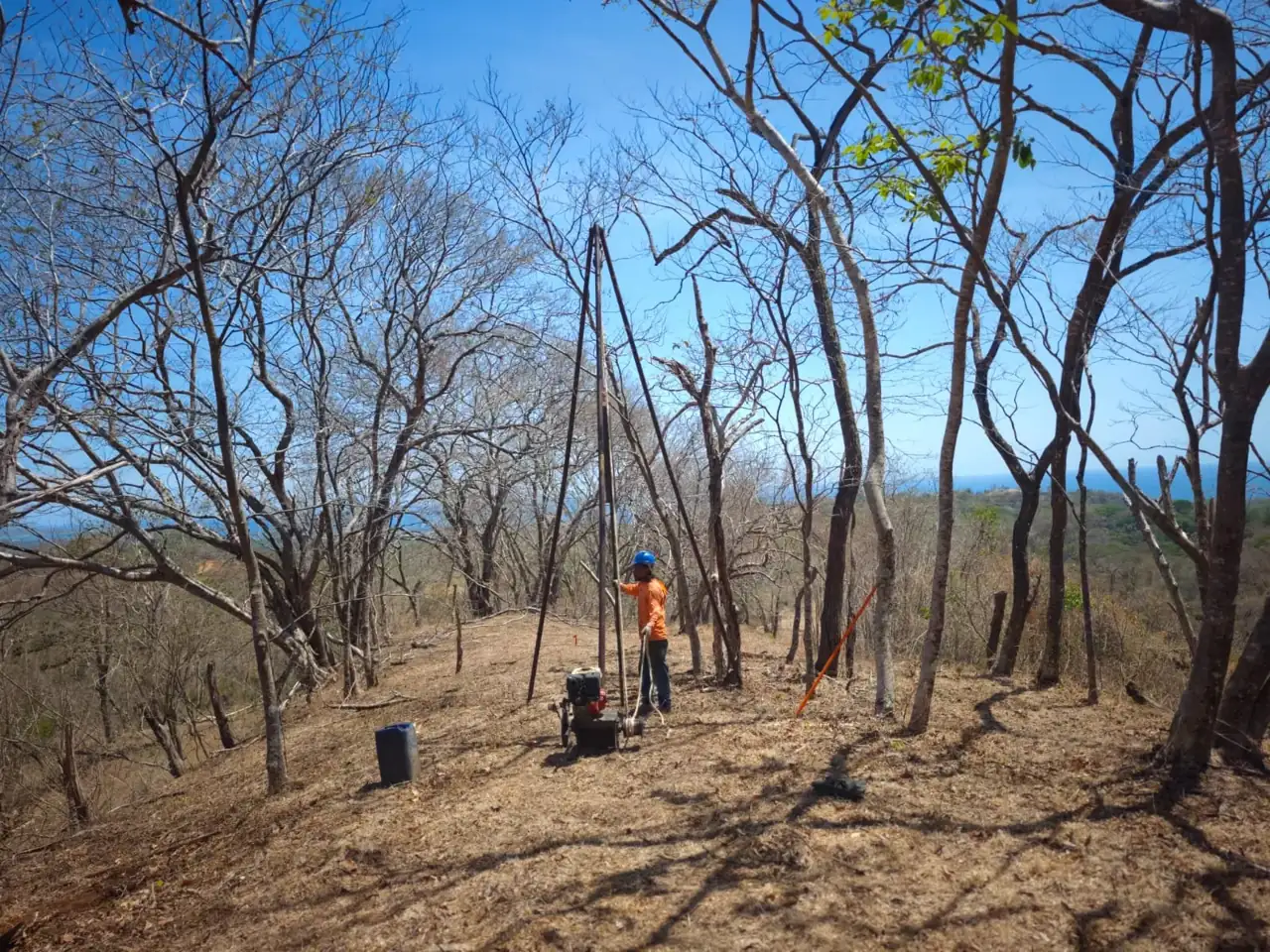
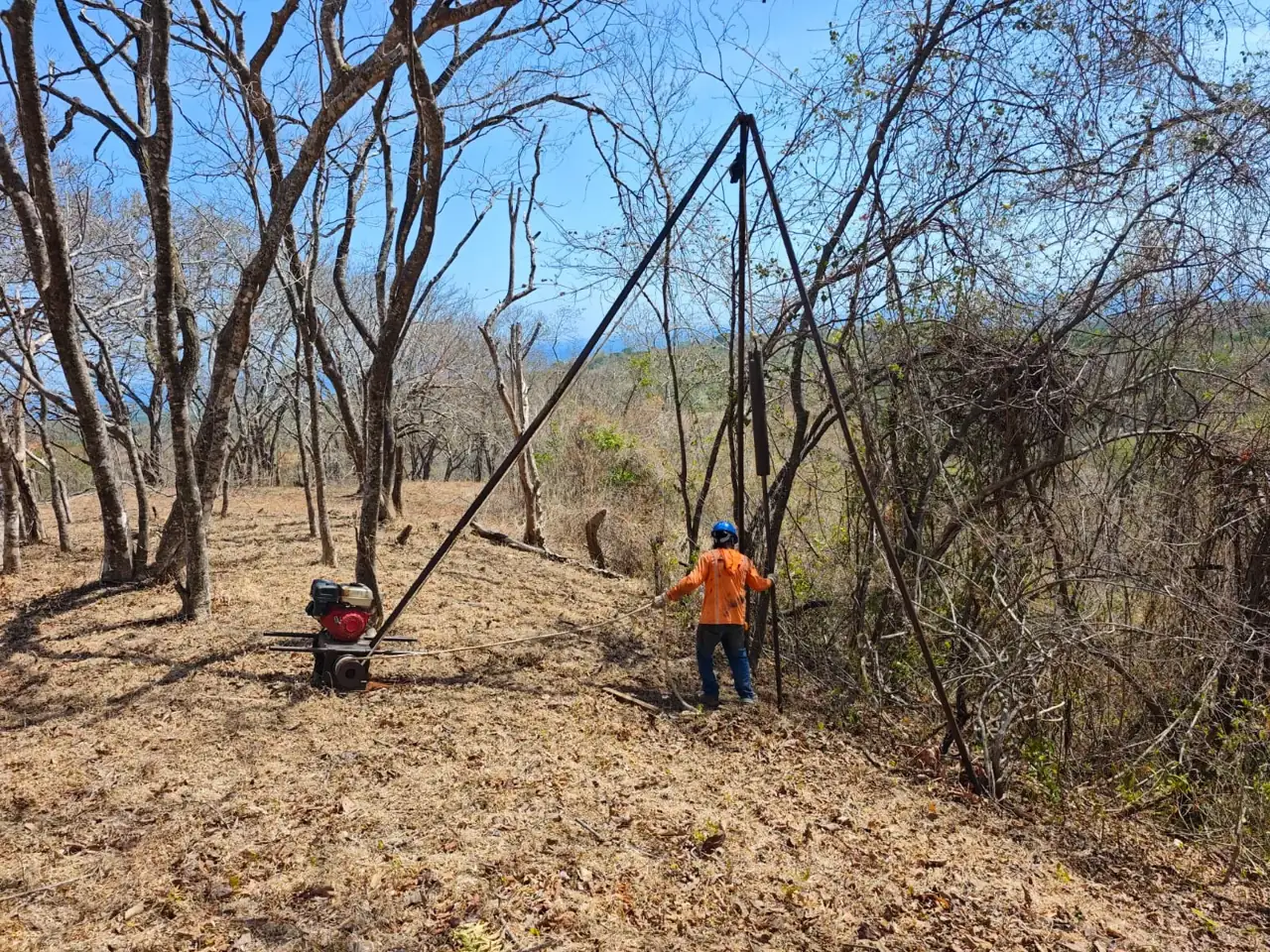
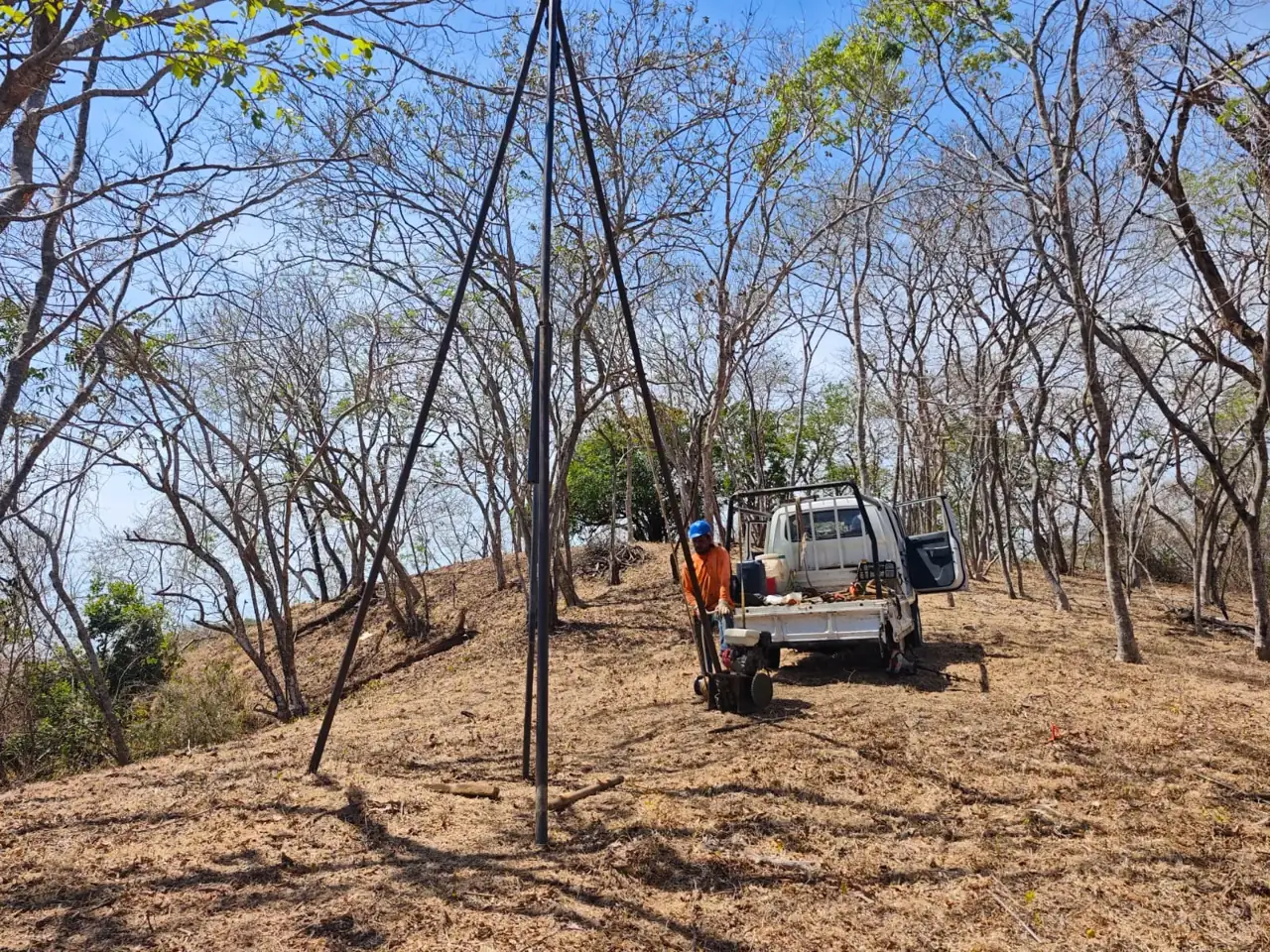
The Standard Penetration Test (SPT, ASTM D1586) is the field test Costa Rican soil labs list first. It is what you see in the photos on this page: a tripod rig, a small engine and a crew working on the lot.
- A 50 mm split barrel sampler is driven into the bottom of a boring by a 63.5 kg hammer dropped 760 mm.
- The crew counts the blows for each 150 mm of penetration, over 450 mm in total.
- The blows for the last 300 mm give the N value. The first 150 mm is discarded because drilling may have disturbed it.
- Refusal is recorded in very hard ground, for example more than 50 blows for one 150 mm step.
- The soil in the sampler goes to the lab for classification and moisture.
The N value is correlated with strength and stiffness. The correlations are empirical, so the engineer reads them together with lab results and the site, not in isolation.
What you get from a soil study
- Boring logs: depth, SPT N value, soil type and moisture for each boring.
- Groundwater: the level where it was found during drilling.
- Lab results: soil classification, unit weight and moisture.
- Bearing capacity: what the ground can carry at the proposed foundation depth.
- Settlement: how much the ground may compress under the house.
- Foundation recommendation: shallow, semi deep or deep foundations such as piles, and the depth to found on.
- Special risks: expansive clay, liquefaction or slope stability where the site calls for it.
- Seismic site type: the ground class the structural engineer uses under the Código Sísmico.
- Infiltration test: for the septic system, when ordered.
- Our summary: what the results mean for the design and the budget, in plain English.
Ground problems a soil study finds
Expansive clay
Dark smectite clays called vertisols swell when wet and shrink and crack when dry. In Guanacaste they occur mainly on flat and low land in the plains of the Tempisque, Bebedero, Cañas and Uruca rivers, and they also appear in the Central Valley and the Caribbean. Foundations on them need a specific design.
Liquefaction near the coast
Loose, saturated sand can lose strength in a strong earthquake. After the 2012 M7.6 earthquake, liquefaction features were reported at seven beaches along the Nicoya Peninsula and in Puntarenas, where the port captain's building sank an estimated 50 to 75 cm on its shallow foundations.
Slope stability
On hillside lots the CFIA's slope code asks for boreholes, and for a moderate risk site it considers a minimum of three borings advisable. Permanent slopes must meet safety factors that range from 1.20 to 1.50 under static loads, depending on risk.
Groundwater and fill
A high water table changes excavation, drainage and waterproofing. Fill is the other surprise: some lots were levelled with poor or uncompacted material, and you cannot found a house on it.
Seismic site type and why it matters
Costa Rica's seismic code classifies the ground under a building. The class changes the earthquake forces the structure is designed for, so it feeds straight into the cost of the frame and foundations.
| Site type | Ground | Shear wave velocity (top 30 m) |
|---|---|---|
| S1 | Rock or rigid, dense soil | 760 m/s or more |
| S2 | Medium dense to dense, or medium stiff to stiff soil | 350 to 760 m/s |
| S3 | 6 to 12 m of soft to medium stiff clay | 180 to 350 m/s |
| S4 | More than 12 m of soft clay | 180 m/s or less |
How the soil study process works, step by step
- Topographic survey first. The topographic survey shows where the house is likely to sit, so the borings go where the loads will be.
- Scope. The engineer sets the number and depth of borings from the house size, the slope and the risk.
- Access. A path is cleared so the rig can reach each boring point.
- Field work. Borings and SPT tests, with samples taken at each interval.
- Lab tests. Classification, moisture and any special tests the site needs.
- Report and review. The lab issues the report and we go through it with you and the engineer.
The timeline depends on the size and complexity of the site and the number of borings. We confirm the date with the quote, so the report is ready before your purchase deadline.
Soil study by region
These are typical considerations for each region, not hard data. The study on your lot is what counts.
| Region | Typical ground and slope issues | What the study focuses on |
|---|---|---|
| Guanacaste coast | Dry forest hillsides above the beaches; expansive clays on low river plains inland | Bearing on slopes, expansive clay, fill on levelled pads |
| Nicoya Peninsula | Coastal ridges and beach sand; liquefaction features reported at several beaches in 2012 | Liquefaction near the beach, slope stability on ridges |
| Central Pacific | Steep hills behind the coast; liquefaction features reported at Playa Tivives and Puntarenas in 2012 | Retaining walls, drainage, sandy ground near the shore |
| South Pacific | Steep, wet hillsides | Slope stability, groundwater, drainage behind walls |
| Central Valley | Ridges and valley slopes; slope failures and poorly drained walls damaged in 2012 | Slope stability, wall drainage, clay layers |
| Caribbean | Low, wet coastal plain; liquefaction was more damaging in the 1991 Limón earthquake | Groundwater, liquefaction, soft clay and deep foundations |
How it fits with design and permits
The soil report goes to the structural engineer with the architectural plans from our architectural design team. It sets the foundation, and the foundation sets part of the budget, so we want it before design is final.
The finished plans are registered with the CFIA and filed with the municipality through our permits and water letters service. The choice between concrete, hybrid and steel frame also responds to the ground; see construction systems.
If you are still choosing land, read our checklist for buying land to build, or building on your own land if you already own it.
Cost and how it is paid
We quote each soil study per lot. The number and depth of borings, the slope and the access for the rig all change the cost, so we do not publish a fixed price.
The study is ordered through our land consulting. If you go ahead and build with us, the consulting fee is credited to your construction. Soil studies, topographic surveys and other studies are paid separately and are not credited.
Minimum construction budget $350,000 USD, before land. Decentra's minimum project budget is $350,000 USD in construction, before land. Surveys and soil studies are sold as part of our land consulting, before you buy.
For build costs per square metre, see our cost to build guide. To send us a lot, write on WhatsApp at +506 8733-2930 or to info@decentrahomes.com.
Sources: Tecnológico de Costa Rica: Estudio de suelo garantiza una construcción segura (Oct 2021); CFIA store: Código de Cimentaciones de Costa Rica; CFIA: Código Geotécnico de Taludes y Laderas de Costa Rica (2015, SCIJ); Schmidt, V. (2014), Revista Geológica de América Central 51: site classes under CSCR-2010; GEER: Geotechnical aspects of the Sept. 5, 2012 M7.6 Samara, Costa Rica earthquake (Jan 2013); Alvarado, Mata and Chinchilla (2014), Agronomía Costarricense 38(1): clays in vertic soils of Costa Rica; Fundamentals of Foundation Engineering (LibreTexts): The Standard Penetration Test; Labcore Costa Rica: Estudio de suelos; SPG Consultores: Estudios de suelos Costa Rica (2025); Municipalidad de Desamparados: Requisitos permisos de construcción; Municipalidad de Esparza: Reglamento, artículo 80 (SCIJ); Municipalidad de Puriscal: Requisitos permisos obras mayores 2026; Diario Extra: ¿Qué necesitás para obtener un permiso de construcción en Costa Rica? (2026); Tico Times: How to buy property in Costa Rica, 20 essential tips (Dec 2021).
Google reviews
“We have had a great experience with Decentra. Their follow up skills are impeccable and they are a one stop shop for all phases of your build.”
“I engaged with Sean and the owner Sergio to obtain building costs for a residential project I was considering in the mountains of the Central Valley. I found them to be very welcoming, informative, accommodating…”
Soil study questions
Is a soil study required to build a house in Costa Rica?
Most municipal checklists for a single home do not list it separately, but the structural plans must meet the Código de Cimentaciones and the Código Sísmico, and the engineer needs soil data to do that. Urban projects and many sloped sites have it written into the rules.
What is an SPT test?
The Standard Penetration Test drives a sampler into the ground with a 63.5 kg hammer dropped 760 mm. The blows for the last 300 mm give the N value, which the engineer uses with lab results to judge strength and bearing capacity.
How much does a soil study cost in Costa Rica?
It depends on the number and depth of borings, the slope and access for the rig. We quote each lot. The study is paid separately from our consulting fee and is not credited to the build.
How long does a soil study take in Costa Rica?
It depends on the size and complexity of the site and the number of borings. We confirm the date with the quote so the report is ready before your purchase deadline.
Should I get a soil study before buying land?
Yes, if you can. The report tells you the foundation type and whether problems like expansive clay, loose fill or a high water table will raise the cost, while you can still negotiate or walk away.
What is an estudio de suelos?
It is the Spanish name for a soil study or geotechnical study: borings, SPT tests, lab classification and a report with bearing capacity and a foundation recommendation.
Everything we do
Take the full turnkey package, or bring us in for one stage.
- Land and construction consultingLot checks, surveys, soil studies and water letters before you buy
- Architectural designA CFIA-licensed architect, 3D renders and construction plans
- Permits and water lettersCFIA plans, municipal permits and water availability
- Topographic surveysLevels, contours and boundaries before design
- Luxury custom homesTurnkey construction, from foundations to furniture
- Concrete, hybrid or steelConcrete block, poured concrete, hybrid and steel frame
- Pools and outdoor livingInfinity pools, terraces and outdoor kitchens
- Renovations and additionsKitchens, bathrooms, joinery and full remodels
- Commercial and multi-unitHospitality, retail and multi-unit buildings
- Cost to build in Costa RicaPer square meter prices, fees and permits for 2026
Tell us about your project
The fastest way to reach us is WhatsApp. Or send the form and we reply within one business day.
Minimum construction budget $350,000 USD, before land
Message us on WhatsApp- +506 8733-2930
- Phone
- +1 503-994-8017
- Showroom
- Altos de Flamingo, Playa Flamingo, Guanacaste, Costa Rica, by appointment
- Licensing
- CFIA certified under SIM SRL