

Construction scams in Costa Rica: how to protect yourself from bad builders
Most construction scams in Costa Rica follow a few patterns: unregistered builders, payments far ahead of the work, permits never filed, swapped materials and uninsured crews. Each one can be checked before you pay.
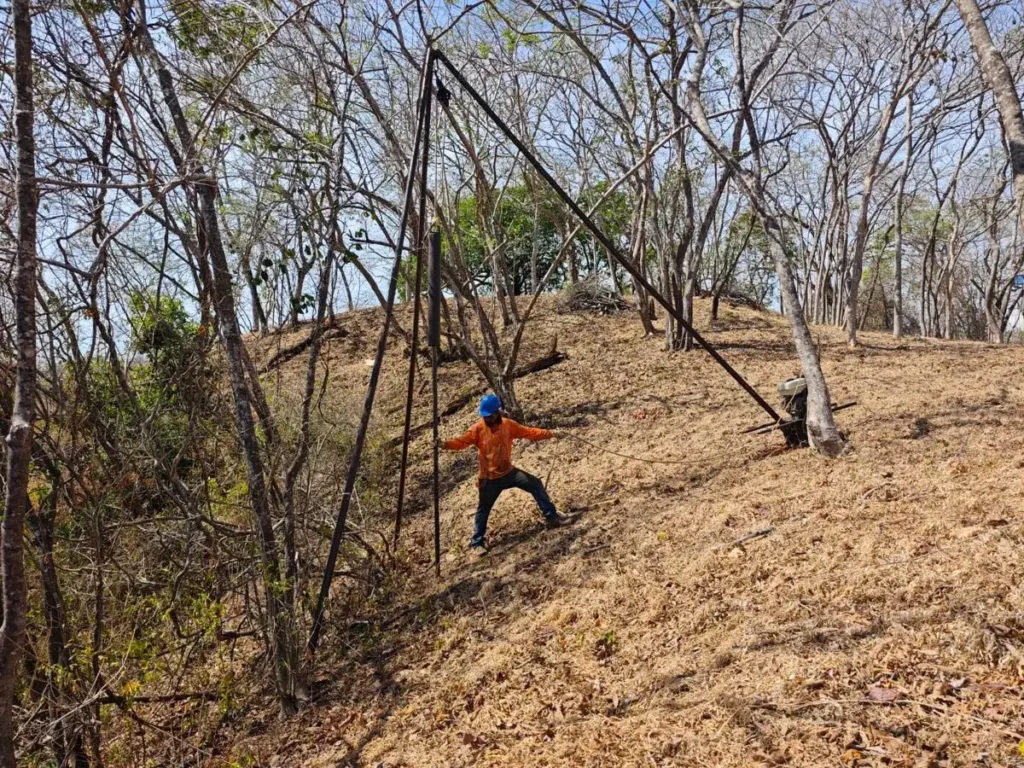
Construction scams in Costa Rica usually take one of a few forms: a builder with no CFIA registration, a payment schedule that runs far ahead of the work, a "permit included" quote that is never filed, cheaper materials than the plans call for, or crews with no workers' insurance or CCSS registration. You can catch almost all of them with checks you can do yourself, before and during the build. The rule behind every check is the same: pay only for work you can verify.
This guide goes deeper than the short builder section in our Costa Rica real estate scams guide. It covers how to check a builder and an engineer with the CFIA, how payment scams work, how to confirm a permit exists, how to spot swapped materials and borrowed signatures, what happens when a job is abandoned, and what to do if it happens to you. It is general information, not legal advice.
How common are builder scams in Costa Rica?
There is no public count of construction fraud on its own, but reported cases follow a pattern. In October 2026 CR Hoy reported that the CFIA had opened a disciplinary process against a prefabricated home company and its owner, an architect, over alleged scams, with four cases set for hearings from November. In one, according to the client, a house in Desamparados was contracted in 2024 for ₡15 million, work began in January 2025 with delivery promised in three months, and the site was abandoned after the grey work (obra gris), with ₡12 million paid. In 2025 a lawyer for five clients said up to 70 families may have been affected. The company did not answer CR Hoy (CR Hoy, October 2026).
The complaints describe one method: advance payments for a whole house or for materials, missed deadlines blamed on staff or weather, and claims of insolvency when clients asked for refunds. The CFIA keeps preliminary investigations confidential, and one client said he was not told of earlier complaints when he asked about the company (CR Hoy, October 2026). Registration tells you a builder may work. It does not tell you the builder is reliable.
Builders without CFIA registration: how to check the CFIA registry
Under Law 3663, the CFIA's founding law, only members of the Colegio Federado may practice engineering and architecture, works in those fields must be carried out under the responsibility of registered members at every stage, and national and foreign construction and consulting firms must be registered with both the Registro Nacional and the CFIA (Law 3663, articles 9, 12 and 52).
Check with the CFIA's own tools, not a number on a website or a logo on a truck:
- Professional and company directory. The CFIA publishes an online directory of registered professionals and companies (CFIA, Practice of the Profession). Search the company name and the name of every engineer and architect who will sign the plans or direct the work.
- Project lookup. The same CFIA page links a tool to view a project's data and its seals. Once your plans are registered, ask for the CFIA project number and look it up yourself.
- Ask the CFIA. Its main lines are (506) 2103-2200 and 2103-CFIA (CFIA, Practice of the Profession).
A registered company with an unregistered "engineer" is a warning sign. Our guide on how to choose a home builder in Costa Rica covers references, portfolios and interview questions.
Front-loaded payment schedules and disappearing deposits
The costliest scam is also the simplest: the builder collects a big share of the price and the work stalls. Builders in Costa Rica commonly ask for a mobilization advance of about 10% to 15% of the contract at signing, though practice varies. No law sets the figure, so treat it as market practice and fix it in the contract.
The shape of the schedule matters more than the first payment:
| Stage | Front-loaded schedule (risky) | Schedule tied to work (safer) |
|---|---|---|
| At signing | A large share of the price "to buy materials" | A modest mobilization advance, agreed in writing |
| Before the permit | Construction payments while the permit is "in process" | Design and permit fees only, against delivered plans and a permit number |
| During construction | Monthly payments whatever the progress | Payments against stages you or your inspector can see are finished: foundation, structure, roof, rough-ins, finishes |
| Materials | Cash for materials you never see | Invoices in your name, or deliveries counted on site against the plans |
| Last payment | Paid when the house "looks finished" | A holdback until the punch list is done and the work is formally closed |
A useful test at any point: what you have paid should never exceed the value of the work in place plus the materials on site. If it does, that gap is what you lose if the builder disappears. Our construction contract guide explains how to write stages, retentions and change orders into the contract.
"Permit included" quotes that never get filed
In the scam version of a "permit included" quote, the builder collects the permit money and starts work without filing. You then carry the risk of an unpermitted structure on your own land. A legal project leaves a paper trail you can check:
- CFIA project number. Plans are registered with the CFIA before the municipal permit. Ask for the number and check it with the CFIA's project lookup.
- Municipal permit number. Ask for the permit resolution and confirm it with the municipality's urban development office. A photo of a receipt is not a permit.
- The digital logbook (bitácora). CFIA members working in the construction phase must use the digital logbook, and when work begins the opening entry must record the permit number, the start date and the required studies (CFIA, Reglamento de la Bitácora Digital, articles 3 and 11). If your builder cannot show you an opening entry with a permit number, construction should not have started.
- CCSS standing. The CCSS says proof of being up to date with it is required for municipal permits, among other procedures, and it runs a public online debt lookup called Consulta Morosidad (El Observador, July 2022, quoting the CCSS collections director).
The same goes for documents that make a lot look buildable. If a builder or seller hands you a water letter, check that the water letter is real with the office that issued it. Our building permit checklist lists everything a complete permit file needs.
Swapped or under-spec materials
Material swaps are harder to spot than a missing permit because the house still goes up: fewer or thinner bars than the drawings show, weaker concrete, a cheaper block or roof sheet, or cheaper windows and fixtures. Once a slab is poured, nobody can count the steel inside it.
- Write the specification down. Bar sizes, concrete strength, block type, roof gauge, window series and fixture models belong in the plans and the contract, with brand and model where it matters.
- Inspect before every pour. Rebar and formwork should be checked against the structural drawings before concrete is placed. Ask for dated photos with a tape measure in the frame and keep them.
- Check deliveries. Compare delivery notes and invoices with the specification, and have materials you pay for invoiced in your name or counted on site.
- Read the logbook. Each responsible professional must record site visits, observations, orders and corrective measures in the bitácora, on the day of the visit or within three calendar days (CFIA, Reglamento de la Bitácora Digital, article 12). A professional who never writes anything is not supervising.
- Know the visit frequency. CFIA training material states that the construction direction service (dirección de obra) requires a site visit every seven calendar days (CFIA, Figuras de ejercicio profesional).
Missing INS workers' insurance and CCSS payroll registration
Every employer in Costa Rica must insure its workers against work risks, under article 193 of the Labor Code. If an uninsured worker is injured, the employer bears the cost of the benefits (Labor Code, article 231), and INS recovers them plus administrative expenses; employers must also report wages to the CCSS in a monthly payroll (El Observador, October 2019, column by an insurance broker on Law 6727). For many years INS was the only provider of the policy; MNK, formerly Oceánica, now offers it as well (El Financiero, January 2026).
A labour quote far below the others can mean the builder is saving on insurance and social security. If no clear employer with a policy is on record, ask your lawyer before work starts where liability for an accident on your lot would fall. Then ask for three things, at the start and during the build:
- The workers' risk policy number, the insurer and the project it covers. Call the insurer to confirm it is in force.
- The builder's CCSS standing, checked on the CCSS public lookup.
- A clause in the contract confirming that the builder is the employer of everyone on site and is responsible for the policy and the payroll.
Fake plans or a borrowed engineer's signature
A quieter scam is a set of plans signed by a professional who never drew them, never checked them and will never visit the site, often called lending a signature (préstamo de firma). It lets an unqualified builder look legal on paper.
The CFIA's Code of Ethics allows professionals to authorize plans only when they prepared and reviewed them, or when the work was carried out under their control, and it sets a suspension of six to twenty-four months for signing documents they did not personally prepare, study or review (CFIA, Código de Ética Profesional, articles 13 and 28). Law 3663 adds that plans prepared abroad cannot be covered by a member's signature unless that member is directly responsible for the construction (Law 3663, article 57).
Signs to look for:
- The engineer or architect on the plans has never met you and is not named in your contract.
- The professional named in the bitácora records no visits.
- The structural calculations or soil study are missing, or were made for a different lot.
Meet every signing professional, confirm each one in the CFIA directory, and check that the project registered under your CFIA number is your lot and your house.
Abandoned jobs and liens
When a builder walks away, two problems follow: an unfinished house, and unpaid debts that may come back to the project. Work through them in this order:
- Document the site. Photograph and measure the work, list the materials on site, and collect every contract, invoice, transfer record and message.
- Change the professional of record properly. Under the CFIA logbook rules, a professional who suspends work must record the work as stopped, with the reasons and the state of the work, and the outgoing and incoming professionals must each record the handover (CFIA, Reglamento de la Bitácora Digital, articles 16 and 18). A new builder should not simply carry on under the old file.
- Value the work in place, so you know what you overpaid and what finishing will cost.
- Check the property record. A literal certification from the Registro Nacional shows a property's owner, encumbrances (gravámenes) and annotations (Registro Nacional, Guía de Servicios Inmobiliario 2025). Have your lawyer pull one now, and again before you make a final payment to anyone.
- Close out workers and suppliers. Unpaid debts can go to judicial collection, which can end in an attachment order (Teletica, October 2026). Ask your lawyer whether claims from the old builder's workers, suppliers or the CCSS could reach you, and get written releases where you can.
What to do if a builder scams you
- Stop paying until your own lawyer has reviewed the contract and the payments.
- File with the CFIA if a registered professional or company is involved. Under the CFIA's ethics procedure a complaint goes first to a conciliation centre (Centro de Concertación), parties can take money matters to the CFIA's Conflict Resolution Center, and liability prescribes five years after the act (or, for facts that need investigating, after the investigation report), although filing a complaint interrupts that period (CFIA, Reglamento de procedimientos de aplicación de la ética, articles 2, 4, 96 and 97). Sanctions are disciplinary, such as suspension, so the process does not by itself return your money.
- File a criminal complaint with the OIJ if money was taken with no intention of building. Our real estate scams guide sets out those steps.
- Consider the consumer office. Clients in the CR Hoy case also filed with the Dirección del Consumidor (CR Hoy, October 2026).
- Bring a civil claim for breach of contract and the amount you paid above the value of the work. The Desamparados client got back all but ₡3 million after consulting a lawyer (CR Hoy, October 2026).
Checklist: how to protect yourself from bad builders
| Check | When | How |
|---|---|---|
| CFIA registration of the company and each signing professional | Before signing | CFIA online directory, or call the CFIA |
| Written contract with scope, plans, price and payment stages | Before any payment | Reviewed by your own lawyer |
| CFIA project number and municipal permit number | Before work starts | CFIA project lookup and the municipality |
| Bitácora opening entry with the permit number | First week on site | Ask for access or a copy |
| Workers' risk policy and CCSS standing | Before work starts and during the build | The insurer and the CCSS public lookup |
| Rebar and formwork against the drawings | Before every pour | Dated photos and inspector sign-off |
| Annotations on the property record | Before the final payment | Registro Nacional literal certification, through your lawyer |
How Decentra helps
Since 2020 Decentra Homes has completed 50+ residential and commercial projects as a design-build custom home builder in Costa Rica. Design and construction are CFIA certified under SANYC Ingeniería (CFIA registration CC-10880), and our architect, Sergio Cerceño, is CFIA-licensed. Check both in the CFIA directory. Minimum construction budget $350,000 USD, before land, for new builds.
Already have a builder, plans or a quote? Book construction consulting with a CFIA-licensed engineer and architect with 15 years of experience, at $200 per hour. Write to us on WhatsApp (+506 8733-2930) or use the contact form.