

How to choose a home builder in Costa Rica: 2026 guide
To choose a home builder in Costa Rica, confirm the company shows as "Inscrita" with the CFIA, its architect and engineer are current CFIA members, the INS workers' risk policy is in place before work starts, payments are tied to inspected milestones, and you can visit finished homes and call past clients.
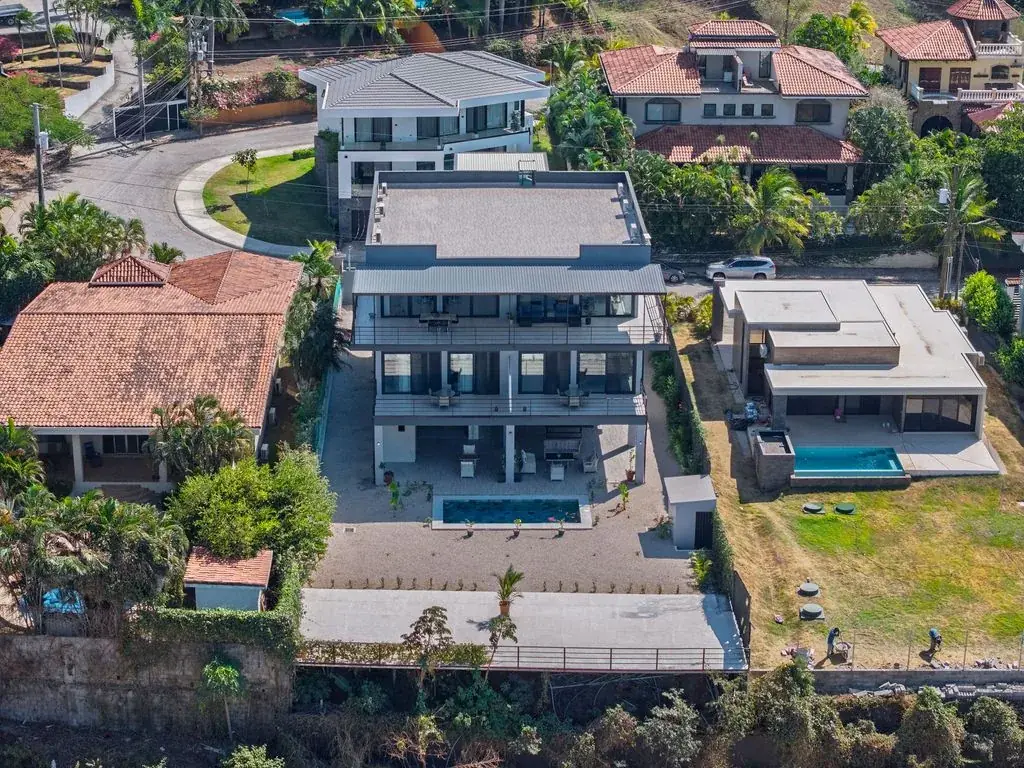
To choose a home builder in Costa Rica, check five things before you sign: the company shows as "Inscrita" in the CFIA directory, its architect and engineer are current CFIA members, the INS workers' risk policy will be in place before work starts, the contract ties every payment to an inspected milestone, and you can walk through finished homes and call past clients. This guide explains how to run each check from abroad, what a custom home builder in Costa Rica should do for you, the red flags, real cost ranges and the questions to ask.
Costa Rica has no Better Business Bureau, and large contractor listing sites such as HomeAdvisor and Houzz do not cover Costa Rican contractors (Tico Times). So the checking is on you. The good news is that most of it can be done online and by phone before you fly down.
What does a home builder in Costa Rica do?
A home builder turns your land and your brief into a finished, permitted house. On a full service project that covers:
- Land review before or after you buy: access, water, power, boundaries, slope, drainage and what the municipality allows you to build.
- Design and plans drawn and signed by CFIA-registered professionals and filed through the CFIA's APC platform, where they are reviewed against the Seismic Code and Electrical Code (Diario Extra).
- Permits: the water and services letter, the land-use certificate, CFIA registration of the plans and the municipal building permit.
- Construction: hiring and insuring the crew, buying and transporting materials, site supervision and the official project logbook (bitácora).
- Handover: a list of outstanding items, warranties, equipment manuals and completion documents (CRIE).
Not every builder does all of this. Many only build from plans you bring. Knowing which kind you are talking to is the first decision.
Types of builders: design-build, general contractor or owner-builder
You will meet three main ways to build. Each puts the risk and the workload in a different place.
| Option | How it works | Best for | Main risk |
|---|---|---|---|
| Design-build firm | One company handles design, engineering, permits and construction under one contract | Owners abroad who want one party responsible for plans matching the price | You rely on one firm, so vetting it well matters more |
| Architect plus general contractor | You hire an architect for plans and permits, then put the plans out to contractors for bids | Owners who want independent design oversight and can coordinate two parties | Gaps between what was drawn and what was priced; disputes over who is responsible |
| Owner-builder (labor only) | You hire a crew for labor and buy the materials yourself, or manage separate bids for labor and materials | Owners living on site who speak Spanish and know materials | Cost and quality control sit with you; only sensible with real expertise (Dominical Realty) |
Two things are worth knowing whichever route you take. Most Costa Rican contractors run one crew that does most trades, from foundations to plumbing, electrical and tile, rather than hiring a specialist for each (Tico Times; Two Weeks in Costa Rica). That gives the builder more control, but ask who does specialist work and how it is checked. And a "turnkey" offer is a design-build contract by another name; see our guide to turnkey homes in Costa Rica for what it should include.
How to vet a home builder in Costa Rica: the checklist
Run every item below on every builder you are seriously considering, including us.
1. Check the company on the CFIA registry
The CFIA (Colegio Federado de Ingenieros y de Arquitectos) is the professional body for engineers and architects in Costa Rica. It runs a public directory of registered companies and professionals. To check a company:
- Ask the builder for its legal company name and its corporate ID number (cédula jurídica).
- Open the CFIA company directory and search by the exact business name or the ID number.
- Read the status. Only "Inscrita" (registered) means the company is authorized to carry out engineering, architecture or construction work. Other statuses do not (CRIE).
- Make sure the name in the directory matches the name on the quote, the contract and the bank account you will pay.
If the company is foreign or new, ask how it is registered. The CFIA has a separate temporary registration track for foreign companies (CFIA).
2. Check the architect and engineer on the CFIA registry
Then check the people who will sign your plans. Search the CFIA professional directory by name and confirm each one is a current member. You can also request official membership certificates from the CFIA. The CFIA also publishes a list of professionals with a valid Professional Update, but a name missing from that list does not mean the person is not a member (CFIA). Ask who will be the responsible professional on site and how often they visit.
Keep in mind what registration means. It is a regulatory check, not an endorsement of a builder's work, prices or finances (CRIE). That is why the rest of this list matters as much.
3. Confirm the INS workers' risk policy
Before construction starts, the project must have a workers' risk policy (póliza de riesgos del trabajo) from the INS, the national insurer. It covers workers and the owner if there is an accident, and it goes to the municipality with the CFIA-approved plans for the building permit (Diario Extra). Under Article 193 of the Labor Code, employers must insure their workers against work risks. An employer who does not can be fined and made to repay the INS for every cost of an accident, which can be far higher than the premium (El Mundo).
Ask for the policy number and whose name it is in. If a builder suggests skipping it to save money, walk away.
4. Call references and visit finished homes
Photos are curated. A house that has been through two rainy seasons is not. Ask to visit homes similar to yours in size, finish level, construction system and terrain, ideally ones a few years old, and look at the roof, waterproofing, windows and finishes. Building rules exist, but enforcement can be light, so seeing how a builder finishes work no one inspects is one of the most useful checks you can do (Dominical Realty). Collect names through people who built in the same area rather than ads (Dominical Realty), and ask for references from comparable projects (CRIE).
Questions for past clients:
- Did the final price match the contract? What caused any changes?
- How late was the house, and how did the builder tell you?
- How were defects handled after you moved in?
- Would you hire them again for the same house?
5. Get a written contract with milestone payments
Have your own lawyer review the contract. It and its attachments should name the parties and list the drawings, specifications, price basis, payment stages, exclusions and how changes are approved. It should say who is responsible for approvals, supervision, insurance and employment, and how delays, defects and disputes are handled (CRIE). Ask for start and completion dates, an itemized cost and a materials list, and for lien releases from subcontractors, suppliers and the tax and insurance authorities, so you are protected if the builder fails to pay them (Tico Times).
Name the allowances. If tile is priced at a set amount per square meter, the contract should say so, and upgrades are paid separately (Two Weeks in Costa Rica).
6. Use an escrow-style payment schedule
Pay for work that is done and inspected, not for dates on a calendar. A common structure from one long-time broker's guide: a down payment of 10 to 20%, then stage payments released only when each stage is finished, with 10 to 20% held back until the whole job is complete. A request for 50% up front is a red flag (Tico Times).
For extra protection from abroad, ask your lawyer to hold the build funds in a dedicated account or an escrow arrangement and release each payment against a signed milestone report and photos. Escrow is already standard when you send a large sum into Costa Rica to buy property (Two Weeks in Costa Rica), and the same discipline works for construction. Pay only the company named in the contract.
| Milestone | What should be done and checked before you pay |
|---|---|
| Signing | Contract, drawings, specifications and payment schedule signed; deposit within 10 to 20% |
| Foundations | Footings and slab poured to the engineer's plans; logbook entry by the responsible professional |
| Structure | Walls, columns, beams or frame complete; inspection recorded |
| Roof and enclosure | Roof on, windows and doors in, house closed to the weather |
| Systems and finishes | Plumbing, electrical, tile, cabinets and fixtures installed as specified |
| Handover | Punch list cleared, warranties and manuals delivered; final holdback of 10 to 20% released |
7. Get warranties in writing
Ask what the builder will stand behind after handover, for how long, and how you report a defect. Ask which equipment, such as pumps, water heaters and air conditioning, carries its own manufacturer's warranty, and collect those papers at handover (CRIE). If a warranty is only spoken, it is not part of the price.
8. Confirm who handles permits and the water letter
Ask who prepares and files each permit, and ask for a copy of the municipal permit before work starts. In 2025 CFIA inspectors visited 5,934 construction sites across all 84 cantons and found 1,216 of them, or 20%, had no municipal permit (Delfino). Unpermitted work is hard to insure, finance or sell.
Red flags when hiring a builder in Costa Rica
- No legal name, ID number or "Inscrita" CFIA status you can check.
- A very low bid. Be wary of very high bids and doubly wary of very low ones (Dominical Realty). Ask what the low bid leaves out.
- A large deposit. 50% up front is a warning sign (Tico Times).
- Payments to a person or company that is not on the contract.
- "We can start before the permit."
- No INS policy, or a plan to add it later.
- A short contract with no drawings, specifications or exclusions attached.
- A schedule with no assumptions. If a builder promises a very short build, plan for a few extra months (Two Weeks in Costa Rica).
- No finished homes you can visit, only renders and social media posts.
- Reluctance to show the logbook, invoices or inspection records.
- Claims that building a house gets you residency. Construction and immigration are separate decisions (CRIE).
How much do home builders in Costa Rica charge?
Costs depend on finish level, size, terrain and access, so treat any single per-square-meter number with care. These are Decentra Homes' own current construction figures, per square meter of house, before land:
| Finish level | Construction cost per m2 (before land) |
|---|---|
| Basic | About $700 |
| Mid-range | About $1,000 |
| Upper mid-range | $1,000 to $1,200 |
| Luxury | $1,500 to $1,800 |
| Ultra luxury | $1,800+ |
| Pool | About $2,500 per m2 of pool, all-in (excavation and grade work, shell, finish and filtration); LED lighting and custom features add to that |
Add about 5.5% to 6% of construction value for design and plans under the CFIA fee schedule, and keep a 10 to 15% contingency. Decentra's minimum project budget is $350,000 USD in construction, before land. Our cost to build a house in Costa Rica guide has the full breakdown.
When you compare quotes, compare them against the same drawings and specifications. Line them up item by item and check whether each includes professional fees, site preparation, utility connections, permits, taxes, transport, fixtures, landscaping, waste removal and final inspections (CRIE). Ask whether each bid is a fixed price or an estimate (Tico Times).
How long does it take to build a house in Costa Rica?
Our typical build takes 5 to 8 months on site. Design, plans and permits come before that, and their length depends on the lot and the municipality. Weather matters: the rainy season runs roughly May to November, and permits and back-ordered materials can also cause delays (Two Weeks in Costa Rica). Ask any builder for a written schedule with its assumptions about approvals, weather, materials and access (CRIE). Our guide on how long it takes to build a house in Costa Rica walks through each phase.
Permits and the water letter: what your builder should handle
A building permit in Costa Rica follows a set order (Diario Extra):
- Land-use certificate (certificado de uso de suelo) from the municipality, which sets what you can build, how many floors and how much of the lot you can cover.
- Due diligence on the land: boundaries, topography, soil, registry records for liens or easements, and municipal debts.
- Water and services letter confirming water and power are available.
- Plans approved through the CFIA's APC system, drawn by CFIA members.
- INS workers' risk policy.
- Municipal building permit, filed with the approved plans and the INS policy, with taxes and fees paid. Work starts after it is issued.
A CFIA plan seal on its own does not authorize construction; municipal permission is a separate step (CRIE). Some sites, such as coastal, steep or protected land, can need extra environmental review; we check that for each lot. Water is often the slowest piece: read our water letter guide, and see how we run the whole file on our permits and water letters page.
Check the land before you pick the builder
A good builder will ask about your lot before quoting. Have these checked with your lawyer and a design professional:
- Water source: the town system (AyA or a local ASADA) or a concession. A concession title should state how many homes it can supply (Two Weeks in Costa Rica).
- Power: ICE lines should run close to the lot, as extending service is slow and costly (Two Weeks in Costa Rica).
- Legal access: a registered right of way to a public road.
- Boundaries: a stamped, registered survey plan checked on the ground.
- Zoning and title: residential use allowed, taxes paid, no liens or disputes.
- The coast: land within 200 meters of the high tide line is under maritime zone rules that usually rule out new private construction (Two Weeks in Costa Rica).
Already own a lot? See building a house on your own land in Costa Rica. Still looking? Our land and construction consulting reviews a lot before you buy, and the consulting fee is credited to construction if you go ahead with us. Topographic surveys, soil studies and other studies are paid separately and are not credited.
Construction systems: what to ask your builder
Ask each builder which systems it builds in and why it recommends one for your lot. The common choices are reinforced concrete and block, galvanized steel frame, and hybrids of the two. Each has trade-offs in cost, schedule and how it suits your terrain, so ask the builder to explain them for your lot, not in general. A hybrid uses each system where it works best. We build in concrete, hybrid and steel; compare them on our construction systems page, or see our galvanized steel frames if you already have a builder. Whatever the system, the structure must be designed by a CFIA engineer to the Seismic Code.
Questions to ask a Costa Rica home builder
- What is your legal company name and ID number, and what is your CFIA status?
- Who are the architect and engineer on my project, and who is the responsible professional on site?
- How many projects are you running now, and how many people do you employ directly? (Tico Times)
- Do you use subcontractors? Who employs, insures and supervises them? (CRIE)
- Is your price fixed against the plans, or an estimate? What is excluded?
- What are the payment milestones, and who inspects each one?
- Who handles the land-use certificate, water letter, CFIA registration and municipal permit?
- Whose name is the INS policy in, and can I see it before work starts?
- How do you handle change orders? Is every change priced and signed before the work?
- How will I get updates while I am abroad, and how often?
- Can I meet the site foreman? (Tico Times)
- Can I see the project logbook?
- Which finished homes can I visit, and which past clients can I call?
- What warranties do you give, and how do I report a defect after handover?
- What construction systems do you build in, and which do you recommend for my lot?
Choosing a builder from abroad
Most of our clients come from the USA and Canada, and some from Europe. Building from abroad takes a few extra steps:
- Language. Permits and much of the paperwork are in Spanish. If you do not speak it, use a translator and learn the names of the main materials (Dominical Realty), or choose a builder who works in English.
- Authority. Decide in writing who can approve changes on your behalf and up to what amount (CRIE).
- Eyes on site. Ask for weekly photo or video updates, or have a person you trust visit and take photos (Dominical Realty).
- Independent checks. Arrange independent inspections at key milestones, such as foundations and structure (CRIE).
- Meet in person. If you can travel once before signing, meet the team more than once and visit finished homes (Dominical Realty).
Where to build: regions and builders
Builders tend to work in set areas, because crews, suppliers and municipal relationships are local. Ask each builder where it has finished homes and which municipalities it has permitted projects in. Regions differ in what you need to check:
- Guanacaste (Playa Flamingo, Tamarindo, Playas del Coco, Nosara, Samara): dry season heat, coastal rules and water availability.
- Central and South Pacific (Manuel Antonio, Dominical, Uvita, Ojochal): steep lots, heavy rain, drainage and access.
- Central Valley (Escazú, Santa Ana, San Jose): urban permitting, tighter lots and neighbors.
- Caribbean and Northern Zone (Puerto Viejo, La Fortuna): humidity, rain and material choices.
See all the areas we build in on our locations page.
Where Decentra Homes fits
We are an award-winning design-build firm, so you can hold us to every check on this page. Our architect, Sergio Cerceño, is CFIA-licensed. We have completed 50+ residential and commercial projects, with more than 10 years of building internationally and 6 in Costa Rica. We handle land consulting, design, permits, construction and pools under one contract, building in concrete, hybrid and steel. Our showroom is in Altos de Flamingo, Playa Flamingo, Guanacaste. Financing is available through a third-party lending partner for qualified clients.
Learn more about us or look through finished homes in our portfolio, and ask to visit one. Whoever you choose, run every check above. To see how we answer the questions on this page, WhatsApp +506 8733-2930 or email info@decentrahomes.com.