

Septic systems in Costa Rica: rules, percolation tests and sizing for a new home
A new home in Costa Rica usually needs a septic tank and drain field designed under Decree 42075-S-MINAE, with an infiltration test, set distances and at least 1.5 m from the trench bottom to the water table.
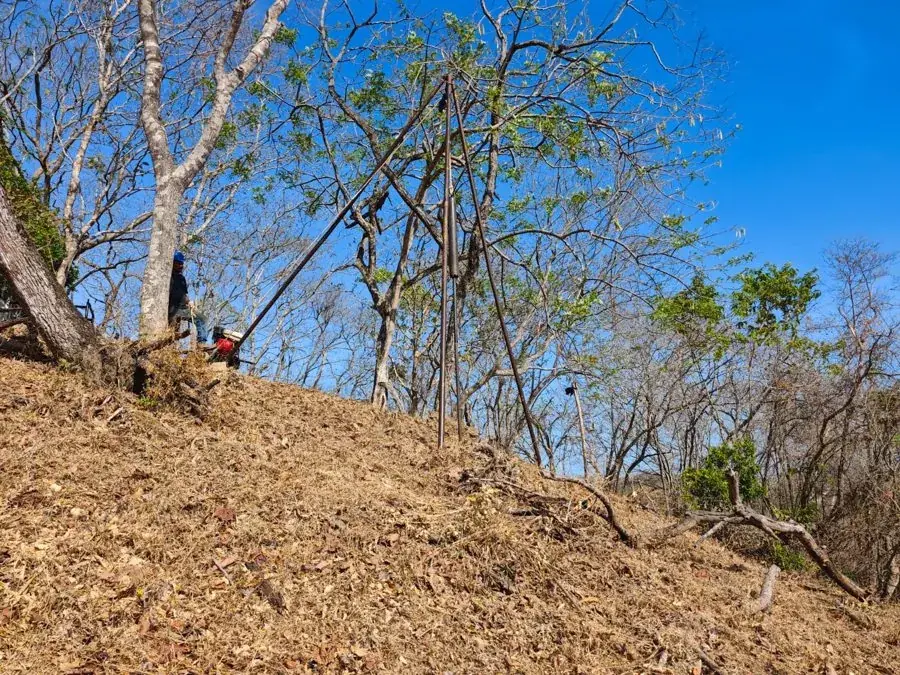
Most new homes in Costa Rica outside the larger towns treat their own wastewater with a septic tank followed by a drain field of infiltration trenches. The design must follow Executive Decree 42075-S-MINAE, which requires an infiltration (percolation) test signed by a licensed professional, sets minimum distances and a minimum depth to the water table, and allows a drain field only where the soil absorbs water within set limits. When the soil, the slope or the groundwater rule out a drain field, or the flow is larger than a single home produces, the project needs a different treatment system approved by the Ministerio de Salud.
This guide explains the rules that apply to a new house, how the infiltration test works, the sizing basics your engineer uses, when a treatment plant is needed instead, what changes on the coast and how the septic design fits into the building permit. It is general information, not legal or engineering advice; your engineer and the Ministerio de Salud confirm what applies to your lot.
Do you need a septic system to build in Costa Rica?
In most places, yes. Banco de Costa Rica (July 2025), citing AyA data, reports that about 70% of the population uses septic tanks and only 22% is connected to a sanitary sewer. In Guanacaste there is no sewer system connected to a public treatment plant, so each property there handles its own wastewater (Howler).
The governing rule for treated household wastewater that goes into the ground is the Reglamento para la disposición al subsuelo de aguas residuales ordinarias tratadas, Executive Decree 42075-S-MINAE. It was published in La Gaceta on April 14, 2020 and took effect six months later. It applies nationwide to homes and activities that treat ordinary wastewater and infiltrate it into the subsoil.
Three points from the decree matter most for a single-family home:
- Single-family homes may use infiltration directly. Other projects must show that other disposal methods are technically unfeasible; single-family homes are exempt from that requirement (Art. 6).
- The only permitted drain field is infiltration trenches. Absorption or infiltration wells (pozos de absorción) are prohibited for any wastewater (Arts. 14 and 33).
- Untreated wastewater may not go into the ground. Septic effluent may not run to rivers, streams or storm drains, and a pipe may not be used in place of a septic tank (Arts. 34, 36 and 37).
Septic tank and drain field rules for new homes
The decree sets the construction details in its annexes. Your engineer designs to these minimums and then sizes the system for your house.
The septic tank
- Hydraulic retention time of at least one day, meaning the useful volume must hold at least one day of the design flow.
- Liquid depth between 1.00 and 2.80 m, with at least 30 cm of free space above the liquid.
- Length three to four times the width, with a minimum width of 70 cm, and an access lid of at least 60 cm.
- A vent pipe of at least 38 mm (1.5 in), and the tank top at least 15 cm above ground.
- In a two-chamber tank, the first chamber takes at least half the length.
- A grease trap for kitchen dishwashing water.
The drain field
- Trenches 0.30 to 0.90 m wide with perforated or slotted pipe of at least 100 mm, laid on clean gravel, with a level trench bottom.
- No more than 30 cm of soil cover and no plastic or impermeable sheets between layers.
- Lines no longer than 60 m, with an inspection box every 20 m.
- Trenches spaced at least 1.8 m center to center on flat ground; on slopes of 1% to 30% they follow the contour and are spaced at least 5 m apart.
- No drain field on slopes steeper than 30% (Art. 16).
Minimum distances
| Measured from the edge of the drain field to | Minimum distance |
|---|---|
| Property line | 1.0 m (the tank also keeps 1.0 m) |
| Nearest building on the property | 1.0 m |
| Potable water supply pipe | 1.5 m |
| Slopes steeper than 25% | 2.0 m |
| Potable water storage tank | 3.0 m |
| Rivers and streams | As set by the Forestry Law |
Source: Decree 42075-S-MINAE, Art. 10 and Annex 1. The decree does not set a numeric distance to a drinking water well or source; it refers to the Water Law (Ley 276) and the Forestry Law, so if your lot has a well or a spring nearby, check the setback with your engineer. Under the Forestry Law, permanent springs have a 100 m protection radius (CRIE, September 2026).
How the percolation (infiltration) test works
In Costa Rica the percolation test is called a prueba de infiltración. It decides whether a drain field is allowed on the spot you chose and how large it must be. The decree (Arts. 18 and 19 and Annex 3) sets the method:
- At least two tests per drain field site. Subdivisions and condominiums with several systems need representative tests for each infiltration zone. Engineer Elías Rosales of the Instituto Tecnológico de Costa Rica recommends two tests for a single-family home and at least four, evenly spaced, for larger projects.
- Dig the holes. A first excavation 0.30 to 0.60 m deep and 0.80 to 1.0 m wide, then a test hole 0.10 to 0.30 m wide and at least 0.30 m deeper, with 5 cm of coarse sand or fine gravel at the bottom.
- Saturate the soil. Keep the hole full of clean water for at least 24 hours.
- Measure. Keep at least 15 cm of water over the sand and read the drop every 30 minutes for four hours. The rate is 30 minutes divided by the drop in the last interval, in minutes per centimetre.
- Report. The report gives the date, georeferenced test locations, depths, the depth of the water table, photos, the rates and the signature of a licensed professional.
The accepted range is 2 to 24 minutes per centimetre (Art. 14). Soil that drains faster than 2 min/cm is rejected because effluent would reach groundwater with too little treatment; soil that drops less than 1.2 cm in 30 minutes fails because it cannot absorb the water. Do the test where the field will actually go, and in the rainy season if you can, because a dry-season result can flatter clay soils. A soil study and a topographic survey help choose that spot early.
Septic sizing basics
Sizing starts with how much wastewater the house will produce per day. The decree takes the per-person water supply figure, applies a return factor of 0.8 and uses these design flows (Annex 3, Table 3):
| Location type | Water supply per person per day | Design wastewater per person per day |
|---|---|---|
| Rural | 200 litres | 160 litres |
| Urban | 300 litres | 240 litres |
| Metropolitan area | 375 litres | 300 litres |
| Coastal | 375 litres (consult AyA) | 300 litres |
As an example, a coastal home designed for six people works out to 1,800 litres a day, or about 54 m³ a month. The engineer then:
- sizes the septic tank so it holds at least one day of that flow;
- reads the allowed application rate for the measured infiltration rate from the decree's Table 2 (for example, 63.88 litres per m² per day at 4 min/cm, but only 26.08 at 24 min/cm);
- divides the daily flow by that rate to get the infiltration area and multiplies it by a precipitation factor of at least 2.5;
- converts the area into trench length and spacing for the chosen trench width and depth.
The practical lesson is that slow soil needs a much larger field. Plan the space for it before you place the house, the pool and the driveway, and remember that a guest house or more bedrooms raise the design flow. Most septic failures reported in Guanacaste come from drain fields that are too small or saturated, not from the tank (Howler).
Also see: Squatters in Costa Rica: how to protect an empty lot and How to check a property title at Costa Rica’s Registro Nacional
When you need a treatment plant instead of a septic tank
The decree draws the line by flow. Septic tanks with a drain field are for flows of up to 190 m³ per month (Art. 7). Above that, all wastewater must be treated in a system approved under Executive Decree 39887-S-MINAE, the treatment system approval regulation, with an inspection box, operating reports twice a year and effluent limits such as 50 mg/L for BOD and suspended solids (Art. 8). Projects above 190 m³ per month that infiltrate also need a SENARA opinion on a contaminant transport study (Art. 40).
A treatment plant also adds steps to the permit. Under Decree 39887-S-MINAE, the system needs a location permit from the Ministerio de Salud before plan review, which the ministry must resolve within 22 natural days and which is valid for two years, and then approval of its construction plans (Arts. 4, 5, 12, 13 and 16).
A single home will rarely reach 190 m³ a month, but a group of villas, a condominium, a boutique hotel or a home with several rental units can. You may also need a different system when:
- the infiltration test fails or the soil is outside the 2 to 24 min/cm range;
- the seasonal high water table is too shallow;
- the only space for a field is on a slope steeper than 30%;
- a local regulation requires treatment systems, as the buffer zone rules for the Ostional wildlife refuge, which cover land in Nosara, do for new buildings (Delfino, June 2026).
Which alternative fits, and whether it can discharge or must still infiltrate, is a design decision for your engineer and the Ministerio de Salud, so check it for your specific lot before you buy. Our land and construction consulting covers pre-purchase lot checks with a CFIA-licensed engineer and architect with 15 years of experience.
Coastal lots and high water tables
Beach towns are where septic design gets difficult. The decree requires the seasonal high water table to be at least 1.5 m below the bottom of the trenches (Art. 6), and the test report must record its depth below finished grade (Art. 19). Engineer Rosales recommends designing for at least 2 m of separation. Flat lots close to the beach, river mouths and old mangrove or wetland ground often have groundwater much closer to the surface in the rainy season.
Other coastal points to check:
- Sandy soils can drain too fast. Rates under 2 min/cm are rejected.
- Design flows are higher. The decree uses 300 litres per person per day for coastal areas.
- Rental use changes the load. Individual treatment systems and septic tanks are very sensitive to the amount and quality of wastewater (Picado-Valverde, TEC, 2016), and heavy weekend use can flush the bacteria out of a tank (Rosales). Tell your designer if the house will host full groups.
- Rain saturates fields. Backups in the rainy season, every year or two, are a common sign of a saturated or undersized field (Howler).
If you are still choosing a lot, ask for an infiltration test and a water table reading as part of due diligence. Our guide to buying land in Costa Rica to build covers the other checks.
How the septic system fits in the building permit
The septic tank and drain field are part of the plans your CFIA-registered professionals prepare and file through the CFIA's APC platform. The infiltration test report, signed by a licensed professional, backs up the design. The Ministerio de Salud approves treatment systems and any design changes before construction (Decree 42075-S-MINAE, Arts. 7 and 12). For single-family homes and projects of 300 m² or less, the Ministerio de Salud's sanitary approval of plans uses a sworn statement signed by the responsible CFIA professional, who must keep the plans on site for inspectors (Ministerio de Salud declaración jurada, CFIA help centre).
Diario Extra (2026) lists the order as land-use certificate, due diligence, water and electricity availability, plans through APC, the INS workers' insurance policy and then the municipal permit. Do the infiltration test before the design is final, because a failed test can move the house. See our water letter guide for the other document that decides whether a lot can be built on.
Septic tank maintenance in Costa Rica
- Pump the sludge at least every two years, or as the design states, and have it disposed of under the sludge regulation, Decree 39316-S (Decree 42075-S-MINAE, Art. 38 and Annex 1).
- Clean the grease trap every three months.
- Keep harsh chemicals, bleach-heavy cleaners and grease out, because the system depends on bacteria breaking down organic matter (Howler).
- Keep large trees away from the tank and field, since roots invade pipes (Howler).
- Never drive or build over the drain field, and keep it clear when you add a pool, deck or parking later.
Single-family homes with an individual system do not have to file the operating reports that larger systems file (Art. 20), so maintenance is up to you or your property manager.
How Decentra Homes helps
Decentra Homes is a design-build custom home builder in Costa Rica founded in 2020, with design and construction CFIA-licensed under SANYC Ingeniería (CFIA registration CC-10880) and plans by our CFIA-licensed architect, Sergio Cerceño. We have completed 50+ residential and commercial projects, and our permits and water letters service covers the permit file. Plan the wastewater system with the house, not after it, so the tank and drain field have room next to the pool and driveway. Minimum construction budget $350,000 USD, before land (new builds). Send us your lot details on WhatsApp +506 8733-2930 or through our contact page.