

Construction contract in Costa Rica: what to include before you build
A Costa Rican home construction contract should fix the scope, plans, price type, stage payments, timeline, change orders, warranties, insurance and disputes, and name the CFIA professional in charge.
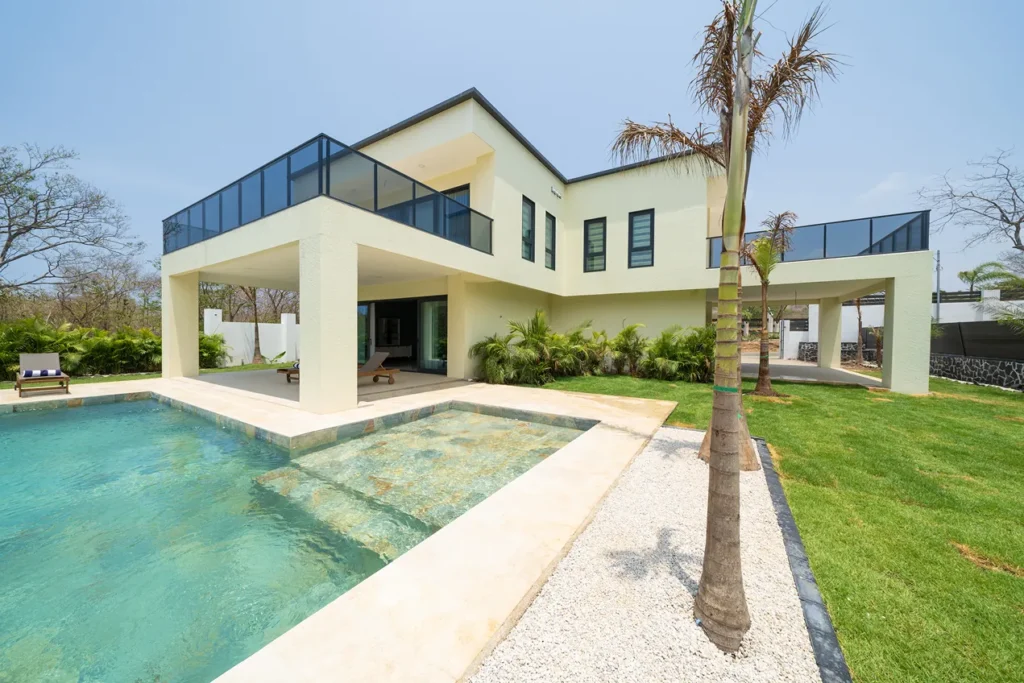
A home construction contract in Costa Rica should be in writing and should spell out the scope, the plans and specifications, the type of price, a payment schedule tied to construction stages, the timeline, how changes are approved, warranties, insurance and how disputes are resolved. It should also name the CFIA-registered professional who is legally responsible for the work. Costa Rican law adds a five-year liability for construction defects that a contract cannot waive, so read every clause with that in mind.
This guide walks through each clause, explains the three main contract types, sets out what Costa Rican law already says about builder liability, and ends with the most common red flags. It is general information, not legal advice. Have a Costa Rican attorney review your contract before you sign.
Do you need a written construction contract in Costa Rica?
A verbal construction agreement is legally valid in Costa Rica, but its terms are much harder to prove in a dispute (BG&A Abogados, January 2025). For a custom home, a written contract is the only sensible option, especially if you are managing the build from abroad.
The professionals involved also have their own written contract rules. Under CFIA's contracting regulation, in force since February 3, 2020, the relationship with an engineer or architect must be set out in writing before any service starts, and the contract becomes official only when it is registered with the CFIA (CFIA, Reglamento para la Contratación de Servicios de Consultoría, Articles 25, 26 and 35). Registration of professional responsibility is mandatory (Article 28).
The three main types of construction contract
The Civil Chamber of Costa Rica's Supreme Court identified three main types of general construction contract in a January 2016 ruling, and each splits the risk differently (Tico Times, September 2026).
| Type | How you pay | Who carries cost risk | Best when |
|---|---|---|---|
| Fixed price (precio alzado) | One agreed total for a defined project | The builder, for price rises on the agreed scope | Plans and specifications are complete and you want a firm number |
| Unit of measure | A set price per finished square meter | Shared: the rate is fixed, the final area decides the total | Plans are complete and the area is clear |
| Administration (cost plus) | Actual costs plus a fee or percentage for the builder | You, the owner | Scope is still moving and you can follow costs closely |
Source: Tico Times, "Building in Costa Rica? Understanding your construction contract options" (September 18, 2026).
Fixed price
The builder cannot raise the price because materials or labor cost more, since it accepted that risk. If you ask for changes, such as a larger floor area or solar panels, the builder should refuse or renegotiate in writing (Tico Times, September 2026). In practice, a builder squeezed by rising costs may slow down or stop, so a fixed price is only as good as the builder's finances and the detail of the plans behind it.
Cost plus
You pay actual costs for materials, labor, taxes, insurance and transport, plus the builder's fee. The builder must report progress, flag problems and keep clear accounts and invoices. If the person supervising the work is also the builder, there is a conflict of interest, and courts look at that arrangement more strictly (Tico Times, September 2026). Insist on open books and regular cost reports.
What a construction contract in Costa Rica should include
Use this as a checklist when you read a draft.
Parties and the responsible professional
Name the owner and the builder with their legal details. If the builder is a company, ask for its legal standing and its CFIA company registration. The contract should name the architect or engineer registered with the CFIA as responsible for the project. A builder who is not an architect or engineer must have a registered professional who is legally responsible (Tico Times, September 2026).
Scope, plans and specifications
The registered blueprints and the structural, electrical and mechanical plans become part of the contract's supporting documents, and they are what proves the facts if there is a serious dispute (Tico Times, September 2026). Attach them, list them by sheet and revision, and add a written specification of finishes: brands, models, thicknesses and allowances. Words like "standard" or "high quality" mean nothing in a dispute.
Price, taxes and allowances
State the price type, the currency and whether VAT is included. Construction and engineering services for CFIA-registered projects are taxed at the general 13% rate since September 1, 2023 (La República, September 2021). List allowances for items you have not chosen yet, and say what happens if the final choice costs more or less.
Payment schedule tied to stages
Pay for work done, not for time passed. Tie each payment to a stage that can be checked on site, confirmed by your inspector. A common protection is a retention: the client holds back 5% or 10% of each payment as a guarantee (Tico Times, September 2026). A typical stage structure looks like this:
| Stage | Evidence before you pay |
|---|---|
| Mobilization or deposit | Signed contract, permits in hand, insurance certificates |
| Foundations | Inspector's report and photos before the pour |
| Structure and walls | Structure complete to the agreed level, logbook entries |
| Roof | Roof closed and waterproofed |
| Systems and finishes | Electrical, plumbing and finishes signed off by the inspector |
| Final handover | Punch list closed, as-built documents, release of retention |
The percentage for each stage is a matter for negotiation and depends on the project. What matters is that each payment matches work you can verify.
Timeline and delays
Set a start date, a completion date and key milestones. Say which delays extend the deadline (permits, extreme weather, changes you request) and which do not. Penalties for non-compliance are one of the key clauses lawyers recommend (BG&A Abogados, January 2025), so agree in writing what happens if the deadline is missed. A typical Decentra home takes 5 to 8 months on site; our guide on how long it takes to build a house in Costa Rica explains what drives the schedule.
Change orders
Every change should be in writing, priced and signed before the work is done. CFIA's regulation backs this up: changes that alter cost or time need the owner's authorization, and every change must be noted and technically justified in the official construction logbook (bitácora) (CFIA, Reglamento para la Contratación de Servicios de Consultoría, Article 9). On a fixed-price contract, a change accepted without a new agreement does not let the builder pass on the added cost (Tico Times, September 2026).
Inspection and the logbook
Under CFIA's regulation, the owner must contract inspection of the work or, if inspection is not contracted, technical direction. The inspector or director must visit at least every seven calendar days (Article 9). Your contract should give your inspector access to the site, the logbook and the invoices.
Warranties and builder liability under Costa Rican law
Costa Rica's Civil Code already gives you protection that does not depend on the contract.
- Five years for construction defects. Under Article 1185 of the Civil Code, whoever is in charge of the work, whether architect, engineer, developer or construction company, is responsible for total or partial losses caused by defects in construction or in the ground beneath it. The period is five years from completion and handover, and it cannot be waived (Howler, "Legal Ease: Is your builder responsible?").
- Shared responsibility. Where several professionals were involved, Article 1186 makes each responsible for their share, based on the official construction logbook (Howler).
- What counts. The claim covers hidden defects tied to the construction process, the quantity or quality of materials, or a lack of supervision, recklessness or negligence. Force majeure does not qualify, and minor cosmetic problems may not be enough (Howler).
- Other breaches. Claims outside that chapter, such as a builder who never finishes, run as breach of contract with a ten-year limitation period (Howler; CIJUL, Universidad de Costa Rica).
Your contract can add to this. Ask for written warranties on specific items, such as waterproofing, roofing and installed equipment, with clear periods and a response time for repairs. Remember that a clause trying to cut the five-year legal liability does not remove it.
Insurance the builder should carry
Workers' compensation (seguro de riesgos del trabajo) is mandatory for every employer in Costa Rica under the Labor Code. Until 2024 the INS was the only provider; a second insurer has since been authorized (El Financiero, January 2026). On a home build, the policy is usually tied to the construction value; one Costa Rican guide puts it at about 1.17% of that value (Howler, "Costa Rica building permit process step by step"). Ask the builder for the policy number and confirm it covers your project.
Also ask about construction all-risk and civil liability cover for damage to the works and to neighbours during the build. Legal commentators recommend full coverage for construction and remodeling projects (Howler). Your contract should say who buys each policy, who is named on it and what happens to a payout.
Dispute resolution
Court cases are slow, so most well-drafted contracts include mediation or arbitration (BG&A Abogados, January 2025). The CFIA runs its own Conflict Resolution Center, which offers conciliation, arbitration and dispute boards for financial disputes over engineering or architecture contracts. At least one party must be a CFIA member, and an arbitration award has the same value as a court judgment. An arbitration clause should state the agreement to arbitrate at the center, the type of arbitration and whether there is one arbitrator or a panel of three (CFIA Conflict Resolution Center).
If you do not speak Spanish, agree on the contract language and which version prevails, and keep a certified translation.
Red flags in a Costa Rican construction contract
- No CFIA-registered professional named as responsible for the work.
- A fixed price offered before the construction plans are finished.
- Large payments up front, or payments by calendar date instead of completed stages.
- Vague specifications, or "allowances" with no amounts.
- No written change-order process, or a builder who says "we will sort it out later".
- No proof of workers' compensation insurance.
- A clause that claims to waive or shorten the builder's legal liability for defects.
- No retention, no handover procedure and no dispute clause.
- A cost-plus contract with no access to invoices.
Our guide on how to choose a home builder in Costa Rica covers the checks to run on the company itself. If you would like a second opinion on a contract or budget before you sign, our construction consulting service reviews it with a CFIA-licensed engineer and architect with 15 years of experience. Legal terms still belong with your attorney.
How Decentra helps
We are a design-build custom home builder in Costa Rica, founded in 2020, with a showroom in Altos de Flamingo, Guanacaste, open by appointment. Our design and construction are CFIA-licensed under SANYC Ingeniería (CFIA registration CC-10880), and we have completed more than 50 residential and commercial projects. We build in concrete, hybrid and steel, typically 5 to 8 months on site. For new builds: Minimum construction budget $350,000 USD, before land. See how we run custom home construction, or message us on WhatsApp to talk through your project.