

Concrete vs steel frame homes on the Costa Rica coast: salt air, humidity and earthquakes
Near the Costa Rica coast, reinforced concrete is the most forgiving structure; galvanized steel frame also works but needs heavier zinc, a sealed envelope and careful detailing.
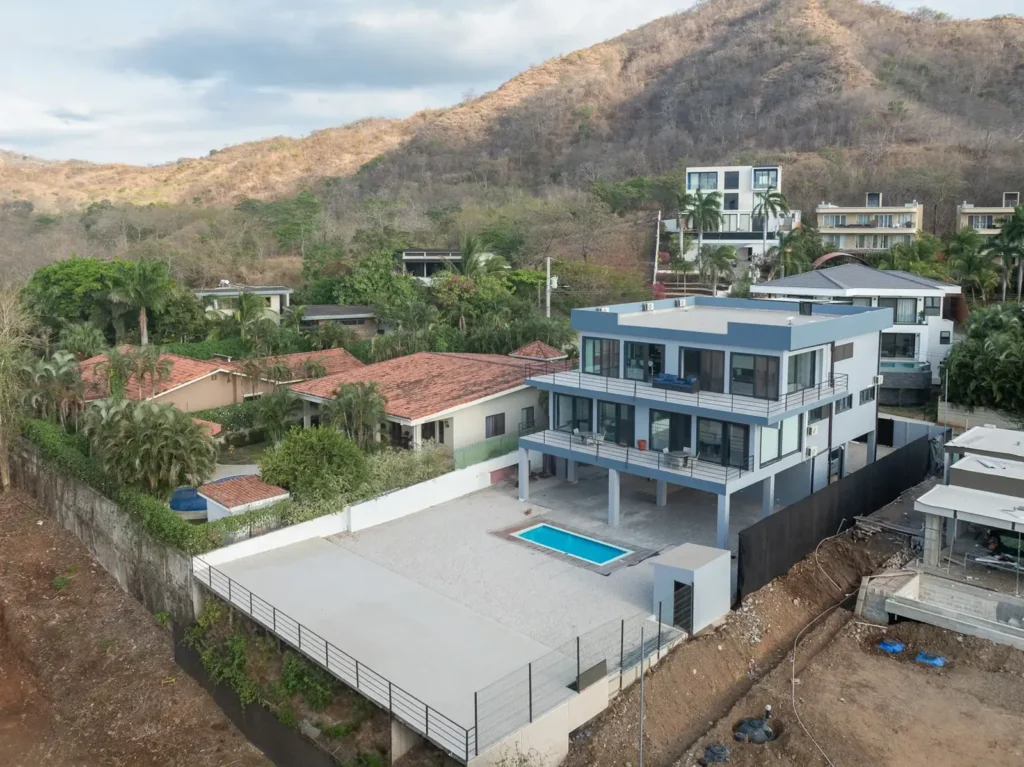
On the Costa Rica coast, reinforced concrete is the most forgiving choice for a custom home: properly specified concrete resists salt air, humidity and termites and is fully covered by the Costa Rican seismic code. Galvanized steel frame is also recognised by the code and goes up faster and lighter, but within reach of sea spray it needs a heavier zinc coating, a sealed building envelope and careful detailing to keep salt and moisture off the steel. Many coastal homes combine the two.
This guide compares concrete and steel frame specifically for beach and near-coast lots: how salt air attacks each one, humidity and termites, earthquake behaviour, build speed, thermal comfort, maintenance, and what to think about for insurance and resale. For an overview of every system, including block, poured concrete and structural steel, see our construction systems page.
Concrete vs steel frame on the coast at a glance
| Factor | Reinforced concrete | Galvanized steel frame |
|---|---|---|
| Salt air | Rebar is protected by dense concrete and cover; chlorides are the main long-term risk | Zinc coating protects the steel; the coating wears faster near the sea |
| Termites and mold | Not a food source | Not a food source; steel is inorganic |
| Earthquakes | Covered by the seismic code, chapter 8 | Covered by the seismic code, section 10.8 for cold-formed steel |
| Weight | Heavy | Light |
| Speed on site | Slower: forming, pouring and curing | Faster structure; finishes take the same time |
| Thermal behaviour | High thermal mass; needs shade and ventilation in humid heat | Low mass; relies on insulation and shade |
| Main maintenance point | Cracks, sealing and paint | Envelope, flashings, cut edges and exposed connections |
How salt air affects homes near the beach
Salt is carried inland on wind and spray, settles on surfaces and draws in moisture. Corrosion engineers classify sites using ISO 9223 corrosivity categories. The American Galvanizers Association (AGA) gives these yearly zinc loss rates for each category, which is a good way to see how fast distance from the sea changes the picture:
| ISO 9223 category | Typical coastal setting | Zinc loss per year |
|---|---|---|
| C3 | Roughly 1 to 30 km from the ocean | 0.7 to 2.1 µm |
| C4 | Under 1 km from the ocean, outside the splash zone | 2.1 to 4.2 µm |
| C5 | Within a few hundred metres of the ocean | 4.2 to 8.4 µm |
| CX | Offshore and the salt-water splash zone | 8.4 to 25 µm |
Source: AGA, HDG corrosion rates for ISO categories C1 to CX.
A home on a bluff above Playa Flamingo and a home a few kilometres inland near Liberia can sit in different categories, so the specification should follow the lot, not the region. Costa Rica's own estimated corrosion maps, published by researchers in Cuadernos de Investigación UNED (2015), deliberately leave out coastal zones of roughly 2 to 5 km and say they must be considered separately. In other words, there is no official map that tells you the category of a beach lot; your engineer has to judge it from exposure, prevailing wind and distance to the surf.
Protecting reinforced concrete from salt air
Concrete protects its reinforcing steel chemically: its high alkalinity keeps the rebar passive. Chlorides from seawater break that protection down, and chloride-induced corrosion is more common than corrosion from carbonation (CIP 25, Corrosion of Steel in Concrete). When rebar rusts it expands and cracks the concrete around it, so the defence is to keep chlorides away from the steel for as long as possible.
For concrete exposed to moisture and an external chloride source such as seawater (exposure class C2), ACI 318 sets a maximum water to cementitious materials ratio of 0.40 and a minimum specified strength of 5,000 psi (ACI; CIP 25). The same guidance calls for adequate cover over the rebar, increased in corrosive environments, a chloride limit of 0.15% by weight of cement in reinforced concrete for this class, at least 7 days of curing and limited crack widths. Supplementary materials such as fly ash, slag cement or silica fume reduce permeability. On a coastal lot, ask your engineer which exposure class the design assumes for foundations, columns, slabs and any concrete that is in contact with salt spray.
Protecting a steel frame from salt air
Light steel framing is protected by a zinc coating. The minimum coating designation for galvanized cold-formed steel framing under ASTM A1003 is G40 (GalvInfo Center, International Zinc Association, 2017). For coastal construction, the Journal of Light Construction recommends specifying the heavier G90 coating, and notes that normal cutting and drilling remove the zinc at the cut, although the surrounding coating usually protects it; areas that do rust can be wire-brushed and touched up with a zinc-rich paint (JLC). The AGA's general rule is simple: the thicker the zinc coating, the longer it lasts in any environment.
Where the steel sits matters as much as the coating. In a ten-year NAHB Research Center field study summarised by the International Zinc Association, galvanized framing inside walls and attics showed minimal corrosion, while samples in a crawl space and under a deck exposed to river spray lost considerably more coating; the report recommends against using it outdoors, such as under decks, and calls for a heavier coating in coastal crawl spaces. For a beach house, that points to a few practical rules:
- Keep structural steel inside a continuous, sealed envelope; do not leave frame members exposed on terraces or under decks.
- Specify a coastal-grade coating for the site's corrosion category, not the minimum.
- Treat every cut, drilled hole and connection as a weak point and protect it.
- Detail flashings, window openings and roof edges so wind-driven rain cannot sit against the frame.
Humidity, mold and termites
Neither concrete nor steel is food for termites or mold. Steel industry groups point out that cold-formed steel is inorganic, offers no food source for mold and is unaffected by termites, and that the International Residential Code recognises it as termite-resistant construction (SFIA, BuildSteel.org). Concrete is mineral too. Doors, cabinets, trim and furniture are still exposed, so termite inspections remain part of owning a home in the tropics.
Humidity is the bigger issue for both systems. Moisture trapped in a wall cavity, a roof or a crawl space feeds mold on finishes and, in a steel-framed house, sits against the coating. Ventilation, roof overhangs, drainage away from the foundation and correctly placed vapour control matter more than the choice of structure.
Which is better in an earthquake?
Both can be designed to the Código Sísmico de Costa Rica. The 2010 code (2014 revision) has a chapter on structural concrete (chapter 8) and a section on seismic systems built with cold-formed steel profiles (section 10.8), and it prohibits adobe, rammed earth, filled bahareque and unreinforced masonry as structural systems (CSCR 2010, revision 2014). The code also places many coastal cantons, including Osa, Aguirre (Quepos), Garabito and Parrita, in zone IV, its highest seismic zone.
A lighter building attracts smaller earthquake forces, which is one argument for steel frame. A reinforced concrete structure is heavier, and the code accounts for that in its design. In practice the soil, the foundation design and the quality of the connections decide performance more than the material. Our guide to earthquake-resistant homes explains the seismic code and zones in more detail, and on a sloping lot read our guide to building on a slope. This is general information, not legal advice; your structural engineer confirms what the code requires for your project.
Is steel frame faster to build than concrete?
The structure usually is. Steel members are fixed together rather than formed, poured and cured, and CIP 25 guidance calls for at least 7 days of curing for concrete. But the structure is only part of a custom home. Roofing, windows, mechanical and electrical work, finishes, the pool and landscaping take the same time whatever holds the house up, and permits and material deliveries to remote beach towns often set the pace. A typical custom home spends 5 to 8 months on site once the permit is issued; our guide on how long it takes to build a house in Costa Rica breaks down the full timeline.
Which is cooler in a hot, humid climate?
Thermal mass works best where nights are much cooler than days. The Australian Government's YourHome guide says high-mass construction is generally not recommended in hot humid climates, that low mass performs best where the day to night range is consistently 6°C or less, and that in tropical areas with a 7°C to 8°C range high mass can cause overheating unless it is carefully designed, well shaded and insulated (YourHome).
That does not rule out concrete on the coast; it means a concrete home has to be designed for the climate. Deep overhangs, shaded walls, cross-ventilation, an insulated roof and windows placed for the breeze keep a concrete house comfortable. A steel-framed house has little mass, so it cools quickly at night but depends on insulation and shading to stay cool in the afternoon. The roof matters most in both cases.
Maintenance on a coastal home
- Concrete: inspect for cracks and rust staining, keep exterior paint and sealers in good condition, and keep water draining away from slabs and foundations.
- Steel frame: inspect flashings, sealants and any exposed connections, touch up damaged zinc with zinc-rich paint, and fix leaks quickly so moisture does not sit in the walls.
- Both: windows, door hardware, railings, roofing fasteners and outdoor equipment take the most salt; specify them for the coast and rinse and service them regularly.
Insurance and resale on the coast
The INS home policy offers direct damage cover for fire, lightning, wind and flooding, and a separate natural disaster cover for earthquakes and volcanic eruptions (La República, 2024). Ask the insurer, before you choose a system, whether the structure type, the distance to the sea or the corrosion protection affects the premium or the terms.
For resale, a buyer's engineer will want to see how the house was built. Keep the CFIA-registered plans, the as-built drawings, the closed construction logbook and the specifications for coatings and concrete. Under the CFIA's digital logbook rules, the final entry records the as-built plans, the final area and cost and the owner's acceptance (CFIA). Whatever the system, a documented, permitted house is easier to sell. For anything specific to your market, ask a local appraiser or broker.
Hybrid homes: concrete where it counts, steel where it helps
A hybrid design can use both. One approach is a reinforced concrete foundation, ground floor and pool, where contact with soil, water and splash is greatest, with a lighter steel frame for upper floors, roof structures or long spans. Each material goes where it performs best, provided the steel stays inside the envelope and the connections between the two are detailed for corrosion.
How Decentra Homes helps you choose
Decentra Homes is a design-build custom home builder in Costa Rica, founded in 2020, with 50+ residential and commercial projects. We build in concrete first, and also hybrid and steel frame. Design and construction are CFIA certified under SANYC Ingeniería (CFIA registration CC-10880), with CFIA-licensed architect Sergio Cerceño. If you want an independent view on a lot or a design, consulting is $200 per hour with a CFIA-licensed engineer and architect with 15 years of experience. Minimum construction budget $350,000 USD, before land. Message us on WhatsApp +506 8733-2930 or through our contact page.