

Sustainable home building in Costa Rica: what makes a tropical build green (2026)
A green home in Costa Rica starts with shade and ventilation, then adds solar, rainwater and proper wastewater treatment; RESET, EDGE, LEED and Bandera Azul can certify it.
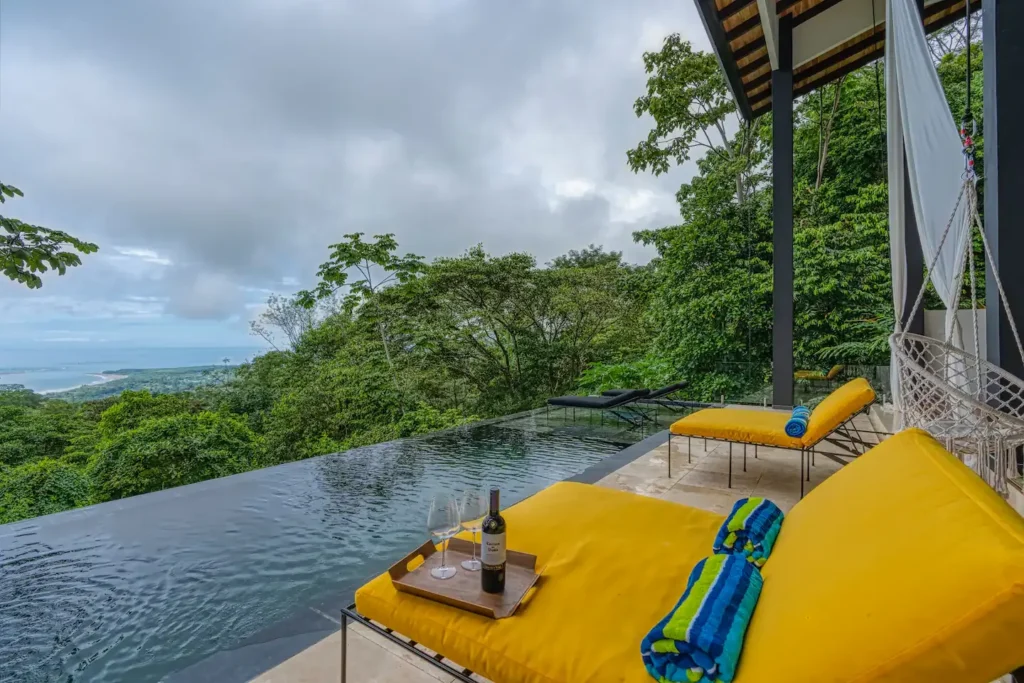
A tropical home in Costa Rica is green when its design does most of the work: shade, cross-ventilation and a well-detailed roof keep it cool, and only then do solar panels, rainwater storage and a correctly sized wastewater system cut what it draws from the grid and the aquifer. Costa Rica has its own green building standard for the tropics, RESET, alongside LEED, EDGE and the CFIA-run Bandera Azul Ecológica for sustainable construction, and EDGE publishes a flat certification price for a single-family house.
This guide covers passive cooling, solar, water, wastewater, materials, the certifications used here and what they cost.
What makes a house sustainable in a tropical climate?
In a cold climate, green building is mostly about keeping heat in. In Costa Rica it is about keeping heat, sun and rain out while letting air move through. The RESET standard, written in Costa Rica by the Instituto de Arquitectura Tropical, sums it up as sustainability "with more architecture than technology" (Construction21). In practice that means four layers, in this order:
- Site and design. Orientation, shade, ventilation, roof shape and room layout.
- Envelope and materials. A durable structure, a roof that sheds heat and rain, and materials that suit humidity and salt air.
- Systems. Solar power, efficient air conditioning where it is still needed, rainwater storage and wastewater treatment.
- Operation. Maintenance, water and energy use.
A house that skips step one will still run hot, whatever is added later. Our architectural design service starts with the first layer.
Passive cooling: the cheapest green feature
The main passive cooling moves are a roof that shades the walls, openings on opposite sides of each room so breezes can cross it, high ceilings or roof vents that let hot air escape, light-coloured roofs and walls, and planting that cools the ground around the house. Australia's YourHome guide, written for its own hot humid north, advises deciding early whether a home will be free running, air conditioned or a hybrid, because converting later needs substantial changes (YourHome, passive cooling).
For a custom home in Guanacaste or the southern Pacific, the realistic target is usually a hybrid: living areas, terraces and kitchens that work with open doors and fans, and bedrooms or a media room that can be closed and cooled efficiently. The less the house relies on air conditioning, the smaller the solar system it needs. Our guide to tropical house design in Costa Rica covers orientation, overhang depths, ventilation and fans in detail.
Solar power for a green home
Costa Rica's grid is already mostly renewable: ICE reported that 98.6% of the country's electricity in 2025 came from renewable sources, mainly hydro, wind and geothermal (ICE, February 2026). Solar at home is a regulated system: you connect through your distributor, which may be ICE, CNFL or a cooperative. Law 10086 and its regulation, Decree 43879-MINAE, replaced the 2015 net metering decree, so exported surplus is now valued in money rather than banked as kWh, the distributor is not obliged to buy it, and a grid access charge applies to self-supplied energy on some rates. Some builders still describe solar here as net metering with ICE; check the current terms with your distributor. Our guide to solar panels for a home in Costa Rica explains these rules, the interconnection steps and battery options.
The design decisions that matter most:
- Cut the load first. Shade, ventilation and efficient equipment reduce the size, cost and roof area of the system you need.
- Give the panels a clear roof plane. Plan it during design, away from shade from trees and slopes, with a structure designed for the extra load.
- Choose grid-tied, no-export or off-grid before the plans are final. The choice changes the electrical room, the space reserved for any battery bank and how the system is permitted.
- Consider solar water heating. A 2015 study in the Tecnológico de Costa Rica's journal Tecnología en Marcha found that 41.3% of Costa Rican households use hot water systems, mostly electric in-line heaters, together using more than 250 GWh a year. Builders commonly recommend solar water heaters as a simple upgrade; ask for a quote sized to your household.
Rainwater harvesting and greywater reuse
Where the public or community water supply is limited in the dry season, storing rain from the roof is a practical way to cut potable water use. A useful rule from Costa Rican practice: rainwater is clean, but it is not potable water. La Nación's 2020 explainer on rainwater systems, which quotes a University of Costa Rica chemist, recommends using it for toilets, floor cleaning, laundry, car washing, irrigation and, with chlorination and filtration, filling a pool, and not for drinking, cooking or washing dishes. The same article notes that all water in Costa Rica must be disinfected before people drink it, and that using rainwater to flush toilets saves about 60 litres of potable water per person per day (La Nación, June 2020).
Planning points for a rainwater system in a new build:
- Roof and gutters. Size gutters and downspouts for tropical downpours and add a first-flush diverter and leaf screens.
- Storage. Size tanks, above ground or buried, to your roof area, rainfall and the dry-season weeks you want covered.
- Separate plumbing. Rainwater lines serve toilets, laundry and irrigation only, kept apart from the potable supply.
- Permits. The system is part of the plans your CFIA-registered professionals file. Check with the municipality and your engineer whether your site needs anything further.
- Efficient fixtures. Use less water before storing it. Under the US EPA's WaterSense label, a US programme, an efficient toilet uses 1.28 gallons (about 4.8 litres) per flush or less, against up to 6 gallons for old models (US EPA WaterSense).
Greywater, the water from showers, sinks and laundry, is legally ordinary wastewater in Costa Rica. Executive Decree 33601-MINAE-S, the wastewater discharge and reuse regulation published in La Gaceta in March 2007, defines ordinary wastewater to include toilets, showers, washbasins, sinks and laundry, allows reuse only for water treated under the treatment system rules, and says reused water may never be used for human consumption (Decree 33601-MINAE-S, Arts. 3, 27 and 28). Some guides say untreated greywater can go straight to the garden; under the decree it cannot. Greywater reuse for irrigation is a treatment design question for your engineer and the Ministerio de Salud. Rainwater is far easier to reuse.
Wastewater: septic or treatment plant
Outside larger towns, most homes treat their own wastewater. The septic tank, drain field and percolation test follow national rules that also decide how much land the system needs. Our guide to septic systems in Costa Rica covers the decree, the infiltration test, sizing and treatment plants. The sustainable choice is the one designed for your soil, water table and real occupancy.
Also see: Tropical house design in Costa Rica: orientation, overhangs and cooling without AC and Best roof for a house in Costa Rica: metal, clay tile, concrete and green roofs compared
Local materials and a durable structure
Durability is part of sustainability. A house that needs major repairs every ten years uses more materials and energy than one built to last. That is why we lead with reinforced concrete, and also build hybrid and steel frame homes: concrete is not food for termites, one reason block and concrete have been the standard here for decades (Howler), and it is covered by the Costa Rican seismic code. RESET rewards the same thinking by scoring the distance materials travel from the factory to the site (La República, 2016).
Some green building content promotes earth construction. In Costa Rica the seismic code is clear: it prohibits the structural use of adobe, rammed earth (tapial), filled bahareque and unreinforced masonry in the earthquake-resisting systems of all buildings (Código Sísmico de Costa Rica 2010, 2014 revision, Art. 1.1). Earth finishes can still be used, but not as the structure.
On the coast, durability means specifying for salt air. Our comparison of concrete vs steel frame homes on the coast explains how each system is protected, and our construction systems page covers the options we build.
Green building certifications in Costa Rica
Four certification systems are used in Costa Rica. Most private homes are built to green principles without certifying. A certificate's value is independent proof of performance, so weigh it against the consultant and certification fees. Here is how they compare:
| System | Who runs it in Costa Rica | What it measures | Fit for a single-family home |
|---|---|---|---|
| RESET (INTE C170) | Developed by the Instituto de Arquitectura Tropical; taken up by the CFIA and INTECO, which evaluates and issues it | Seven chapters, from socio-economic aspects and site to materials, water and energy | Yes: single-family homes fall in its lightest "White" category |
| EDGE | IFC (World Bank Group); certified locally by the Green Building Council Costa Rica (GBCCR) | At least 20% less energy, water and embodied energy in materials than a local baseline | Yes, with a flat fee for one house |
| LEED | US Green Building Council; promoted locally by GBCCR | Points across site, water, energy, materials and indoor quality | Possible, but mostly used for offices, hotels and larger projects here |
| Bandera Azul Ecológica, sustainable construction category | CFIA, since 2017 | Design and construction phases: water, energy, materials, biodiversity and waste | Open to residential buildings |
RESET: the Costa Rican standard for the tropics
RESET stands for Requisitos para Edificaciones Sostenibles en el Trópico. The Instituto de Arquitectura Tropical, a non-profit founded in Costa Rica in 1994, drafted it, and the CFIA and INTECO, the national standards body, took it on as a national standard. Each building is placed in one of four impact categories, White, Yellow, Orange or Red, and must meet 70% of the criteria for its category. Single-family homes sit in the White category, which has 39 criteria, compared with 121 for the Red category. Accredited RESET consultants prepare the file and INTECO evaluates it and issues the certificate (Construction21). The 2014 edition was published as INTE C170:2014 (Góchez, UCR, 2020), and INTECO's catalogue now lists INTE C170:2025, with a 2025 corrigendum, as the edition in force (INTECO, checked November 2026). The category and criteria counts above describe the earlier edition, so ask INTECO or a RESET consultant how the 2025 edition treats a single-family home, and for current fees.
EDGE: the most practical certificate for one house
EDGE was launched in Costa Rica on May 14, 2015 by the IFC and the Green Building Council of Costa Rica. To certify, a building must use at least 20% less energy, 20% less water and 20% less energy embodied in its materials than a standard building, measured with free EDGE software (IFC, May 2015). In 2022 a house in Costa Rica was certified after construction with reported savings of 36% in energy, 32% in water and 48% in embodied energy (Estrategia & Negocios, January 2022).
EDGE also publishes its prices. For Costa Rica, GBCCR charges a $300 registration fee and $1,500 to certify a single-family house, split 65% at the design stage and 35% after construction. EDGE also requires an independent auditor, whose fee is not in that table, so confirm it with GBCCR (EDGE certification pricing, checked November 2026).
LEED: widely used, mostly commercial
Costa Rica is the strongest LEED market in Central America. In March 2021 it had 227 LEED projects covering about 2.3 million square metres, with commercial offices the largest group (ACR Latinoamérica, March 2021). LEED can certify homes, but here it is mostly chosen for commercial buildings; for a boutique hotel or mixed-use project, see our commercial construction service.
Bandera Azul Ecológica for sustainable construction
Costa Rica's Bandera Azul Ecológica programme has a sustainable construction category, Category XV, and the CFIA has run it since 2017. It evaluates nine areas, including integrated design, climate efficiency and comfort, water, energy, materials, waste and resilience (Delfino, September 2026). Under the CFIA's 2019 procedures manual, a project can apply for a design seal, which is stamped digitally on the plans registered with the CFIA, and for a construction award; in the design phase water, energy and materials each weigh 30% and biodiversity 10%, and a project must apply for the construction award before 20% of the work is done (CFIA, PBAE Category XV manual, 2019).
How much does a sustainable home cost in Costa Rica?
Most of what makes a tropical home green is design, which is part of every project fee. Some items add cost:
| Item | Cost guidance | Source |
|---|---|---|
| Construction, before land | About $700 per m² basic, about $1,000 mid-range, $1,000 to $1,200 upper mid-range, $1,500 to $1,800 luxury, $1,800+ ultra luxury | Decentra Homes, 2026 |
| Design and plans | About 5.5% to 6% of construction value | CFIA fee schedule, as applied by Decentra |
| Contingency | 10 to 15% of construction | Decentra Homes |
| EDGE certificate for one house | $300 registration plus $1,500 certification, plus the auditor | EDGE pricing for GBCCR, 2026 |
| Rainwater system | In 2020, from up to ¢220,000 for a basic rural system with a 450 to 600 litre tank, to up to $2,500 for a buried 1,700 to 2,500 litre tank with an automatic pump | La Nación, June 2020 |
| Solar | Depends on load, roof and distributor rules; get current quotes | See our solar guide |
The rainwater figures are from 2020, so treat them as a sense of scale. For a full breakdown, see our guide to the cost to build a house in Costa Rica.
Checklist for a green build in Costa Rica
- Is the house shaded and cross-ventilated by design, with air conditioning only where it is needed?
- Is there a clear, unshaded roof plane and a structure ready for solar?
- Are gutters, storage and separate plumbing planned for rainwater?
- Has the percolation test been done where the drain field will go?
- Is the structure specified for salt air, humidity and the seismic code?
- Do you want a certificate, and if so, which one, registered before design is final?
How Decentra Homes helps
As a design-build custom home builder in Costa Rica, Decentra Homes plans the green features with the house rather than adding them later. We were founded in 2020, have completed 50+ residential and commercial projects and have a showroom in Altos de Flamingo, Guanacaste, open by appointment. Design and construction are CFIA certified under SANYC Ingeniería (CFIA registration CC-10880), and our CFIA-licensed architect, Sergio Cerceño, designs for shade, ventilation, solar and water from the first sketches. We build in concrete first, and also hybrid and steel frame. Minimum construction budget $350,000 USD, before land. Message us on WhatsApp at +506 8733-2930 or through our contact page.