

Building a beach house in Costa Rica: setbacks, salt air and design
A Costa Rica beach house goes behind the 50 m public zone and usually behind the 200 m maritime zone, and is designed for salt air, sand, seafront wind and the western sun.
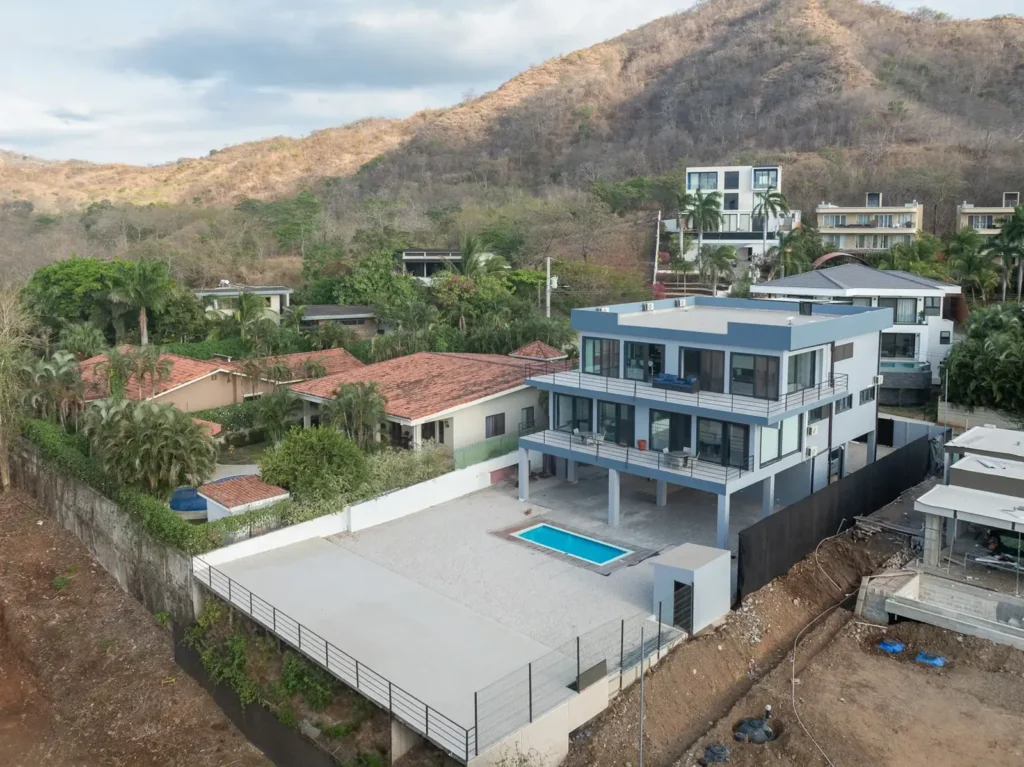
Building a beach house in Costa Rica starts with where the house may legally stand: the first 50 m from the ordinary high-tide line is public zone that cannot be occupied, and the next 150 m is restricted zone held only by concession, so the simplest route for a custom home is titled land behind the 200 m maritime zone (Law 6043). After that, the design is about salt, sand, wind and sun: a reinforced concrete structure with marine-grade details, foundations designed from a soil study, a full engineered wind design and a plan that shades the west.
This guide is general information, not legal advice. Confirm the legal status of any coastal lot with a Costa Rican attorney and a licensed surveyor.
It covers how close to the sea you can build, materials for salt air, foundations in sand, wind design under CFIA rules, heat and orientation, pools near the sea, and what a beach house costs at our 2026 rates, with a checklist for the lot.
How close to the beach can you build in Costa Rica?
Law 6043 sets a maritime zone 200 m wide along both coasts, measured from the ordinary high-tide line. The first 50 m is the public zone and the remaining 150 m is the restricted zone (articles 9 and 10). Mangroves and estuaries are public zone whatever their width (article 11), and inside the zone nobody may build, fence or cut trees without legal authorization (article 12).
Concessions, coastal regulatory plans and who may hold them are explained in our guide to building in Costa Rica's maritime zone. This guide picks up once you know where the buildable area of your lot begins.
Leave room for a moving shoreline
The line you measure from is not fixed. A University of Costa Rica oceanographer links beach retreat on the coast to sea-level rise, storm waves, El Niño and vertical tectonic movement, and notes that the September 2012 earthquake raised parts of the North Pacific coast by up to 75 cm (Lizano, Ambientico, August 2014). When you compare lots, look at the elevation above the beach and any signs of erosion, and keep the house and pool well inside the buildable area rather than on its seaward edge.
Salt air: choosing materials for a beach house
The structural choice, concrete or steel frame, is covered in depth in concrete vs steel frame homes on the Costa Rica coast. We lead with reinforced concrete, which on the coast has to be designed for chloride exposure. On a beach house, though, the parts around the structure usually show corrosion first, so they need the same care.
Corrosion engineers rate a site with ISO 9223. Within a few hundred meters of the ocean the category is C5, and in the salt-water splash zone it is CX, the most severe (American Galvanizers Association). Specify each part for the category of your lot.
| Part of the house | What to specify near the sea | Why |
|---|---|---|
| Railings, exposed hardware, hinges, fixings | Type 316 stainless steel, named in the specification | The Nickel Institute calls 316 preferable for coastal regions and warns that writing just "stainless steel" can lead to poor performance |
| Fasteners joining different metals | Stainless fasteners in exposed places, and aluminum electrically insulated from other metals | Carbon steel fasteners rust and stain, and insulating aluminum from other metals prevents galvanic corrosion (Nickel Institute) |
| Galvanized steel parts | A heavier zinc coating, or a change of material where it is exposed | Zinc coatings wear several times faster in category C5 than in C3 (American Galvanizers Association); the rates are in our concrete vs steel guide |
| AC condensers, pool pumps, electrical panels | Equipment rated for coastal use, placed on the sheltered side where it can be rinsed and serviced | Salt deposits and wetness drive corrosion; shelter and access reduce both |
| Windows and sliding doors | Frames, finishes and hardware with a written coastal warranty that states the distance from the sea | They must also meet the wind pressure of the design, covered below |
Foundations in sand: what the soil study decides
Beach sand is a non-cohesive soil. Costa Rica's Seismic Code classes a site with more than 6 m of non-cohesive soil of low or medium density as type S3, and when the soil is not known in enough detail the engineer must assume S3, or S4 if that may apply (CFIA, Código Sísmico 2010 revised 2014, article 2.2). The code does not set rules for liquefaction; it makes the designer responsible for checking that the site is free of that kind of risk and for taking measures if it is not (article 1.3).
That is why a soil study comes before the foundation design on any beach lot. It gives the engineer the bearing capacity, the depth to firm ground and the groundwater level, and those decide whether the house sits on spread footings, a mat slab or deep foundations. Questions to ask your engineer:
- How deep is the groundwater, and will footings or the pool need dewatering during excavation?
- Will the excavation in sand need shoring to protect neighbors and the crew?
- Does imported fill need compaction testing before slabs go down?
- Has the site been checked for liquefaction, and what does the design do about it?
The coastal cantons of Guanacaste, including Santa Cruz, Carrillo and Nicoya, are all seismic zone IV in the code, so the foundation and the structure above it are designed together.
Wind: what CFIA rules mean on the seafront
The CFIA wind guidelines (Alcance 48 to La Gaceta 52, March 21, 2023) treat open water as the most exposed terrain, roughness type D. A site with rougher surroundings that lies within 200 m, or 20 times the building height, of a type D condition must still be designed as exposure D (Table 3-2, note 3). In other words, a house set back from the sand can still count as a seafront house for wind.
- The simplified design annex for single-family homes does not apply to houses facing the sea (Annex C.1).
- Roof cladding and components must be designed for a net pressure of at least 80 kg/m² (section 4.4.3.1).
- In Guanacaste, all districts of Santa Cruz and Carrillo cantons are wind zone IV (Table 3-1).
In practice that means a full wind design by the structural engineer, a roof structure and connections sized for uplift, and windows and sliding doors chosen for the design pressure, not just the view.
Heat and orientation on a beach lot
On most of the Pacific coast the ocean view looks west or southwest, into the afternoon sun, so the side you most want to open is also the hottest. Shading west glass, overhang depths, cross and stack ventilation and when air conditioning still makes sense are covered in our guide to tropical house design in Costa Rica. Three points are specific to a beach lot:
- Sea breezes carry salt and sand, so large openings on the sea side need screens, tracks and hardware that can be rinsed, serviced and replaced.
- A deep covered terrace on the view side is a roof exposed to uplift, so its structure and connections belong in the full wind design described above.
- Outdoor showers, rinse points and drainage near the entrance keep sand and salt water out of the house and off the floors.
Pools near the sea
A pool is construction like any other. Inside the maritime zone it needs legal authorization under article 12 of Law 6043, and on titled land it goes into the permit drawings with the house. Near the beach, three things change:
- Ground. Sand and a shallow water table make the excavation and the shell an engineering question. Ask whether the shell is designed to resist groundwater pushing up on it when the pool is emptied.
- Equipment. Pumps, filters, heat pumps and salt cells last longer in a ventilated, sheltered room, with 316 stainless fittings where metal is exposed.
- Water. Filling and dry-season top-ups need water too, so include the pool when you confirm the water supply for the lot.
Our pools cost about $2,500 per m² of pool, all in: excavation and grade work, the shell, the finish and the filtration system. LED lighting and custom features add to that depending on the design. Sizes and options are in how much it costs to build a pool in Costa Rica.
How much does it cost to build a beach house in Costa Rica?
Our 2026 rates are set by finish level and do not include land:
| Finish level | Rate per m², before land | 380 m² beach house |
|---|---|---|
| Mid-range | about $1,000 | about $380,000 |
| Upper mid-range | $1,000 to $1,200 | $380,000 to $456,000 |
| Luxury | $1,500 to $1,800 | $570,000 to $684,000 |
| Ultra luxury | $1,800 and up | $684,000 and up |
Worked example for a 380 m² luxury beach house with an 8 m by 4 m pool:
- House: 380 m² at $1,500 to $1,800 per m² = $570,000 to $684,000
- Pool: 32 m² at about $2,500 per m² = $80,000
- Design and plans: about 5.5% to 6% of construction value under the CFIA fee schedule = $35,750 to $45,840
- Contingency: 10% to 15% = $65,000 to $114,600
- Total before land: about $751,000 to $924,000
On a beach lot, deeper foundations, coastal-grade specifications and a full wind design can push a project toward the top of its range, so price them from the soil study and the wind design rather than from a rule of thumb. Most of our homes take 5 to 8 months on site once the permit is issued. Minimum construction budget $350,000 USD, before land.
Beach lot checklist before you buy
- A licensed surveyor confirms where the ordinary high-tide line and the 200 m line fall on the lot.
- Your attorney confirms whether the land is titled or held by concession, and what plan applies.
- A water availability letter for the lot, in writing, that covers the house and the pool.
- A soil study that tells the engineer the soil type, the groundwater level and the liquefaction risk.
- The wind exposure and the lot's height above the beach, so the structure and windows can be priced.
- The ISO 9223 corrosion category, so every metal part is specified for the real exposure.
- Any community or HOA rules on height, setbacks and materials.
How Decentra helps you build a beach house
Decentra Homes is a design-build custom home builder in Costa Rica, founded in 2020, with 50+ residential and commercial projects. Design and construction are CFIA certified under SANYC Ingeniería (CFIA registration CC-10880), and our CFIA-licensed architect, Sergio Cerceño, leads the design. We build in concrete first, and also in hybrid and steel. Our showroom is in Altos de Flamingo, Playa Flamingo, by appointment.
Before you buy a coastal lot, construction consulting at $200 per hour with a CFIA-licensed engineer and architect with 15 years of experience checks the lot against the points above. The consulting fee is credited to the construction if you go ahead; surveys and soil studies are paid separately. Message us on WhatsApp at +506 8733-2930.