

How to build a house on your own land in Costa Rica
Yes, you can build on a lot you already own in Costa Rica: once the title, survey plan, land-use certificate, water letter and legal access check out, a design-build firm can take it through design, permits and construction, usually 5 to 8 months on site.
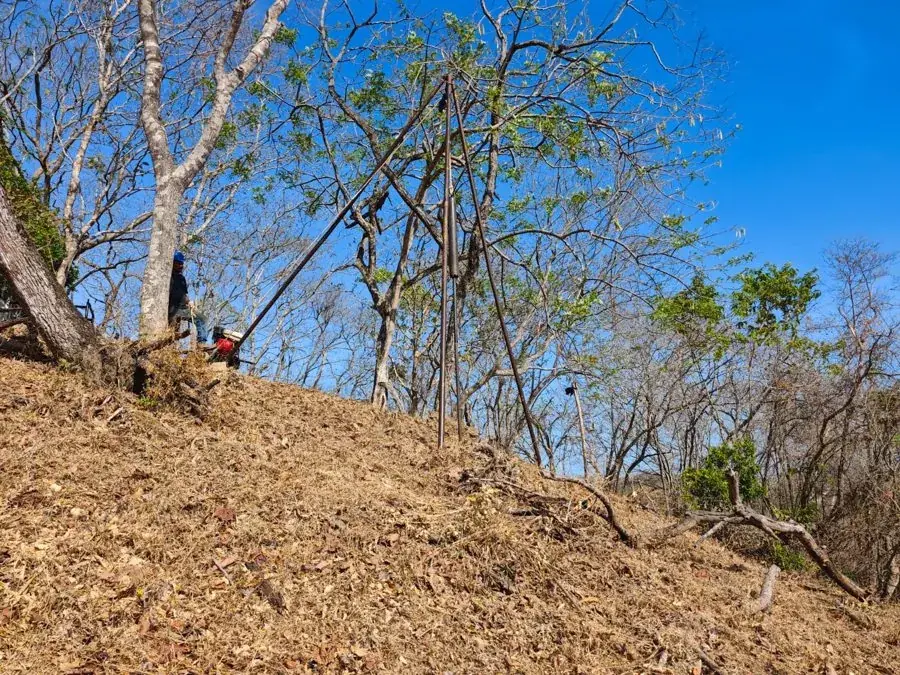
Owning the land is a head start, not a green light. Many lots in Costa Rica were bought years ago, before a new zoning plan, before the water provider ran short, or with a survey that no longer matches the fences. Before anyone draws a floor plan, the lot needs a short legal and technical review. This guide covers that review, how a builder takes the project over once the lot is cleared, the design-build steps and what the house will cost.
Can you build on land you already own in Costa Rica?
In most cases, yes. A foreigner can hold titled property in Costa Rica with only a passport, with no residency, visa, local partner or minimum price required (Tico Times, September 2026). Ownership by itself does not give you the right to build, though. A building permit depends on the lot's land-use rules, a water availability letter, legal access and plans signed by CFIA-registered professionals. The exception to normal ownership is land near the beach, covered below.
The good news for owners: you skip the search and the purchase, and you can start the checks right away. Most of them take a few documents and a site visit.
The 7 checks to run on a lot you already own
- Title at the Registro Nacional
- Survey plan (plano catastrado) against the land
- Land use (uso de suelo) from the municipality
- Water availability letter
- Legal access and electricity
- Slope, soil, rivers and trees
- Maritime zone status, if the lot is near the beach
| Check | Who issues or confirms it | What it tells you |
|---|---|---|
| Registry report (informe literal) | Registro Nacional | Owner, liens, mortgages, easements, annotations |
| Plano catastrado | Licensed surveyor, recorded at the cadastre | Boundaries, area, location |
| Uso de suelo | Municipality | Permitted use, floors, lot coverage |
| Water letter | AyA, the local ASADA or a municipal system | Whether the lot can get a connection |
| River alignment | INVU | Setback from rivers and creeks |
| Road alignment | MOPT, for lots on national roads | Setback from the road |
| Municipal tax certification | Municipality | Whether property taxes are paid up |
1. Title: is it clean and in the right name?
Every property has a folio real number at the Registro Nacional, and the record shows the owner, boundaries, fiscal value and annotations such as liens and mortgages (Tico Times, September 2026). Pull a fresh registry report even if you bought the lot with a lawyer years ago. Check that the owner on record is exactly the person or company that will apply for the permit, and that the municipal taxes are paid.
Two details catch owners out at permit time. If the lot is held by a company, the municipality can ask for a current certification of the company's legal standing (personería jurídica). If the lot has several owners, it can ask for a document showing they all agree to the application (Municipalidad de Puriscal, 2026). Requirements vary by canton, so confirm them with yours.
2. Survey plan: does the paper match the ground?
The plano catastrado should be checked against the physical property by a licensed surveyor (Tico Times, September 2026). Fences move, markers disappear and neighbors build over lines. Ask the surveyor to find the markers, then order a topographic survey with contours. The architect designs from it, and the engineer uses it to price earthworks and retaining walls.
3. Land use: what does the zoning allow today?
The uso de suelo certificate, issued by the municipality, sets the type of construction allowed, the number of floors, the maximum lot coverage and other limits from the local zoning plan (Diario Extra, 2026). Zoning changes, so a certificate from when you bought may not reflect the rules today. A current one is also on the permit checklist (Municipalidad de Puriscal, 2026).
4. The water letter: can the lot get water?
No water letter, no permit. Construction permits require a water availability letter from the local ASADA or AyA, and a private well usually needs a concession from the Dirección de Agua, so it is rarely a quick substitute (Tico Times, September 2026). Letters are not a formality. AyA received 23,272 availability requests in 2023 and turned down 22% of them, for reasons that included no water main in front of the property and no water to give (Delfino, March 2024).
If your water comes from a spring, the concession should state how many homes it can supply. A spring rated for three homes should not serve five lots (Two Weeks in Costa Rica, 2025). Our permits and water letters service prepares and submits these requests.
5. Access and electricity
Confirm a legal right of way from a public road, especially if other properties sit between your lot and the main road (Two Weeks in Costa Rica, 2025). A track that neighbors let you use is not the same as a registered easement. For power, find out how far the nearest line and transformer are. Extending service can be slow and costly, and solar needs a large upfront investment (same source; Dominical Realty, 2014).
6. Slope, soil, rivers and trees
Slope decides foundations and retaining walls, and a level lot is the easiest way to hold a budget (Dominical Realty, 2014). A soil study tells the engineer the bearing capacity of the ground.
Water on or near the lot sets hard limits. Under Article 33 of the Forestry Law, there is a protection area of a 100 meter radius around permanent springs, and 15 meters on each bank of rivers and creeks in rural areas, 10 meters in urban areas, rising to 50 meters where the terrain is broken (Delfino, February 2026). Forest cover is its own issue: owning land does not by itself authorize clearing it, so ask SINAC before removing trees or opening an access route (CRIE, September 2026).
7. The maritime zone
If your lot is near the beach, check whether you hold title or a concession. Under Law 6043, the first 200 meters inland from the high-tide line belong to the state. The first 50 meters are a public zone where nothing can be built. The next 150 meters are a restricted zone where the municipality grants concessions instead of title, and only where a regulatory plan exists. A foreigner needs at least five years of legal residency to hold a concession (Tico Times, October 2022; Tico Times, September 2026). Building inside a concession follows its own rules, so have your lawyer confirm what you hold before any design work.
What if the lot fails a check?
A failed check is not always the end. Some problems have known fixes: a boundary error can be corrected with a new survey, a missing easement can sometimes be negotiated and registered, and a design can step back from a river setback or work with a slope. Others are harder, such as no water availability in an area where the provider has no capacity. The point of doing the checks first is that you find out before paying for plans. Our land and construction consulting gives you a written view of the lot and what it takes to build there.
How a builder takes over from there
Once the lot is cleared, a design-build firm runs the rest under one contract: the architect, the engineers, the permits and the construction crew. One party is responsible for the plans matching the price, which matters when you live in another country. These are the steps we follow on a lot the client already owns.
Step 1: consultation and lot review
We start with your brief (bedrooms, size, pool, finish level and budget) and the lot's documents. The consulting fee is credited to the construction if you go ahead with us. Topographic surveys, soil studies and other studies are paid separately and are not credited.
Step 2: survey and soil study
These two studies set the base for the design. On a hillside or view lot they often move the budget more than the finishes do.
Step 3: concept and 3D model
Our CFIA-licensed architect designs the house around the lot's views, sun, breeze and slope. You review the concept and 3D model online and approve it before plans start. See architectural design.
Step 4: construction plans and budget
Full plans follow: architectural, structural, electrical and plumbing, with a detailed budget. Design and plans run about 5.5% to 6% of construction value under the CFIA fee schedule. Plans must be prepared by professionals registered with the CFIA and are reviewed against codes such as the Seismic Code and the Electrical Code (Diario Extra, 2026).
Step 5: CFIA registration and the municipal permit
The plans are uploaded to the CFIA's APC platform, and the permit application goes to the municipality where the lot is. A CFIA plan seal alone does not authorize construction; you need the actual municipal permit (CRIE, September 2026). The INS workers' risk policy is required before construction starts (Diario Extra, 2026). Do not let anyone break ground without a permit. In 2025, CFIA inspectors visited 5,934 sites and found that 20% had no municipal permit (Delfino, September 2026).
Step 6: construction
Site work and foundations come first, then structure, roof, walls and openings, systems and finishes. Most of our homes take 5 to 8 months on site; very large homes take longer. We build in concrete, hybrid and steel. Compare them on our construction systems page.
Step 7: handover
Walk the house with a written punch list, and collect the warranties, manuals, final plans and the closed project logbook. Move water and electricity accounts into your name and confirm what final inspection your municipality requires.
How much does it cost to build on your own lot?
Because you already own the land, the budget is the house, the site work and the fees. These are our current construction figures per square meter, before land:
| Finish level | Per m2 | Per sq ft (approx.) |
|---|---|---|
| Basic finish | About $700 | About $65 |
| Mid-range | About $1,000 | About $93 |
| Upper mid-range | $1,000 to $1,200 | About $93 to $111 |
| Luxury | $1,500 to $1,800 | About $139 to $167 |
| Ultra luxury | $1,800+ | About $167+ |
On top of construction, plan for:
- Design and plans: about 5.5% to 6% of construction value under the CFIA fee schedule.
- Pool: about $2,500 per m2 of pool, all-in (excavation and grade work, the shell, the finish and the filtration system). LED lighting and other custom features add to that. See pool construction.
- Studies: topographic survey and soil study, paid separately.
- Permits and insurance: the municipal permit fee, the CFIA registration and the INS policy. One published breakdown puts these at about 1%, 0.33% and 1.33% of construction value (Vacations Costa Rica).
- Contingency: 10 to 15%.
Minimum construction budget: $350,000, before land. As a rough guide, $350,000 of construction at a luxury finish of $1,500 to $1,800 per m2 is about 195 to 235 m2 (2,100 to 2,500 sq ft) of house, before the pool, fees and contingency. Our cost to build guide breaks down each item.
Companies that build homes on your land: what to look for
If you are comparing companies that build on a client's lot, look for one that starts with the lot, not the floor plan. Ask:
- Will you review my title, survey, land use and water before quoting?
- Are your architect and engineer registered with the CFIA, and can I check them in the CFIA directory?
- Who prepares and submits the water letter and permit application?
- Is the price fixed against the plans, and what is excluded?
- Are payments tied to completed, inspected milestones?
- Can I see finished homes and speak to past clients?
Registration with the CFIA is a regulatory check, not a guarantee of quality, so pair it with references and site visits (CRIE, September 2026). You can see our finished work in our portfolio, including the Rainforest Ocean-View Villa and Villa Pochote, or visit our showroom in Altos de Flamingo, Playa Flamingo.
Building on your lot from abroad
Most owners are in the USA, Canada or Europe while the house goes up. What makes it work:
- Documents first. Send scans of the registry report, plano catastrado and any letters you have. Much of the lot review can start without you flying in.
- One named approver for changes, with a spending limit in writing (CRIE, September 2026).
- Payments against inspected milestones, each with photos and the logbook entry.
- Two well-timed trips if you can only make two: the concept review on the lot, and the final walk-through.
Regions differ. Guanacaste is dry with pressure on water, the South Pacific is steep and wet, and the Central Valley is close to suppliers. Our locations pages cover water, zoning and access town by town.
Send us your lot
If you own a lot and want to know what it takes to build on it, send us the plano catastrado and a few photos. We will tell you what to check first. Minimum construction budget: $350,000, before land. WhatsApp +506 8733-2930 or email info@decentrahomes.com.