

Best roof for a house in Costa Rica: metal, clay tile, concrete and green roofs compared
The best roof for a house in Costa Rica depends on distance to the sea, rain, CFIA wind zone, structure and budget; metal, clay tile, concrete slab and green roofs all work when detailed well.
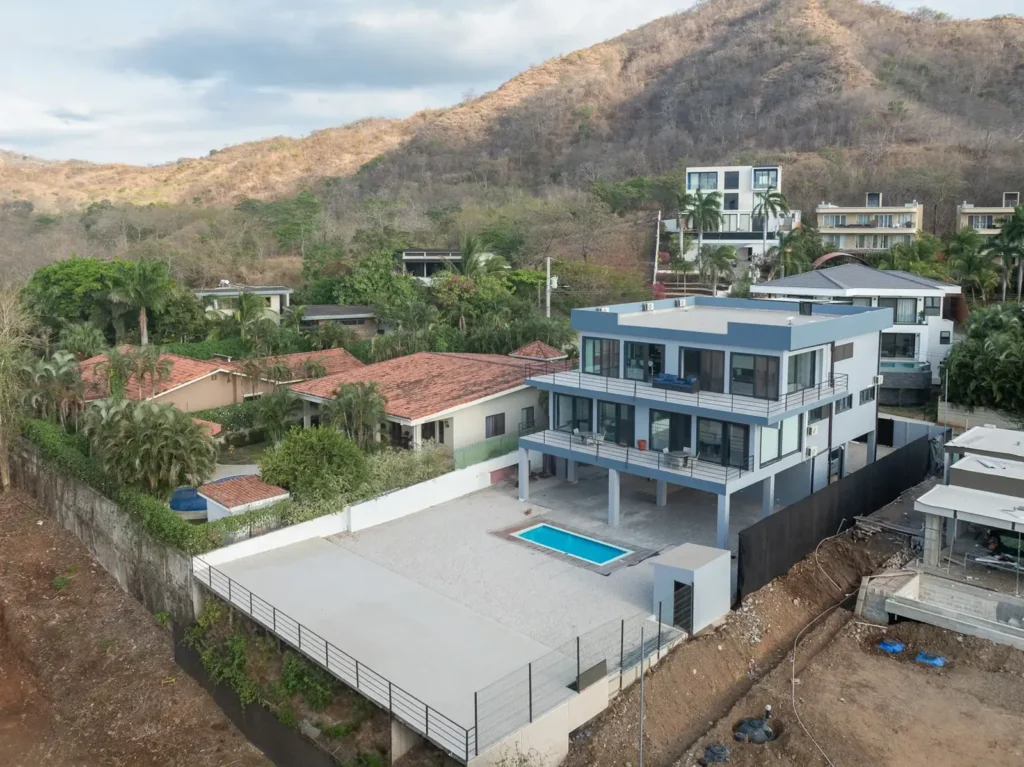
There is no single best roof for every house in Costa Rica; the best one for yours depends on how close you are to the sea, how much rain and wind the site gets, the look you want and the structure underneath. Coated metal is the lightest and usually the cheapest to install, clay tile is quieter and cooler but heavy and needs metal underneath, a concrete slab roof is the most solid and can carry a terrace or a green roof, and stone-coated steel sits between them. Whatever you choose, the details, flashings, gutters, fasteners and wind anchorage, decide whether it leaks.
This guide compares metal, clay tile, concrete slab, stone-coated steel, green and palm roofs for Costa Rica, then covers salt air, rain, the CFIA wind zones, earthquakes and weight, heat, what roofs cost and how to maintain them.
Roof types in Costa Rica compared
| Roof | Weight | Heat and rain noise | Salt air | Main watch points |
|---|---|---|---|---|
| Galvanized or coated metal sheet | Light | Hot and loud without insulation underneath | Coating choice and distance to the sea are critical | Rust at cuts, fasteners and laps; repainting |
| Stone-coated steel tile | Light | Quieter than plain sheet | Depends on the metallic coating and warranty terms | Fastening and flashing details |
| Clay tile | Heavy | Good insulation, quieter in rain | Clay itself does not rust; the metal underneath and the fixings can | Needs a stronger structure and metal underneath; tiles become brittle; hard to walk on |
| Concrete slab (losa) | Heaviest | Stores heat unless shaded or insulated | Durable if the concrete is specified for chlorides | Waterproofing membrane, slope to drains, cracks |
| Green roof on a concrete slab | Heaviest when saturated | Much cooler surface | Plants must suit salt wind | Root-resistant waterproofing, drainage, irrigation in the dry season |
Sources: Howler, "Roofing 101: Guanacaste style"; US EPA on green roofs; Decentra Homes. Plastic tile and asphalt shingles are also sold in Costa Rica; Howler reports that UV exposure limits plastic tile to about 10 to 15 years and makes shingles brittle, with a life of about 20, so we do not cover them further here.
Metal roofs: light, fast and common
Metal sheet comes in several grades in Costa Rica. Howler's guide to Guanacaste roofing describes plain galvanized sheet ("zinc") as the cheapest option, but warns that rust can limit its life to a decade or less unless it is painted every couple of years, and that it gets very hot and loud in rain, so it needs insulation underneath. Tile-profile metal sheet can last more than 20 years with maintenance, and pre-painted sheet can be ordered in exact lengths to avoid joints (Howler).
What decides how long a metal roof lasts is the metallic coating under the paint and how close the house is to salt water. Two common coatings are zinc (galvanized) and aluminium-zinc, often sold as Galvalume; the manufacturer DECRA, for example, describes its stone-coated steel as carbon steel coated on both sides with a 55% aluminium-zinc alloy (DECRA, June 2023). Thicker coatings last longer, and AZ55 carries a longer mill warranty than AZ50 in ArcelorMittal Dofasco's terms (45 versus 40 years).
Check the salt-air exclusion in the warranty
Metal roofing warranties are where salt air shows up in writing. ArcelorMittal Dofasco's Galvalume warranty excludes buildings within 1,500 feet, about 460 m, of a salt water environment. Englert's international roof warranty gives no warranty for prepainted or bare Galvalume within one mile of the seacoast or salt or brackish water, while prepainted aluminium keeps its cover there if the owner rinses and maintains it every year and keeps records. These are North American manufacturers, but local suppliers often carry similar conditions, so ask for the warranty for your exact site in writing before you choose a product.
On a beach lot, that usually points to aluminium or a coastal-rated coating, stainless steel fasteners, sealed cut edges and a yearly fresh-water rinse. Our comparison of concrete vs steel frame homes on the coast explains the ISO corrosion categories that also apply to roofs.
Clay tile roofs: quiet and cool, but heavy
Clay tile is the traditional Costa Rican roof and still the look many owners want. Howler notes that it insulates well and dampens rain noise, but that it is heavy and needs a larger, stronger structure, that a metal roof is still needed underneath because the tiles become brittle after about 10 to 15 years, and that tiles limit walking on the roof for maintenance (Howler). Tile also needs enough slope to shed tropical rain. In practice a tile roof in Costa Rica is a metal or membrane roof with tile on top, which is why it costs more than its material price suggests.
Published lifespans for the same material vary widely between Costa Rica roofing guides, for clay tile as much as for metal, because they depend on the product, the coating, the installation and the maintenance. Ask the supplier for the tested life and the written warranty of the exact product before you compare prices.
Concrete slab roofs and roof terraces
A reinforced concrete slab roof suits the way we build: we build in concrete first, and also hybrid and steel frame. A slab roof does not rust, does not rattle in rain and can double as a roof terrace, a base for solar panels or a green roof. Its weak points are water and heat:
- Waterproofing. A flat slab needs a fall to its drains, a durable membrane and careful detailing at walls, drains and railings. Most slab leaks start at those edges, not in the middle.
- Heat. Concrete stores heat, so an exposed slab over a bedroom needs insulation, a light-coloured or planted surface, or a shading roof above it.
- Weight. A slab is far heavier than a metal roof, which the structural engineer accounts for in the columns, foundations and seismic design.
- Salt air. Near the sea, the concrete mix and the cover over the rebar should be specified for chlorides, like every other exposed concrete element.
Green roofs in Costa Rica
A green roof is a planted layer over a waterproofed slab. The US EPA reports that green roof surfaces can be up to 56°F (about 31°C) cooler than conventional roofs, and that a simple extensive green roof can cost as little as one-tenth to one-third of an intensive roof garden built for people to use (US EPA, green roofs). The US General Services Administration's 2011 study estimated an average life expectancy of 40 years for a green roof against 17 years for a conventional roof, because the planting protects the membrane, and measured rainwater retention of 38% to 54% on Philadelphia roofs with 3 inches of growing medium (GSA, May 2011).
Those are US figures. In Costa Rica, two local conditions matter most: a long dry season on the Pacific side, so plants need to survive months without rain or the roof needs irrigation, and very heavy rain in the wet season, so drainage must never block. The structure has to carry the saturated weight of soil and water, which is a calculation for your engineer, and the membrane must be root-resistant. Choose native or adapted plants that tolerate sun, wind and, on the coast, salt.
Palm and thatch roofs
Palm thatch, natural or synthetic, is common on ranchos, pool bars and other outdoor structures in Costa Rica. Builders commonly install it over a waterproof metal roof rather than relying on the thatch to keep water out, and natural palm needs periodic replacement and is a fire risk. On a house, treat thatch as a finish over a real roof: if you want the look, ask for the waterproof layer underneath, the fire treatment and the replacement cycle in writing.
Rain: slope, gutters and flashings
Average annual rainfall in Costa Rica runs from about 1,800 mm in one Guanacaste subregion to more than 4,800 mm in parts of the southern Pacific and the Caribbean, according to the IMN's climate regionalization; our guide to building in the rainy season has the figures by region. A roof here has to move a lot of water quickly. The points that matter:
- Flashings first. A home inspector writing in the Tico Times reported roofing and flashing defects that let water in on 95% of the homes he had inspected, and said many roof edges lack flashing above the gutters, which is where most leaks start (Tico Times, November 2021).
- Enough slope. Every roofing product has a minimum pitch in its installation guide; follow it, and add margin for wind-driven rain.
- Oversized gutters and downspouts that discharge away from the foundation and, where planned, into rainwater storage.
- Overhangs deep enough to keep rain off walls and window frames.
- Fewer penetrations. Every skylight, vent and valley is a potential leak.
Wind: what the CFIA wind zones mean for your roof
Wind lifts roofs, especially overhangs and edges. The CFIA's Lineamientos para el diseño por viento de edificaciones en Costa Rica, published in Alcance 48 to La Gaceta 52 on March 21, 2023, divide the country into wind zones I to V by district. Some examples from its Table 3-1:
| Area | Wind zone |
|---|---|
| Santa Cruz canton (Tamarindo, Playa Flamingo area) and Carrillo canton (Playas del Coco area) | IV, all districts |
| Nicoya canton: Nosara district / Sámara district | IV / III |
| Tilarán canton (Lake Arenal area) | V, all districts |
| Garabito canton (Jacó) | IV, all districts |
| Quepos canton (Manuel Antonio) | III, all districts |
| Osa canton: Bahía Ballena district (Uvita) / most other districts | III / II |
| Limón and Talamanca cantons (Puerto Viejo) | I, all districts |
Source: CFIA wind guidelines, Table 3-1. Zone numbers are not wind speeds; the engineer takes the design wind speed for each zone from the guidelines, and where site-specific climate data is used instead, the basic wind speed cannot be taken below 90 km/h (section 3.1).
Three rules from the guidelines matter for roofs. Roof cladding and components must be designed for a net pressure of at least 80 kg/m² in any direction (section 4.4.3.1). The pressure under a windward overhang is added to the pressure on top (section 4.4.1.4). And the simplified design annex for single-family homes does not apply to houses with overhangs longer than 1.0 m, roof slopes over 20%, or sites in open country, on the seafront or near deep gorges (Annex C.1). Most custom coastal homes are therefore designed with full wind calculations, including how the roof is fixed to the structure.
Earthquakes and roof weight
A heavier roof adds mass at the top of the building, and mass is what an earthquake pushes on. That does not rule out tile or a concrete slab; it means the structure is designed for them from the start under the Código Sísmico de Costa Rica. Changing from metal to tile or adding a green roof after the plans are done is a structural change, not a finish change. Our guide to earthquake-resistant homes in Costa Rica explains the seismic zones and code.
Heat: colour, insulation and ventilation
In the tropics the roof is the surface most exposed to the sun. The US EPA cites research finding that reflective cool roofs can lower maximum indoor temperatures in homes without air conditioning by 1.2 to 3.3°C, and cut peak cooling demand in air-conditioned homes by 11% to 27% (US EPA, cool roofs). Whatever the material, a light colour, insulation under metal or slab, and a ventilated space between roof and ceiling make the biggest difference to comfort. Our guide to tropical house design in Costa Rica covers overhang depths, ventilation and fans. For the wider picture on passive cooling, solar and certifications, see our sustainable home building guide.
How much does a roof cost in Costa Rica?
We do not have an independent, current price list per square metre for each roof type in Costa Rica that we can cite, so we do not publish one. What the sources above do support:
- Relative cost. Plain galvanized sheet is the cheapest material; clay tile costs more than its tiles alone because it needs a stronger structure and metal underneath; a concrete slab adds structure, waterproofing and insulation (Howler).
- Life-cycle cost. A roof that needs repainting every few years, or replacing after 10 to 15, can cost more over time than a higher-priced roof that lasts.
- Green roofs. The GSA put green roof maintenance at about $0.14 per square foot per year in its US analysis (GSA, May 2011).
In a custom home, the roof is part of the construction cost per square metre. Decentra's 2026 costs before land are about $700 per m² for a basic finish, about $1,000 mid-range, $1,000 to $1,200 upper mid-range, $1,500 to $1,800 luxury and $1,800+ ultra luxury, plus a 10 to 15% contingency. See our guide to the cost to build a house in Costa Rica, and ask for each roof option to be priced on your own design.
Roof maintenance before the rainy season
The Tico Times inspector's pre-rain checklist is simple and worth following every year (Tico Times, November 2021):
- inspect and clean the roof, flashings, joints and sealants, and repaint and recaulk where needed;
- clear gutters, downspouts, pipes and drains;
- cut back branches and vines over the roof;
- clear vegetation touching the walls.
On the coast, add a fresh-water rinse of metal roofs and fittings, and keep records if your warranty asks for them.
How Decentra Homes helps
The roof is one of the first things we settle in a design, because it shapes the structure, the drainage and the comfort of the house. Decentra Homes is a design-build custom home builder in Costa Rica, founded in 2020, with 50+ residential and commercial projects. Design and construction are CFIA certified under SANYC Ingeniería (CFIA registration CC-10880), and our CFIA-licensed architect, Sergio Cerceño, designs the roof together with the structure, wind loads and drainage. Our construction systems page explains how we build in concrete, hybrid and steel. Minimum construction budget $350,000 USD, before land. Message us on WhatsApp at +506 8733-2930 or through our contact page.