

Hidden costs of building a house in Costa Rica
The costs a per m² price leaves out in Costa Rica: 13% VAT, import duties, the 1% permit fee, CFIA stamps, INS insurance, studies, utilities, site work, closing costs and the luxury tax.
The hidden costs of building a house in Costa Rica are the items a per m² construction price leaves out: 13% VAT on construction services if a quote is given before tax, import duties and VAT on imported finishes and appliances, the 1% municipal permit fee, the INS workers' risk policy, design fees, studies, utility connections, site work on sloped lots, furniture, landscaping, insurance and the annual luxury home tax. On the land side, closing costs add about 3.5% to 5% of the purchase price (RE/MAX Costa Rica, February 2026).
This guide lists each of those costs, how big it usually is, who sets it and when it falls due, then puts them together in a worked example. It is general information, not tax or legal advice: confirm VAT, duties and closing costs with a Costa Rican accountant, customs broker or attorney. For construction prices themselves, see our guide to the cost to build a house in Costa Rica.
Hidden costs checklist
| Cost | Typical size | Set by |
|---|---|---|
| VAT on construction services | 13% for CFIA-registered projects since September 1, 2023 | Law 9635 |
| Import duties on imported goods | 1% to 15%; most US-made goods duty free under CAFTA-DR | Customs tariff and trade agreements |
| Selective consumption tax | 30% to 40% on some appliances, such as refrigerators | Selective consumption tax law |
| Design and plans | About 5.5% to 6% of construction value | CFIA fee schedule |
| CFIA construction stamp | Added to professional fees; ask for the amount | CFIA |
| Municipal permit fee | 1% of construction value | The municipality |
| INS workers' risk policy | About 1.17% of assessed construction value (one guide) | The insurer |
| Topographic survey and soil study | Quoted per lot | Surveyor and geotechnical engineer |
| Water and electricity connections | Depends on distance to the networks | AyA or the local ASADA; the electricity provider serving the site |
| Site work on slopes | Priced per lot | The design and the lot |
| Contingency | 10% to 15% | Your budget |
| Land closing costs | About 3.5% to 5% of the price | Law and attorney fees |
| Luxury home tax | 0.25% to 0.55% a year above the 2026 threshold | Ministerio de Hacienda |
Sources for each line are in the sections below.
Taxes that catch new builders
13% VAT on construction services
Costa Rica's 2018 public finance law, Law 9635, phased VAT in for engineering, architecture, surveying and civil construction services on projects registered or endorsed by the CFIA. The rate was 0% until August 31, 2021, 4% from September 2021, 8% from September 2022 and the general 13% rate from September 1, 2023 (La República, September 2021; El Observador, August 2023). The Cámara Costarricense de la Construcción said at the time that the increase would pass through to the final cost of homes (El Observador, August 2023).
The hidden part is how a quote is written. If a contract price is given before VAT, the difference is large: 13% of $368,000 is $47,840. Ask every builder and professional to state in writing whether VAT is included, and ask your accountant how it applies to each part of your contract.
Import duties and VAT on imported finishes and appliances
Many owners want a particular brand of windows, tile, kitchen or appliance from home. According to the US International Trade Administration, Costa Rica's customs duties range from 1% to 15% ad valorem, and a 13% VAT applies to most goods, including imports (ITA, June 2026). Under CAFTA-DR, 100% of US-originating consumer and industrial goods have entered duty free since January 1, 2015.
Two details matter. First, the duty depends on where a product was made, not where you bought it, so an appliance bought in Miami but made elsewhere may not qualify. Second, Costa Rica also charges a selective consumption tax on some goods; the ITA lists 30% to 40% on some domestic appliances, such as refrigerators. Add freight, insurance and a customs broker's fee, and check with the broker before you order.
The luxury home tax
Once a home is finished, the national luxury home tax (impuesto solidario) may apply every year. For 2026, homes whose construction value is at or below ¢143,000,000 are exempt; above it, progressive rates run from 0.25% to 0.55%, with payment due by January 15 (EY, December 2025). Our luxury home tax guide explains how the value is calculated.
Permit, professional and registration fees
- Design and plans. About 5.5% to 6% of construction value under the CFIA fee schedule. Because the fee is a percentage, it rises if the construction value rises.
- The CFIA construction stamp. The CFIA's consulting services regulation says professionals must add the construction stamp (timbre de construcción) to their fees and pay it in full to the Colegio, and it lists stamps, fees and taxes for permit procedures as reimbursable expenses (CFIA, 2019). The regulation does not state the amount, so ask your architect for it. Howler also notes payment for the construction stamps linked to the APC platform and the legal logbook.
- Municipal permit fee. The construction tax is 1% of the value of the work (Q Costa Rica, 2020). Howler notes it is the last payment before the permit number is issued, worked out on the value the CFIA's APC platform assigns.
- INS workers' risk policy. Workers' risk insurance is mandatory for every employer under the Labor Code (El Financiero, January 2026), and municipalities ask for the policy before the permit fee is paid; Escazú, for example, requires it to be shown before the construction tax is paid (Municipality of Escazú). One guide puts it at about 1.17% of the assessed construction value (Howler). INS was the only provider until 2024; MNK, formerly Oceánica, now offers it too (El Financiero, January 2026).
The full sequence of documents and fees is in our building permit checklist.
Site costs a per m² price leaves out
Topographic survey and soil study
Both should come before you buy, or at least before design. The topographic survey maps levels and boundaries; the soil study tells the engineer what the foundations must carry. Each is quoted per lot and paid separately.
Water and electricity connections
The permit file needs a water availability letter from AyA, or from the ASADA that runs a rural aqueduct, and an electricity availability letter from the electric company serving the site (Howler). Ask early which providers serve your lot. The cost depends on how far the lot is from existing lines and pipes. A lot several hundred meters from the nearest pole or main can need a line extension, so get written quotes during due diligence.
Frontage, drainage and earthworks
Municipal rules add items that rarely appear in a builder's per m² price. In Escazú, building or repairing the sidewalk, curb and gutter along the street frontage is the owner's obligation. A stormwater drainage permit is needed once impermeable area reaches 400 m² or earthworks reach 200 m³, Projects over 500 m² or with earthworks over 200 m³ must submit a terracing plan with cut and fill tables, and if material leaves the site, a haul route to an authorized landfill outside the canton (Municipality of Escazú). Rules vary by canton, so check yours.
Road access and retaining walls on sloped lots
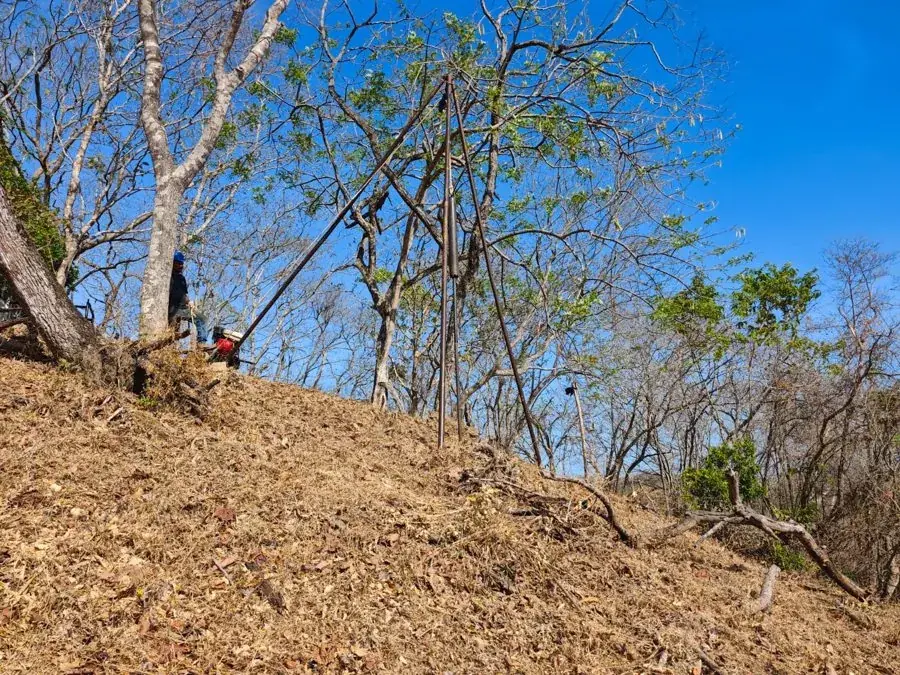
On a hillside, retaining walls, drainage and the access road can be a significant share of the budget. They are priced per lot after the survey and soil study. Our guide to building on a slope in Costa Rica covers the options.
Costs after the structure is finished
- Furniture, appliances and window coverings. Imported pieces carry the duties and taxes above.
- Landscaping. Planting, irrigation, outdoor lighting, fencing and a gate are usually outside the house contract.
- Pool extras. Decentra's pool figure of about $2,500 per m² of pool is all in for excavation and grade work, the shell, the finish and filtration; LED lighting and other custom features add to it.
- Home insurance. INS's Seguro Hogar Comprensivo covers buildings against fire, lightning, wind, flooding, landslides and rain, with a separate coverage for earthquakes and volcanic events. As an example, INS quoted about ¢11,726 a month for a home valued at ¢50 million with ¢5 million of contents (La República, February 2024). Premiums depend on the insured amount.
Also see: Cost per square foot to build a house in Costa Rica (2026) and What can you build in Costa Rica for $300K, $500K or $1M?
Closing costs on the land
If you are buying the lot, budget about 3.5% to 5% of the purchase price for closing. RE/MAX Costa Rica breaks that down as a 1.5% transfer tax on the registered value, legal fees of 1% to 1.25% and notary and registration fees of 0.5% to 1% (RE/MAX Costa Rica, February 2026). A Costa Rican attorney writing in the Tico Times adds that 13% VAT applies to legal fees and the real estate agent's commission, and that several stamp taxes (timbres) are part of the total (Tico Times, March 2022). On a $200,000 lot, 3.5% to 5% is $7,000 to $10,000.
Contingency: the cost you plan for
A contingency of 10% to 15% of construction covers what nobody can see before the work starts: rock in an excavation, a design detail that needs more steel, a price change on a material. It is not meant for upgrades you choose along the way. Use the top of the range on a steep, remote or rocky lot.
Worked example: what hidden costs add to a $368,000 build
A hypothetical 320 m² home at $1,150 per m² (upper mid-range) on a $200,000 lot:
| Item | Amount |
|---|---|
| Construction (320 m² × $1,150) | $368,000 |
| Design and plans (5.5% to 6%) | $20,240 to $22,080 |
| Municipal permit fee (1%) | about $3,680 |
| INS workers' risk (about 1.17%) | about $4,306 |
| Contingency (10% to 15%) | $36,800 to $55,200 |
| Land closing costs (3.5% to 5% of $200,000) | $7,000 to $10,000 |
| Total of the items above, excluding the land price | about $440,026 to $463,266 |
Still to price for this lot: the survey and soil study, water and electricity connections, any site work, furniture, landscaping and insurance, plus VAT if any quote was given before tax. The permit fee and INS policy are worked out on the assessed value, so the real figures can differ slightly.
How to keep hidden costs from surprising you
- Do the survey, soil study and utility quotes before you close on the land.
- Ask for an inclusions and exclusions list with every construction quote.
- Get VAT treatment in writing from your builder and confirm it with your accountant.
- Price imported items with a customs broker before you order them.
- Set the contingency at the start and track it separately from upgrades.
How Decentra helps you budget for hidden costs
The items in this guide are easiest to control when they are priced at the start, alongside the house. Decentra Homes is an award-winning custom home builder in Costa Rica, founded in 2020, with 50+ residential and commercial projects. We are CFIA certified for design and construction under SANYC Ingeniería (CFIA registration CC-10880), and our CFIA-licensed architect is Sergio Cerceño.
We work mainly in concrete, and also build hybrid and steel frame homes, typically in 5 to 8 months on site once the permit is issued. Minimum construction budget $350,000 USD, before land, applies to new builds. To review a budget or a lot before you commit, book construction consulting at $200 per hour with a CFIA-licensed engineer and architect with 15 years of experience. Financing is available through a third-party lending partner for qualified clients. Reach us on WhatsApp, +506 8733-2930, or via the contact form.