

Solar panels for a home in Costa Rica: rules, grid connection and batteries
Under Law 10086 you can connect home solar panels to the grid in Costa Rica by applying to your distributor, with a CFIA engineer's sworn declaration, or run a no-export or off-grid system with batteries.
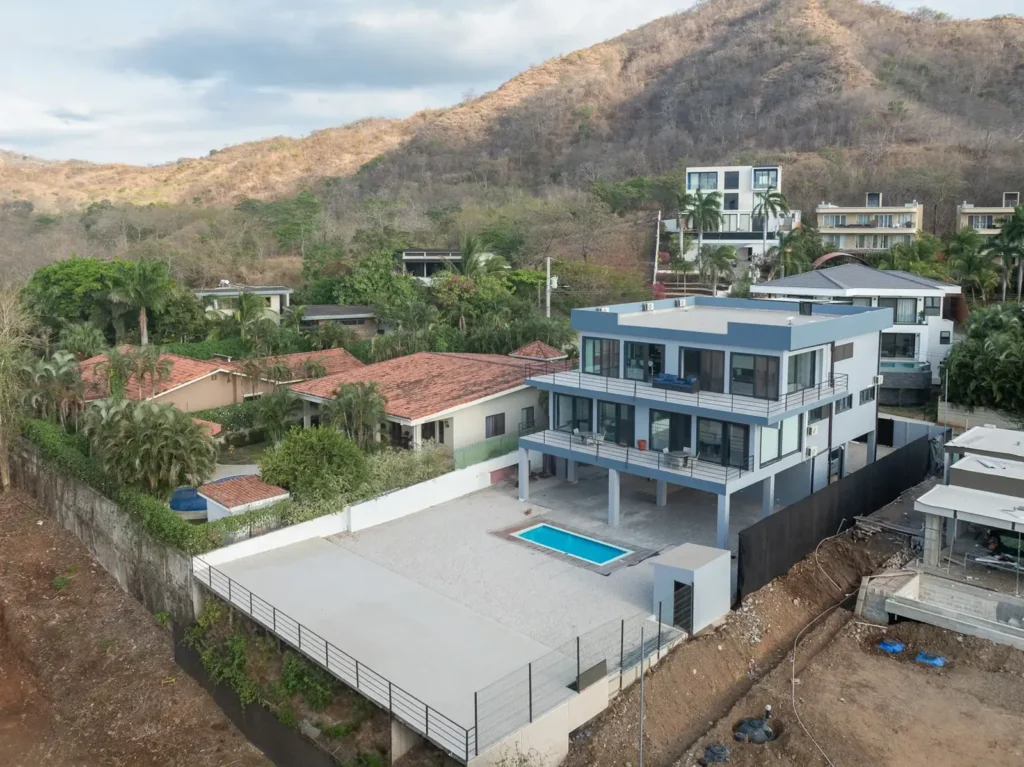
Yes, you can put solar panels on a home in Costa Rica and connect them to the grid. Since Law 10086 (in force January 2022) and its regulation, Decree 43879-MINAE (February 2023), you apply to your electricity distributor (ICE, CNFL or a cooperative such as Coopeguanacaste), a CFIA-registered engineer signs a technical sworn declaration, and the distributor inspects, connects and meters the system. You can also choose a system that never exports power, or go fully off-grid with batteries.
This guide covers what the law allows, how surplus energy and the grid access charge work today, the interconnection steps, battery options, what to plan for in a new build and how much output drops in the rainy season. We only quote figures from published sources; for prices and savings, ask your distributor and installer for current numbers. It is general information, not legal advice: confirm the rules that apply to you with your distributor or ARESEP.
What Law 10086 says about solar panels on homes
Law 10086, "Promoción y Regulación de Recursos Energéticos Distribuidos a partir de Fuentes Renovables", was signed on December 8, 2021 and published in Alcance 3 to La Gaceta on January 7, 2022 (Law 10086, Coopeguanacaste copy). Its regulation is Executive Decree 43879-MINAE, published on February 1, 2023, which repealed the old 2015 net metering decree, 39220-MINAE (ICE notice in La Gaceta 127, July 2023).
The law treats a home solar system as "generación distribuida para autoconsumo": renewable power produced mainly to supply your own demand at the same site. It defines three ways to run it (Law 10086, Article 2):
| Modality | What it means | Typical use |
|---|---|---|
| With surplus delivered to the grid | Connected to the grid; energy you do not use is exported and the distributor may compensate you for it | Most grid-tied homes |
| Without surplus delivered to the grid | Connected to the grid, but equipment prevents export while it runs in parallel | Homes that want lower bills without a surplus contract, often with batteries |
| Island (off-grid) | No connection to the national grid at all | Remote lots without a grid line |
Batteries and electric vehicles with their interconnection systems are also counted as distributed energy resources (Article 2). ARESEP, the regulator, sets the tariffs and the technical requirements for each modality (Article 6), and penalties for breaking the rules run from five to twenty base salaries (Article 14).
Who connects your system: ICE or a cooperative?
You do not choose your utility. The company that sends your electricity bill is your distributor, and you deal with it for the whole process. Costa Rica has eight distributors: ICE, CNFL, ESPH, JASEC and four cooperatives, Coopelesca, Coopeguanacaste, Coopesantos and Coopealfaroruiz (El Observador, November 2024). In Guanacaste, for example, your distributor may be ICE or Coopeguanacaste depending on the area, so check a recent bill or ask the seller before you buy a lot.
Each distributor must keep the "penetration capacity" of its circuits up to date and publish circuit data (Law 10086, Article 7). A circuit that is already full of solar can limit what you are allowed to connect, so ask early.
How net metering works in Costa Rica now
The old 2015 rules were classic net metering: unused energy was "banked" in the grid every month and used during an annual cycle, but you could only take back up to 49% of what you generated (Decree 39220-MINAE, Articles 34 and 37). Contracts signed under that decree keep their own transition rules (Law 10086, Transitorios V and VI).
Under Law 10086 the logic changed from banking kilowatt hours to economic compensation:
- Surplus is valued in money. The distributor "may" compensate exported energy at the hourly and seasonal tariff at the moment it is injected, and the credit appears on your bill (Law 10086, Article 2). The law requires that economic equivalence to be respected (Article 12).
- Buying your surplus is not mandatory. A distributor may buy surplus from generators in its area when it benefits the company and its customers (Article 12).
- Purchase prices are rising for new contracts. In September 2025 ICE announced an average increase of 111% in the prices it pays new distributed generators, with eight-year contracts extendable by two one-year periods, and a higher "firm" price for solar with batteries that meets technical requirements (Delfino, September 2025).
- Simple netting still exists in some contracts. ARESEP's 2024 tariff resolution says taking back previously injected energy applies only to services with a simple netting mechanism (ARESEP RE-0126-JD-2024).
Because each distributor sets its own contract terms within ARESEP's rules, ask yours for the current compensation method and price in writing before you size the system.
The access tariff, or "sun tax"
If you stay connected to the grid you pay an access tariff for using it as backup. Its history explains why many owners are cautious:
- Before 2021 the charge was based on the surplus you exported (El Observador, November 2024).
- It was then based on total consumption ("consumo natural"), and an opinion column in Delfino put the resulting bill increases at about 30% to 400% for some generators (Delfino, March 2024).
- ARESEP changed the method in resolution RE-0126-JD-2024 of September 25, 2024. The charge is now based on self-supplied energy, defined as your natural consumption minus the energy you buy from the distributor, and it applies to customers on single-component (monomial) rates (ARESEP RE-0126-JD-2024).
- The new formula applied from November 1, 2024, and at least seven of the eight distributors said they would charge the maximum ARESEP allows (El Observador, November 2024). Before the change, the Tico Times reported access charges of ¢16 to ¢30 per kWh depending on the distributor (September 2024).
The practical point: the access tariff is part of the payback math. Ask your distributor what it charges today and have your installer include it.
Permits and interconnection steps for home solar
The core steps, from Law 10086 and ICE's procedure, are:
- Apply to the distributor before you install. ICE's process uses an application for interconnection (form GD01) and an application for a technical study (GD02) (ICE, La Gaceta 127, July 2023). Article 13 of Law 10086 sets a simpler notify-first route, aimed at customers in vulnerable conditions, for residential systems of 2 kW or less and registered small businesses under 15 kW; most custom homes need a larger system.
- Design the system with a CFIA engineer. Law 10086 requires a sworn declaration of technical compliance and equipment quality, signed by a CFIA-registered engineer authorised to sign electrical plans, for systems without surplus delivered to the grid (Article 8), and ICE's procedure includes a sworn declaration for interconnection (ICE, July 2023).
- Install and request inspection. ICE uses an inspection request (GD03) and a sworn declaration for interconnection (ICE, July 2023). The distributor may verify the installation.
- Pay for interconnection and metering. Law 10086 puts the interconnection and metering costs on the generator for the simplified route (Article 13); ask your distributor what it charges in your case.
- Escalate if needed. The distributor must resolve complaints within 10 business days; if it does not, or says no, you can go to ARESEP. You have two months to file a complaint (Article 15).
Under Article 10 of Law 10086, a system under 500 kVA, far above a normal house, needs no municipal permit or SETENA environmental viability for the solar installation itself. Other distributors follow the same law but use their own forms, so Coopeguanacaste or CNFL paperwork will look different from ICE's.
A point for new builds: no billing history
Under the old rules CNFL required a permanent service contract with at least six months of billing and limited generation to 100% of past consumption (CNFL procedure, La Gaceta, August 2019). Those rules came from the repealed decree, but ask your distributor how it sizes a system for a house that has no consumption history yet. It may affect whether you connect on day one or after you have lived in the house for a while.
Also see: Sustainable home building in Costa Rica: what makes a tropical build green (2026) and Tropical house design in Costa Rica: orientation, overhangs and cooling without AC
Battery options for a home in Costa Rica
Batteries are not required for a grid-tied system, but there are three good reasons owners add them:
- Outages. In May 2024 ICE announced electricity rationing for the first time in 17 years, starting May 13, after low rainfall cut hydro output; hydro supplied about 74% of the country's electricity at the time (El Observador, May 2024).
- Export rules. If your distributor pays little for surplus, a battery lets you use more of your own production, and the "without surplus" modality is designed for that.
- Better purchase prices. ICE's 2025 scheme pays its highest "firm" prices to solar with batteries that meets its technical requirements (Delfino, September 2025).
Off-grid (island) homes rely on batteries completely and do not deal with the distributor at all. Wherever a battery is connected to the grid, ARESEP's technical requirements for that modality apply (Law 10086, Article 6), so choose equipment your installer can certify.
Planning solar into a new build
A new house is the cheapest moment to get solar right. These are the items to settle during design, which our architectural design service can cover:
- Roof orientation and shape. Plan a clear roof plane facing the sun's path for most of the year, without hips, skylights or vents breaking it up.
- Shade. Trees, hillsides and taller neighbouring buildings cut output. On jungle and hillside lots, the site survey should show what will shade the roof.
- Structure. The roof is designed for the panel load and fixings from the start. Our construction systems page explains how we build in concrete, hybrid and steel.
- Space and conduit. Reserve a ventilated, accessible place for the inverter and any battery, and run conduit before walls are closed.
- Sizing. Size from a realistic load estimate: air conditioning, pool pumps and electric vehicle charging change the answer a lot. Check sizing against your distributor's current rules.
- Coastal exposure. Near the ocean, ask for equipment and fixings rated for salt air.
The house itself still goes through the normal construction permit process, which we handle through our permits and water letters service.
How much do solar panels produce in the rainy season?
Less than in the dry season, but not as little as many buyers expect. The Instituto Meteorológico Nacional's study of global solar radiation in Costa Rica gives these station averages (IMN, Castro, 1987):
| Region | Annual daily average at stations | Seasonal pattern |
|---|---|---|
| Guanacaste and North Pacific | 18 to 19 MJ/m² at Nicoya, Liberia and Santa Rosa (about 5 kWh/m²) | At Santa Rosa, 18 to 23 MJ/m² from December to April, falling to 16 in June and October |
| Central and South Pacific | 16 MJ/m² at Palmar Sur, 18 at Puriscal | Peak months vary by station; Palmar Sur peaks in February |
| Caribbean | 15 MJ/m² at Limón and Bribrí | Limón lowest in December, at 12 MJ/m² |
On the Pacific side the rainy season starts between March and May and radiation drops when the rains arrive (IMN). In the North Pacific example, the June figure is about 30% lower than the March and April peak. The study is old and gives an uncertainty of 1 to 1.5 MJ/m² for the data behind its maps, so treat it as a guide and ask your installer for a production estimate for your exact site.
Solar checklist before you build
- Which distributor serves the lot, and what circuit capacity is left?
- Which modality: export surplus, no export, or off-grid?
- What will the distributor pay for surplus, and what access tariff applies?
- Will a CFIA engineer sign the design and sworn declaration?
- Is the roof designed for panels, with no shade and room for the inverter and battery?
- How will the system be sized without billing history?
How Decentra Homes helps
Decentra Homes is a design-build custom home builder in Costa Rica, founded in 2020, with 50+ residential and commercial projects and a showroom in Altos de Flamingo, Guanacaste, open by appointment. Our CFIA-licensed architect, Sergio Cerceño, can plan the roof, structure and service spaces for solar from the first sketches. See our custom home construction service, and our cost to build a house in Costa Rica guide for 2026 costs per square metre. Minimum construction budget $350,000 USD, before land. Message us on WhatsApp at +506 8733-2930 or through our contact page.