

Condominium development in Costa Rica: horizontal condos, permits and build costs
A developer's guide to condominiums under Law 7933: horizontal, vertical and lot condos, INVU, Salud, SETENA and water approvals, infrastructure, phasing, the reglamento and costs.
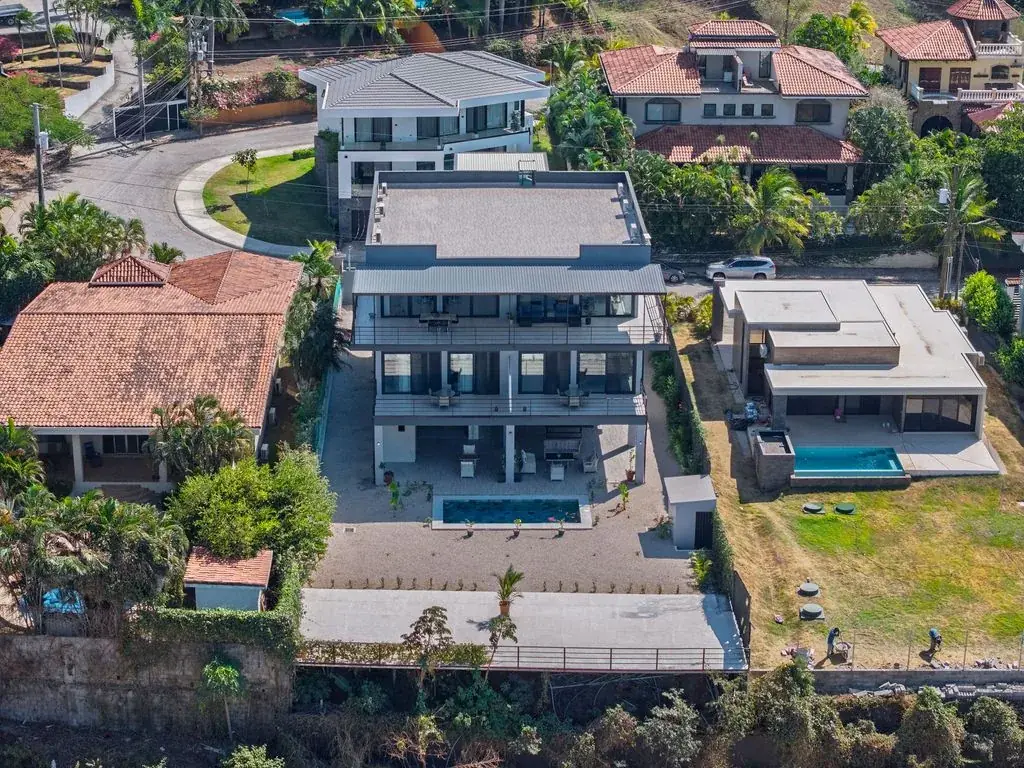
To develop a condominium in Costa Rica you register a condominium regime under Law 7933, the Ley Reguladora de la Propiedad en Condominio, after the anteproyecto is approved by INVU, the Ministerio de Salud and the municipality (Law 7933, article 3). Along the way you need CFIA-registered plans, a water availability letter from AyA, an ASADA or a MINAE concession, an approved wastewater system and, for larger projects, SETENA environmental viability. The developer builds the private roads, water and wastewater systems, writes the first reglamento and sets up the owners' association before handing it over.
This guide is general information for developers, not legal advice. Confirm the structure of your project with a Costa Rican lawyer and notary, and confirm technical requirements with each institution.
It covers the types of condominium the law allows, the approvals in order, the infrastructure a developer builds, phasing, the reglamento, the owners' association and a realistic timeline. If you are buying a lot inside an existing community, our guide to building inside a gated community covers the buyer's side.
What types of condominium does Costa Rican law allow?
Law 7933 lets a developer place several kinds of property under the condominium regime: floors, units and parking in a building, several buildings on one property, land suitable for construction, and projects developed in stages (Law 7933, article 1). Each private unit becomes a finca filial, a separately titled property, and the original property becomes the finca matriz that holds the common areas (Registro Nacional).
The Registro Nacional's guidance on condominium survey plans uses these working categories:
| Type | What each owner holds | Typical small project |
|---|---|---|
| Horizontal condominium | A lot or a house as a private filial, plus a share of the common areas | A gated community of houses or lots |
| Vertical condominium | A unit in a multi-storey building; the land and common facilities are shared | An apartment or townhouse building |
| Mixed condominium | One finca matriz that contains both horizontal and vertical parts | Houses plus a small apartment block |
| Combined condominium | Different compatible uses and building types, within local zoning | Homes with a few commercial units |
| Condominium of condominiums | A filial that is itself divided into smaller filiales | A phase that becomes its own subcondominium |
Source: Registro Nacional, Planos de agrimensura de fincas en régimen de condominio.
Condominio de fincas filiales: selling lots that buyers build on
Many small developers sell building lots rather than finished homes. In a horizontal lot condominium each lot is registered as a finca filial primaria individualizada (FFPI), and the buyer later builds a house on it (Registro Nacional). The developer delivers the infrastructure and common areas; the buyers deliver the houses, under the design rules in the reglamento. The infrastructure still has to be complete and approved, and the reglamento has to control what gets built.
Which approvals does a condominium development need?
Law 7933 requires an anteproyecto approved by INVU, the Ministerio de Salud and the municipality before the finca matriz and the filiales are described in the deed (article 3), and the notary must have seen the approved plans (article 2). Condominiums approved since 2014 have gone through APC, the online construction plans platform, and when the plans are in APC each filial's survey plan must cite the APC project number (Registro Nacional).
| Approval | Who issues it | What it covers |
|---|---|---|
| Land use certificate (certificado de uso de suelo) | Municipality | Whether the planned use fits the zone |
| Water availability | AyA or the local provider; an ASADA registered with AyA; or a MINAE water concession for wells | Whether the project can get water for every unit |
| Environmental viability | SETENA | Projects over 1,000 m² of construction file a D1; 500 to 1,000 m² in a fragile area file a D1-C |
| Site design and building plans | CFIA (APC platform) with INVU, the Ministerio de Salud and the municipality | Layout, roads, common areas, units and engineering |
| Fire safety plan review | Bomberos | Prevention and fire protection under its technical manual and NFPA standards |
| Wastewater treatment system | Ministerio de Salud | Location permit, plan approval and later an operating permit |
| Municipal building permit | Municipality | Permission to start works |
| Registration of the regime | Registro Inmobiliario, through a notary | The escritura constitutiva, the reglamento and the filiales |
Sources: Law 7933, articles 2, 3 and 5; Municipalidad de Sarapiquí (land use certificate procedure); SETENA FAQ; CFIA water availability requirements; Decree 34768-MP (Bomberos), articles 66 and 85; Decree 39887-S-MINAE.
Water availability: AyA, ASADA or your own well
Water often decides how many units a site can hold. The CFIA requirements table accepts three routes: a certification of water service availability from AyA or the local provider; a letter from an ASADA that is registered with AyA; or a MINAE concession for a well or spring with potability tests. For urbanizations, condominiums and subdivisions served by an ASADA, it also asks for a technical opinion from AyA's rural aqueducts directorate (CFIA, citing oficio DAR 1679-2007). Our guide to the water letter in Costa Rica explains the letter itself.
SETENA for a condominium
SETENA's own FAQ sets the basic thresholds: works under 500 m² of construction are category C and do not go through environmental impact assessment; works of 500 to 1,000 m² in an environmentally fragile area file a D1-C; works over 1,000 m² file a D1, and the impact score decides whether a sworn commitment, a management plan or a full study follows. If SETENA's conditions are met, it must issue its resolution within 14 natural days for a D1 with a sworn commitment, 21 with a management plan or 28 with a full study, and a viability is valid for up to five years before work starts (SETENA FAQ, citing Decree 43898). Ask your environmental consultant how the area of a multi-unit project is counted.
What infrastructure does the developer build?
In a condominium the access roads and internal circulation can be common property of the owners (Law 7933, article 10), which means the developer builds them, and the owners' association maintains them. A small development usually carries five infrastructure packages.
- Roads and drainage. Internal roads, culverts, retention and outfalls, designed so fire trucks can reach every unit and so runoff does not land on neighbours. Hillside sites need the most engineering here.
- Water system. The connection to AyA or the ASADA, or a well under concession, plus storage tanks, pumps and the distribution network to each filial.
- Wastewater. Individual septic systems where the soil and lot size allow it, or a shared treatment plant. Shared systems need Ministerio de Salud approval, described below.
- Power and telecom. Conduit, transformers and meters coordinated with the electricity provider, and conduit for fibre.
- Common areas. The gate, perimeter, landscaping and any pool or clubhouse the project promises. Our development and infrastructure construction service covers this scope.
Treatment plants for condominiums
Decree 39887-S-MINAE, the regulation for approving wastewater treatment systems, sets the path. Anyone who will build or operate a treatment system needs its construction plans approved by the Ministerio de Salud (article 16). Before the plans are reviewed, the developer requests a location permit, which the ministry must resolve within 22 calendar days and which is valid for two years (articles 12 and 13). The plan file includes a certified cadastral plan, the drawings, design calculations and an operation, maintenance and control manual (articles 15 and 17). Systems serving condominiums, urbanizations and subdivisions must then hold a valid sanitary operating permit (article 30), and effluent limits follow Decree 33601, the wastewater discharge and reuse regulation.
The owners' association inherits the plant, its permit and its reporting, so put its operation in the first association budget.
When the water source is the sea
Decentra did civil works on the Hacienda Pinilla seawater desalination plant with SANYC Ingeniería, the CFIA-registered company we work under (CFIA registration CC-10880).
How do you phase a condominium development?
Law 7933 allows projects developed in stages whose urbanization or civil works are placed under the regime, and filiales of an earlier stage can become the finca matriz of a new condominium while staying filiales of the original one, as long as this follows the approved plans and the reglamento (article 1). Filiales only exist once the escritura constitutiva is registered (article 6), so registration has to come before you can title units in a phase.
Practical rules for phasing:
- Design the full master plan and size the water, wastewater and power systems for full build-out, then build them in sections.
- Write the phasing into the approved plans and the reglamento from the start, because Law 7933 ties later stages to both.
- Finish the roads, utilities and common areas that serve a phase before its units are delivered.
- Keep the SETENA viability's five-year start window in mind when you set the dates of later phases.
A development feasibility study is where density, phases and per-phase budgets are tested before you buy or design.
The reglamento and the escritura constitutiva
The developer, as owner of the finca matriz, sets the initial reglamento de condominio y administración (Law 7933, article 34). It goes into the deed (article 4), and the escritura constitutiva is registered in the condominium section of the Registro Inmobiliario (article 5). At minimum the reglamento must cover the administrator's appointment and removal, owners' contributions to common expenses, how assemblies are called and run, the use of common areas, sanctions and dispute resolution, and changes to façades and exterior elements (article 33).
For a developer, the reglamento is the tool that protects the project after the units are sold. Points to settle with your lawyer and architect:
- Design rules for lots (heights, setbacks, coverage, materials and colours) and a design review procedure, if buyers will build on FFPI lots.
- Construction rules for buyers' builders: hours, deposits, access and cleanup.
- Permitted uses, including whether short-term rentals are allowed.
- How the phasing works and what the developer may still build in later stages.
- How fees are shared, through each filial's percentage of the condominium's value.
Setting up the owners' association
A condominium is run by an assembly of owners and an administrator. The asamblea de condóminos deals with matters of common interest and must meet at least once a year, with a quorum of two thirds of the condominium's value (Law 7933, article 24). The administrator, who can be a person or a company, runs day-to-day affairs and calls the assembly; owners holding at least a third of the value can also call it (articles 25 and 29).
A clean handover from developer to owners usually includes:
- A first annual budget that covers security, landscaping, the water and wastewater systems, insurance and a reserve.
- An appointed administrator and a bank account for the condominium.
- As-built drawings of roads and utilities, equipment warranties and the treatment plant's operation manual and permits.
- A clear record of which works are finished and which belong to future phases.
How much does it cost to build condominium units in Costa Rica?
The units are built like any house or apartment, so Decentra's 2026 construction rates apply, before land: about $700 per m² for a basic finish, about $1,000 per m² mid-range, $1,000 to $1,200 per m² upper mid-range, $1,500 to $1,800 per m² luxury and $1,800+ per m² ultra luxury. Pools cost about $2,500 per m² of pool, all in. Design and plans run about 5.5% to 6% of construction value under the CFIA fee schedule, and we recommend a 10 to 15% contingency.
Example only, using Decentra's rates: six units of 150 m² each at an upper mid-range finish is 900 m², or about $900,000 to $1,080,000 of construction before land. Roads, water, wastewater, power and common areas are priced separately, line by line, because they depend on the site's slope, soil, water source and the number of lots. Our cost to build a house in Costa Rica guide gives the 2026 rates by finish level.
Minimum construction budget $350,000 USD, before land. We do not prepare sales or return projections.
How long does a condominium development take?
Few steps have fixed legal times, so the schedule depends on the site, the studies and how complete each file is. This is how the stages line up.
| Stage | What happens | Fixed times we can confirm |
|---|---|---|
| Feasibility | Title, zoning, water, access, slope and a concept layout | None; depends on studies |
| Design and anteproyecto | Master plan, unit designs and infrastructure engineering | None |
| SETENA | D1 and the instrument its score requires | 14, 21 or 28 natural days once SETENA's conditions are met |
| Treatment plant | Location permit, then plan approval | Location permit resolved within 22 calendar days |
| Plans and permits | APC review, Salud, INVU, Bomberos, municipal permit | Varies by municipality |
| Infrastructure | Roads, utilities and common areas for the first phase | Depends on scope and season |
| Units | Construction of the homes or buildings | Our custom homes typically take 5 to 8 months on site |
| Registration | Escritura constitutiva, reglamento and filiales at the Registro Inmobiliario | None |
Sources: SETENA FAQ (Decree 43898, article 12); Decree 39887-S-MINAE, article 12.
Checklist for a small condominium developer
- Confirm the title, cadastral plan and zoning for the density you want.
- Get written water availability before you commit to a unit count.
- Decide horizontal, vertical, mixed or lot condominium (FFPI) with your lawyer.
- Choose septic systems or a treatment plant early, and start the Ministerio de Salud location permit if you need a plant.
- Draft the reglamento with the phasing, design rules and rental rules built in.
- Plan the handover to the owners' association before the first sale closes.
How Decentra helps with condominium development
Decentra Homes is a design-build custom home builder in Costa Rica, founded in 2020, with 50+ residential and commercial projects. We build developments and their infrastructure as well as the homes inside them, in concrete first, then hybrid and steel frame. Design and construction are CFIA-licensed under SANYC Ingeniería (CFIA registration CC-10880), with CFIA-licensed architect Sergio Cerceño. We can also source land for larger developments through our network of landowners across Costa Rica.
If you are still testing a site, our construction consulting is $200 per hour with a CFIA-licensed engineer and architect with 15 years of experience. Financing is available through a third-party lending partner for qualified clients. Message us on WhatsApp or through our contact page, or book a visit to our showroom in Altos de Flamingo, Playa Flamingo, by appointment.