

Importing building materials and finishes to Costa Rica: duties, taxes and when it pays
Importing finishes to Costa Rica means about 1% to 15% duty, 13% VAT and, for some appliances, a 30% to 40% selective tax. US-made goods can enter duty free under CAFTA-DR. Here is when importing pays.
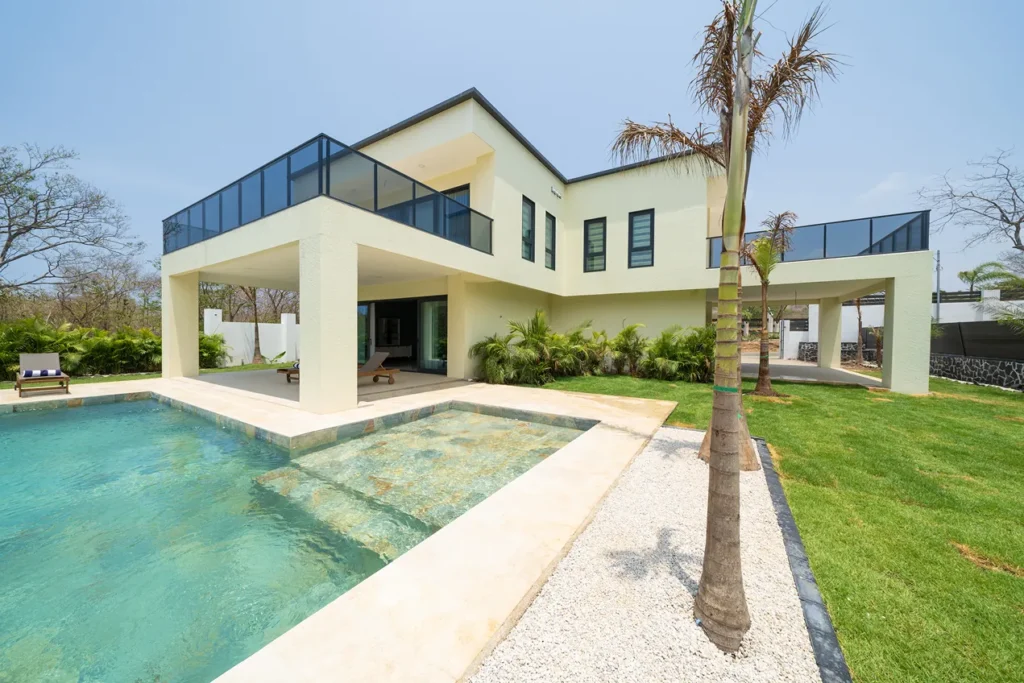
Importing building materials and finishes to Costa Rica means paying an import duty of about 1% to 15% of the value, then 13% VAT, and for some appliances a selective consumption tax of 30% to 40% (US International Trade Administration, June 2026). Goods made in the United States usually enter duty free under CAFTA-DR when their origin is properly certified, but VAT still applies. Structural materials are normally bought locally; importing tends to pay only for specific finishes, fixtures and appliances you cannot get here, ordered early through a licensed customs broker.
This guide explains how each tax is calculated, how CAFTA-DR and other trade agreements change the duty, what a customs broker does, how shipping and ports work, what owners commonly import and buy locally, and the risks. For the other costs a construction price leaves out, see our hidden costs guide. This is general information, not tax or customs advice: confirm every shipment with a licensed customs broker.
What taxes do you pay to import building materials to Costa Rica?
| Charge | Rate | Calculated on |
|---|---|---|
| Import duty (DAI) | About 1% to 15%, by product and origin; includes the 1% Law 6946 charge | The CIF value: cost of the goods plus insurance and freight |
| Selective consumption tax | Only some goods; 30% to 40% on some domestic appliances, such as refrigerators | Customs value plus the duty actually paid |
| VAT (IVA) | 13% on most goods | Customs value plus the other taxes paid |
| Broker, port handling, storage and inland freight | Quoted per shipment | Not taxes, but part of the landed cost |
The rates come from the US International Trade Administration (June 2026); the calculation bases come from the European Commission's Access2Markets fact sheet on exporting to Costa Rica, which also says the import duty is applied to the CIF value.
How the 1% Law 6946 charge fits in
Hacienda treats a 1% charge on the value of imported goods, created in 1983 under Law 6946, as part of the import duty. In Hacienda's own example, where a product's duty totals 10%, 9% is tariff and 1% is the Law 6946 charge (El Financiero, March 2025). Whether that 1% applies to goods entering under a trade agreement depends on the agreement and the product, so ask your broker for the line-by-line figure.
Worked example: one imported refrigerator
A hypothetical refrigerator with a CIF (customs) value of $4,000. The 10% duty and the 30% selective tax are assumed rates for the arithmetic, not the rates for any real model; 13% is the standard VAT rate (ITA). Your broker will confirm the real rates for the exact model.
| Step | Not of US origin (assumed: 10% duty, 30% selective tax) | US origin under CAFTA-DR (0% duty; assumed: 30% selective tax) |
|---|---|---|
| CIF value | $4,000 | $4,000 |
| Import duty | $400 | $0 |
| Selective consumption tax at the assumed 30%, on CIF plus duty | $1,320 | $1,200 |
| VAT at 13% on CIF plus duty plus selective tax | $743.60 | $676 |
| Total taxes | $2,463.60 (about 62% of CIF) | $1,876 (about 47% of CIF) |
The selective tax is an internal tax, so in this example it still applies to the US-made refrigerator; the ITA notes that excise taxes still apply to some imported products, including domestic refrigerators. Broker fees, port charges and inland freight come on top.
CAFTA-DR: when US goods enter duty free
CAFTA-DR took effect in Costa Rica on January 1, 2009, and duty on US-originating consumer and industrial goods fell to zero across the board on January 1, 2015 (ITA, June 2026). Three details decide whether your shipment qualifies:
- Origin follows manufacture, not the shipping point. Shipping from a member country does not qualify a product by itself; each product needs its own origin analysis under the treaty's rules (Deloitte, November 2025). Tile made in Spain and bought in Florida does not become American.
- You need a certification of origin. Under CAFTA-DR article 4.16 it can be issued by the importer, the exporter or the producer, and a Hacienda resolution of November 2025 (MH-DGA-RES-1796-2025) lets Costa Rican importers issue it electronically with a Central Bank digital signature (Deloitte, November 2025).
- Keep the evidence. The importer must be able to support the claim, keep the documents for at least five years, and expect that customs can verify origin after the goods are cleared (Deloitte, November 2025).
Goods from Canada and Europe
Canada and Costa Rica have their own free trade agreement. Under its customs chapter, the exporter completes a certificate of origin for goods on which the importer claims preferential treatment, and a certificate is not required for imports valued at US$1,000 or less (Global Affairs Canada). Goods from the European Union can benefit from the EU and Central America Association Agreement, in force since October 2013, if they meet its rules of origin, shown with an EUR.1 certificate or an invoice declaration (European Commission, Access2Markets).
Do you need a customs broker in Costa Rica?
For a construction shipment, yes. Under the General Customs Law (Law 7557), the customs agent (agente aduanero) is the professional authorized by the customs service to act for third parties (article 33), and an agent's intervention is required in customs regimes except a few optional cases, such as courier shipments and non-commercial imports (article 37). Hacienda's TICA system holds the tariff, internal taxes, documents and any permits or inspections for each tariff classification (European Commission, Access2Markets). Confirm the current rules for your shipment with the broker. Classification is where most surprises start: a product's everyday name does not settle its tariff line, and a different line can mean a different duty and a delay.
Before you order, ask the broker for:
- the tariff classification and the duty, selective tax and VAT for each item;
- whether your origin documents will qualify the goods under CAFTA-DR or another agreement, and who issues them;
- an itemized quote that separates taxes from freight, insurance, port handling, storage, brokerage and inland delivery;
- any permits or inspections the product needs before it can be cleared;
- how long clearance usually takes at the port you plan to use.
Shipping containers and ports: Caldera or Moín?
Large orders come by sea, either in a full container or as part of a shared, consolidated load. Costa Rica's two main container gateways are Puerto Caldera on the Pacific and the APM Terminals container terminal at Moín on the Caribbean. In May 2025 the company that runs Caldera described the situation there as critical because of heavy cargo traffic and limited space, some importers were switching to Moín, and a $600 million modernization of Caldera was being tendered, with the government not expecting its effects on operations before 2029 (El Observador, May 2025). The same report noted that in December 2024 importers were paying an extra $1,000 to $1,500 per container to truck goods overland from Panama and avoid Caldera.
For a build in Guanacaste or on the southern Pacific coast, the closer port on the map is not always the faster one. Ask your broker and freight forwarder which port they recommend for the date you need the goods, and include inland trucking to the site in the quote. Builders' published estimates for imported finishes run roughly 6 to 12 weeks from order to site, longer in peak season, so order once the design is fixed.
What is commonly imported and what is bought locally?
Builders' guides broadly agree on the split below. Treat it as common practice, not a rule: availability changes, and many premium brands now have distributors in San José.
| Category | Usually bought in Costa Rica | Often imported |
|---|---|---|
| Structure | Cement, concrete block, rebar, sand and gravel | Rarely worth it |
| Plumbing and electrical rough-in | PVC pipe, conduit, wire, basic fixtures | Premium fixtures and fittings |
| Tile and stone | A wide range of ceramic and porcelain | Specific large-format, natural stone or European lines |
| Windows and doors | Locally fabricated aluminum systems | High-performance or specific European and US systems |
| Kitchens and appliances | Local cabinetmakers; major brands through San José distributors | Specific European kitchens; models not sold locally |
| Technology | Standard electrical equipment | Audio-visual, automation and specialty systems |
When does it pay to import building materials?
Compare each item on a landed basis: the local price installed against the foreign price plus duty, selective tax, VAT, freight, insurance, broker and inland delivery. Then weigh the wait and the warranty. Importing tends to pay:
- when the product, or the specification you need, is not sold in Costa Rica at all;
- when the goods are US-made, qualify under CAFTA-DR and carry no selective tax, so the main extras are VAT, freight and brokerage;
- when many items travel in one shipment, so freight and broker fees are spread over a larger value;
- when the build schedule has room for the lead time.
It tends not to pay for bulky items of low value, appliances that carry a selective tax and have no local service, or anything the builder needs on a fixed date. A late window order delays the plaster, paint and finishes that come after it.
Risks: breakage, warranty and salt air ratings
Breakage and damage in transit
Insure the shipment at its full value, and read the exclusions, deductibles and claim deadlines before it leaves. Photograph goods when they are packed and when they arrive, and report damage within the contract deadline. Order spare tile and stone from the same production batch, because a later batch may not match.
Warranty outside the country of purchase
Many manufacturer warranties stop at the border. Whirlpool's major appliance warranty, for example, is valid only in the United States or Canada and applies only when the appliance is used in the country where it was bought (Whirlpool). Before you order, ask the manufacturer in writing whether the warranty covers installation in Costa Rica and who will service the product here.
Salt air ratings near the coast
A product made for a dry inland climate can fail quickly by the sea. Ask for the rating, not the brochure:
- Aluminum windows, doors and railings. The FGIA/AAMA 2605 coating specification includes a 10-year South Florida exposure test with limits on colour change, chalking and gloss loss, and what PPG calls the industry's toughest salt-spray and humidity requirements (PPG). Ask whether the finish meets it.
- Stainless steel. Match the grade to the exposure. Guidance from the Australian Stainless Steel Development Association runs from grade 304 for urban or rural sites up to 316 and duplex 2205 for severe marine exposure, and says smoother finishes resist tea staining, the brown surface marks seen on coastal stainless (ASSDA, May 2023).
- Hardware and fixtures. Ask whether the warranty has a coastal or marine exclusion before you buy.
For how the structure itself copes with salt air, see concrete vs steel frame homes on the coast.
Checklist before you import finishes for your build
- Get a local price, installed, for the same or an equivalent product.
- Get the broker's classification and tax estimate for every line.
- Confirm the country of origin and who will issue the certificate of origin.
- Confirm the warranty in Costa Rica and the salt air rating in writing.
- Get an itemized freight quote, including port, storage and inland delivery.
- Agree with your builder on the delivery date, who receives and inspects the goods, and where they are stored on site.
- Insure the shipment and order spares.
If you are managing all of this from home, our guide to building from abroad covers how owners stay in control of a project remotely.
How Decentra helps
As a design-build custom home builder in Costa Rica since 2020, Decentra Homes has completed 50+ residential and commercial projects. Design and construction are CFIA certified under SANYC Ingeniería (CFIA registration CC-10880), our CFIA-licensed architect is Sergio Cerceño, and we build in concrete first, as well as hybrid and steel. A typical build takes 5 to 8 months on site once the permit is issued. Construction costs in 2026, before land, run from about $700 per m² for a basic finish to $1,800+ per m² for ultra luxury; see our guide to the cost to build a house in Costa Rica. Minimum construction budget $350,000 USD, before land, for new builds.
To check a budget that includes imported finishes before you commit, book consulting with a CFIA-licensed engineer and architect with 15 years of experience, at $200 per hour. Reach us on WhatsApp at +506 8733-2930 or send a message from the contact form.