

Building inside a gated community in Costa Rica: HOA rules, design review and permits
To build in a Costa Rica gated community you need the community's design approval under its reglamento and guidelines plus the usual CFIA and municipal permits, so read the rules before you buy.
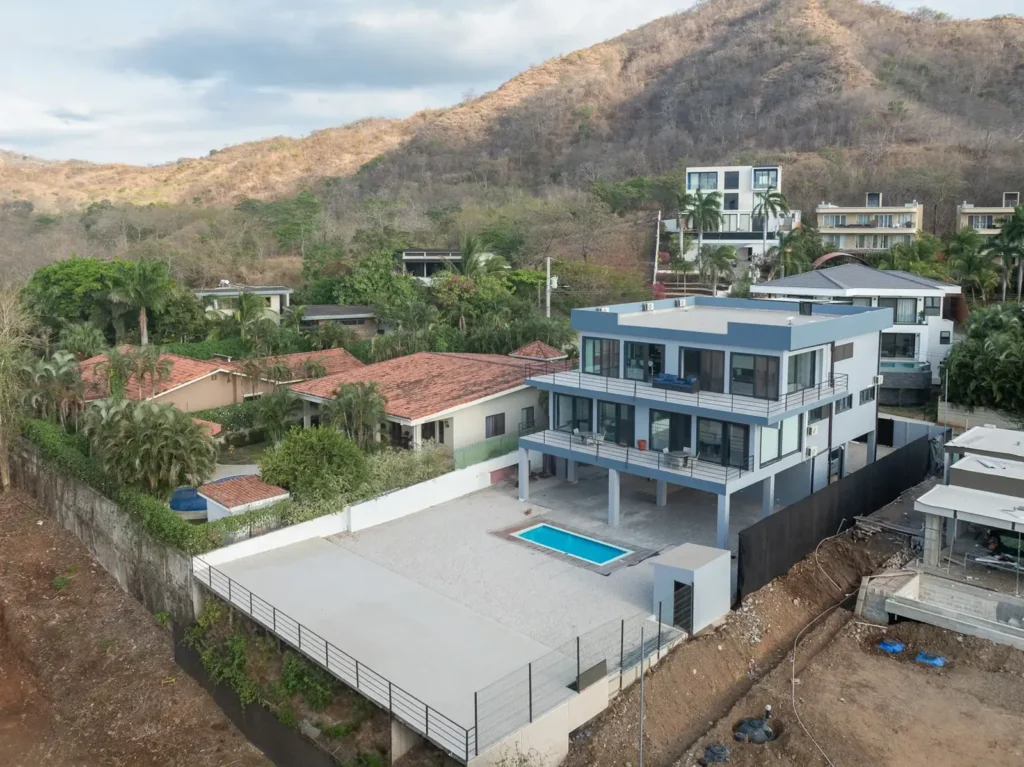
Building inside a gated community in Costa Rica takes two sets of approvals. The community's architectural review checks your design against its reglamento and design guidelines, and the public process (CFIA registration of the plans, the municipal building permit, the water letter and SETENA where it applies) checks it against the law. The community's rules can limit size, height, style and schedule, and they bind you from the day you buy, so read them before you sign.
This guide is general information, not legal advice. Ask a Costa Rican attorney to review the documents of the community you are considering.
It covers condominium law, the reglamento, architectural review and design guidelines, construction rules, approval timelines, fees and how the HOA approval fits with the municipal permit, with examples from Hacienda Pinilla, Reserva Conchal, Las Catalinas and Mar Vista.
Is a gated community in Costa Rica legally a condominium?
Often, but not always. Many communities are set up under the Ley Reguladora de la Propiedad en Condominio, Law 7933. A condominium is created by a deed recorded in the condominium section of the National Registry (article 5), and anyone who buys into it is bound by its existing reglamento (article 34). Other communities are subdivisions of individually titled lots with a gate and an owners' association but no condominium regime. Articles in Howler and on CostaRicaLaw.com say bylaws and fees in that second kind of community are voluntary and cannot be enforced against owners who refuse to comply, which can leave paying owners covering the shortfall.
| Condominium under Law 7933 | Gated subdivision without a condominium regime | |
|---|---|---|
| How it is created | Deed recorded in the condominium section of the National Registry | Separate lots, each with its own title |
| Rules | The registered reglamento binds every buyer | Bylaws are largely voluntary |
| Fees | Unpaid fees are secured on the unit | Owners cannot be forced to pay common charges, according to Howler |
| What to ask for | The registry record of the condominium and its reglamento with amendments | Any document that binds owners, and who maintains the road, gate and water |
What Law 7933 says about fees, works and votes
- Owners share the common costs. Every owner must contribute to administration, upkeep and operation, even if they do not use the common facilities (article 13).
- Structural limits. Owners can carry out work inside their own unit but cannot make changes that affect the structure, main walls or other essential elements (article 16).
- Unpaid fees follow the property. The unit stands as security for unpaid common expenses (article 20), and the Tico Times notes this lien ranks ahead of everything except property tax (July 2021). When a unit is sold, the notary needs a certificate from the administrator showing its payment position, and a buyer can become jointly liable for certified arrears (article 21).
- Assemblies. Votes are weighted by each unit's share of the condominium's value, and the first-call quorum is two thirds of that value (article 24).
- Majorities. Since a 2022 reform of article 27, Law 10229 (published June 28, 2022), amending the deed or the reglamento needs votes representing at least two thirds of the total value, and changing the condominium's general purpose needs unanimity (Bufete de Costa Rica). A 2025 reform, Law 10746, allows virtual assemblies with real-time two-way participation (Howler, GM Attorneys; ECIJA, October 2025).
- The rulebook. Article 33 lists the minimum the reglamento de condominio y administración must cover, and article 34 requires every amendment to be recorded at the registry.
The older text of the law, still reproduced in some copies, required a unanimous vote to change the deed or the reglamento (articles 27 and 34). Law 10229 rewrote article 27, so have your attorney confirm the majority that applies to the change you care about.
The reglamento de condominio: what to read before you buy
The reglamento is the community's rulebook. Ask for the registered version and every recorded amendment, not a summary from the seller (CRIE, September 2026). For a lot you plan to build on, look for:
- Permitted use: one house, a guest house, rentals, home businesses.
- The building envelope: coverage, floor area, height, setbacks and minimum house size.
- Design guidelines and who approves them.
- Approval steps, review fees and time limits.
- Construction rules: hours, contractor access, deposits, deliveries and clean-up.
- Deadlines to start or finish building, and any penalty for an empty lot.
- Fees, reserves, special assessments and how they are set.
- Sanctions and how disputes are handled.
Architectural review boards and design guidelines
Planned communities usually have a design review committee or architectural review board (ARB) that must approve your plans before you build. The few guidelines published online show how specific the rules can be:
- Alegría Village publishes its limits: built area up to 900 m² or 40% of the lot, whichever is smaller; up to 2.5 stories above grade; at least 60 m² of conditioned space; accessory buildings under 40 m² of footprint and under 25 feet tall; and stone sourced from within 200 miles. Its committee is made up of neighbors with architecture, construction and ecological design experience, appointed by the HOA each year (Alegría Village).
- Las Catalinas approves designs through an Architectural Review Board, with guidelines built around durability, the local climate and honest use of materials (Congress for the New Urbanism, May 2022).
- Mar Vista, in the hills of Playa Flamingo, requires regenerative construction, sediment pools during construction to limit erosion, and soil stabilization and revegetation afterwards, according to Blue Water Properties (page updated June 2026).
Guidelines can go well beyond municipal rules into style, materials, colors, roof forms, lighting, landscaping and views. A design that meets the building code can still be refused by the board, so give your architect the guidelines on day one. More on how design works with us: architectural design.
Approval timelines and building deadlines
Community review adds a step before the public permit process, and some communities also set deadlines for you:
- Alegría Village asks owners to submit designs within 18 months of buying, start construction within 12 months of approval and finish within 18 months of starting, unless the committee grants an extension. It says the municipality typically grants permits in about 30 days (Alegría Village).
- Shift Esperanza in Nosara says HOA fees double after three years for any lot that remains undeveloped (Shift Esperanza FAQ).
Ask the board how often it meets, how many review rounds are normal and whether it will look at a preliminary design before full plans. Add those weeks to the schedule ahead of the 5 to 8 months a typical Decentra build spends on site.
Construction hours, deposits and contractor rules
We could not find published construction rules for the four communities named in this guide, so ask for them in writing before you buy. These are the points that affect cost and schedule:
- Working days and hours, and noise limits.
- Registration of the contractor and workers, and how access through the gate works.
- Any refundable construction or damage deposit: the amount, what it covers and how it is returned.
- Delivery hours, truck size or weight limits, and where materials can be stored.
- Who pays to repair roads and common areas damaged during the work.
- Erosion control, waste removal and site fencing.
- Temporary water and power during construction.
HOA fees: what to budget
Fees vary widely. A Dominical Realty listing for a lot in Mar Vista, active when we checked it on November 3, 2026, gives an HOA fee of $330 per month. In Reserva Conchal, fees vary by neighborhood and property type (Krain Costa Rica, June 2026). Security is usually the largest cost, and fees that start low while the developer still covers part of it can double or even triple once the owners take over (Tico Times, July 2021).
Ask for the current budget, two or three years of financial statements, any pending special assessments, and whether fire and earthquake insurance is included.
How HOA approval fits with the municipal building permit
The community's approval does not replace any public permit, and the public permit does not replace the community's approval. Law 7933 requires the condominium project itself to be approved by INVU, the Ministry of Health and the municipality (article 3), and each house inside still needs its own permit. A typical order:
- Your attorney reviews the registry record and the reglamento before you buy.
- Your architect designs to the community's guidelines and the municipal rules.
- The community's board reviews and approves the design.
- The plans are registered with the CFIA and submitted to the municipality through the CFIA's APC platform, which asks for proof of water availability, wastewater disposal and the cadastral plan (CFIA).
- The municipality issues the building permit. Some municipalities ask for written authorization from the condominium: Escazú's checklist for minor works (up to 30 m²), for example, requires a written, notarized authorization from the owners, the board or the administrator for work inside an existing condominium. Ask your municipality what it requires for a new house.
- Construction follows both the permit and the community's construction rules.
| Approval | Who gives it | What it covers |
|---|---|---|
| Design review | The community's board or ARB | Guidelines on size, siting, style and materials |
| Plan registration | CFIA | Professional responsibility and required documents |
| Building permit | Municipality | Land use, setbacks and permit documents |
| Water availability | AyA, the local ASADA or a municipal system | Supply for the new house |
| Environmental viability | SETENA, above its thresholds | Construction over 1,000 m², or 500 to 1,000 m² in a fragile area (SETENA) |
Water deserves its own check even inside a community with its own system, because the permit needs proof of availability. Our permits and water letters service handles both sides.
Hacienda Pinilla, Reserva Conchal, Las Catalinas and Mar Vista: what is published
| Community | What is published or reported | Source |
|---|---|---|
| Hacienda Pinilla | Over 4,500 gated acres; lots marketed with municipal permits and architectural committee approval already in place | Hacienda Pinilla website; Dominical Realty listing (2026) |
| Reserva Conchal | HOA fees vary by neighborhood and property type and generally cover security, water, garbage, reserves and amenities | Krain Costa Rica (June 2026) |
| Las Catalinas | Architectural Review Board approves designs; motor vehicles not permitted through most of the beach town; 87% of the 1,500-acre property to stay forest | Congress for the New Urbanism (May 2022) |
| Mar Vista | 750 acres in the hills of Playa Flamingo; regenerative construction, sediment pools, soil stabilization and revegetation required; one lot listed with a $330 monthly HOA fee | Blue Water Properties (June 2026); Dominical Realty listing (checked November 3, 2026) |
None of the four publishes its full building rules online, so treat this as a starting point and ask the developer or the administrator for the reglamento, design guidelines and construction rules for the specific lot. Local detail is on our Playa Flamingo and Las Catalinas pages.
Checklist before you buy a lot in a gated community
- Confirm whether the community is a registered condominium, and get the registry record.
- Get the reglamento and every recorded amendment.
- Get the design guidelines and the review process, fees and timelines.
- Check the lot's building envelope: coverage, height, setbacks and minimum size.
- Get the construction rules: hours, deposits, contractor access and deliveries.
- Get the fee history, financial statements and the administrator's payment certificate.
- Confirm the water supply and get a water letter for the lot.
- Check any deadlines to build and any penalty for an empty lot.
- Ask the municipality what it requires from the condominium with a permit application.
- Have an architect test a concept design against all of the above before you sign.
The rest of the lot checks, from title to access, are in our guide to buying land in Costa Rica to build.
How Decentra helps you build in a gated community
Decentra Homes is a design-build custom home builder in Costa Rica, founded in 2020 and CFIA-licensed under SANYC Ingeniería (CFIA registration CC-10880), with 50+ residential and commercial projects and architecture by CFIA-licensed architect Sergio Cerceño. We build in concrete first, and in hybrid and steel frame. Before you buy, our land and construction consulting reviews the lot and the community's rules with a CFIA-licensed engineer and architect with 15 years of experience, at $200 per hour. Minimum construction budget $350,000 USD, before land, for new builds.
Our showroom is in Altos de Flamingo, Playa Flamingo, and open by appointment. Send us the community's documents on WhatsApp at +506 8733-2930.