

Buying land in Costa Rica to build: a due-diligence checklist
Before you buy land in Costa Rica to build on, confirm eleven things in writing, from the title and survey to the water letter, setbacks and access.
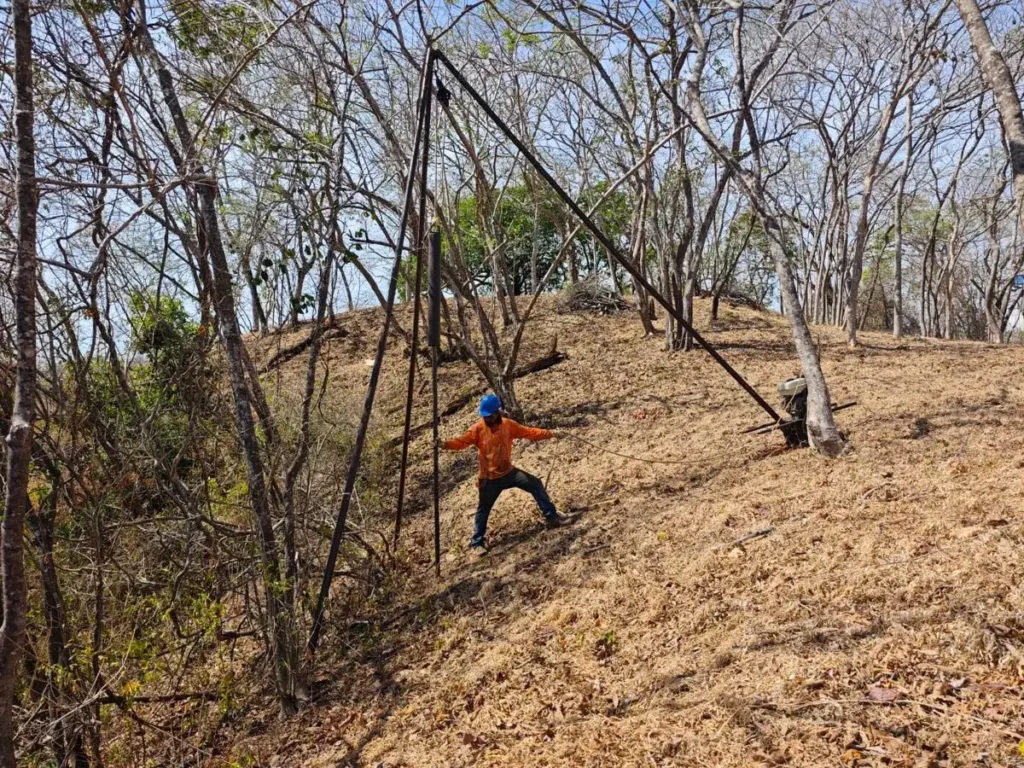
The lot decides what you can build, how long it takes and what it costs. In Costa Rica a lot can have a clean title and an ocean view and still be unbuildable: no water letter, a river setback across the building site, or a road you have no legal right to use. This checklist covers what to verify before you sign a binding offer, who issues each document and the red flags that should pause a deal.
The checklist at a glance
- Title and registry search
- Survey plan (plano catastrado) checked on the ground
- Land-use certificate (uso de suelo)
- Water availability letter
- Maritime zone status, if the lot is near the beach
- Protected areas, rivers, springs and forest
- Legal and practical access
- Electricity, internet and wastewater
- Topography, soil and drainage
- HOA or condominium rules
- Closing costs and ongoing taxes
Who issues what: the key documents
| Document | Issued by | What it tells you |
|---|---|---|
| Registry report (informe literal) | Registro Nacional | Owner, liens, mortgages, easements and annotations |
| Plano catastrado | Drawn by a licensed surveyor, recorded at the National Registry cadastre | Boundaries, area and location |
| Uso de suelo | Municipality | Permitted use, floors, lot coverage and density |
| Water availability letter | AyA, the local ASADA or a municipal water system | Whether the lot can get a water connection |
| River alignment (alineamiento fluvial) | INVU | The setback from rivers and creeks |
| Road alignment | MOPT, for lots on national roads | The setback from the road |
| Municipal tax certification | Municipality | Whether property taxes are paid up |
1. Title: who owns it and what is registered against it
Every property has a folio real number at the Registro Nacional. The record shows the owner, boundaries, fiscal value and any mortgages, liens, easements, lawsuits or embargoes. Unpaid municipal taxes stay with the property, so get a municipal tax certification too. If the lot is held by a company and you are buying the shares, you take on the company's debts and lawsuits, so the company needs its own review (Tico Times, September 2026). Use your own lawyer, never the seller's.
2. The plano catastrado and the survey
The area in the registry must match the registered survey plan, and the plan must match the land. Large or irregular lots can have boundary errors or fences in the wrong place (Tico Times, 2021). Hire a surveyor the seller has not used to walk the boundaries and find the markers. If you are serious about the lot, ask for a topographic survey with contours as well. It is what the architect designs from, and it shows how much earthwork the site needs.
3. Uso de suelo: what the municipality will let you build
The land-use certificate sets the permitted type of construction, the number of floors and the maximum lot coverage under the local regulatory plan (Diario Extra, 2026). Request it from the municipality before you commit, and read it against what you want to build. Where a canton has no regulatory plan, national rules apply. Santa Cruz, which covers Flamingo, Tamarindo and Playa Grande, expects its coastal and urban plan in early 2027 (Teletica, July 2026).
Some areas add their own limits. Around Nosara, the Ostional refuge regulation caps lot coverage at 50% and height at 9 meters in the first kilometer, 12 meters beyond, and the courts made it final in June 2026 (Delfino).
4. Water: the letter that decides if a lot is buildable
A building permit requires a water availability letter from AyA, the local ASADA or a municipal system, and without one a lot is effectively unbuildable (Tico Times, September 2026). This is not a formality. AyA turned down 22% of the 23,272 requests it received in 2023 (Delfino, March 2024), and in 2024, 22 ASADAs near Guanacaste's coastal tourism districts had no technical capacity to grant new connections (Semanario Universidad, June 2026).
Water sources belong to the state, not to the owner of the land (Dominical Realty). A well or spring needs a concession from the Dirección de Agua, and the concession is tied to a specific property and owner (CRIE, 2026). If a lot relies on a spring, check how many homes the concession can supply: a spring rated for three homes cannot serve five lots (Two Weeks in Costa Rica). Get the letter in writing, for the exact lot and the use you plan, before you pay a non-refundable deposit.
5. The maritime zone (ZMT)
On the coast, the first 200 meters from the high-tide line are state land under Law 6043. The first 50 meters are public and cannot be built on. The next 150 meters are held by municipal concession, not title, and a foreigner cannot hold a majority interest in a concession without five years of legal residency (Tico Times, September 2026). Listings often blur titled land and concessions. Have your lawyer confirm which one you are buying, where the zone line falls and whether the area has an approved coastal regulatory plan.
6. Protected areas, rivers, springs and forest
Article 33 of the Forestry Law (Law 7575) protects land along water, with distances measured horizontally (Delfino, February 2026):
- 100 meters around a permanent spring
- 15 meters on each side of a river or creek on flat rural land, or 10 meters in urban areas
- 50 meters on each side where the terrain is steep
- 50 meters around natural lakes and public reservoirs
If a creek touches the lot, ask INVU for the river alignment (alineamiento fluvial). Forested land generally cannot change use, and owning a lot does not give you permission to clear it, so ask SINAC before cutting trees or opening a driveway (CRIE, 2026). Next to national parks the rules can be stricter still. At Playa Grande, a 2008 court ruling froze building inside the disputed Las Baulas park boundary and a 500 meter buffer, and the municipality shut down sites in 2009 (Tico Times, 2009).
7. Access: legal and practical
The lot needs recorded access from a public road or a registered right of way, and the road should work in the rainy season for your intended use (CRIE, 2026). During construction that means a concrete truck, not only a 4x4. Find out whether the road is public or private and who maintains it; rural roads are often kept up by the community, not the municipality (Dominical Realty). Easements for the road, water lines and power should be written on the title in favor of your lot.
8. Electricity, internet and wastewater
Confirm that power reaches the front of the lot, because extending lines to a remote site can be slow and expensive (Two Weeks in Costa Rica). Ask the neighbors which internet service works. Very few areas have a public sewer, so most homes need a septic or treatment system designed by the engineer, and it takes space on the lot (Tico Times, 2021).
9. Topography, soil and drainage
Steep view lots cost more to build on: retaining walls, deeper foundations, drainage and longer driveways. Check whether the building area is cut into the hillside or sits on fill, and whether that fill was compacted. Look for erosion, and think about where water goes in a heavy rain. A lot at the top of a slope usually drains better than one at the bottom (Tico Times, 2021). A soil study before you buy gives the engineer the bearing capacity that decides the foundation.
10. HOA and condominium rules
In a gated community, read the bylaws and confirm they are registered at the National Registry. Ask about HOA fees on raw land, water fees and maintenance fees (Tico Times, 2021). Many communities have architectural guidelines and a design review; in Las Catalinas, for example, every design must pass the town's Architectural Review Board. Check whether the rules limit rentals, a guest house or a second unit.
11. Closing costs and ongoing taxes
For a straightforward purchase, budget roughly 3.5% to 5% of the price: 1.5% transfer tax, about 0.5% to 0.8% in stamps and registry fees, and notary fees of about 1% to 2% plus VAT. Use escrow through a SUGEF-registered agent. After closing, municipal property tax is 0.25% of the registered value each year (Tico Times, September 2026).
Red flags that should pause a purchase
- The seller has no water letter, or the letter is for a different lot or use.
- The plano does not match the registry or the fences.
- The lot is within 200 meters of the beach and the listing does not say whether it is titled or a concession.
- A creek, spring or forest sits on the building site.
- Access depends on a verbal agreement with a neighbor.
- The seller asks you to declare a lower price on the deed. That is tax fraud, and it raises your tax when you sell (Tico Times, September 2026).
- You are asked to send money outside escrow.
Get the lot checked before you sign
Our land and construction consulting puts a builder, an engineer and a CFIA-licensed architect on the lot before you commit. We shortlist lots, visit them with you or for you on video, order the topographic survey and soil study, check zoning, access and the water letter, and give you a written report with a first budget. If you build with us, the consulting fee is credited to your construction; surveys, soil studies and other studies are paid separately and are not credited.
When you are ready to price the house, see our cost to build guide and our permits and water letters service. Minimum construction budget: $350,000, before land. WhatsApp +506 8733-2930 or email info@decentrahomes.com.