

Building a home in Costa Rica: the 2026 guide from land to keys
Building a home in Costa Rica takes nine steps, from checking the land and getting the water letter to permits, 5 to 8 months of construction and handover. Construction runs about $700 to over $1,800 per m² before land, depending on the finish.
Building a home in Costa Rica: the short answer
Building a home in Costa Rica works well for overseas buyers when the steps happen in the right order: check the land, get the water letter, design with a CFIA-licensed architect, register the plans, get the municipal permit, then build.
This page is the overview. It walks you through the full process from land to keys, what a custom home costs in 2026, how permits and the water letter work, which construction system to pick and where people build. Where a topic needs more depth, we link to a dedicated guide.
- Who can build: foreigners can buy titled land and build on it with a passport, no residency needed (Tico Times, September 2026).
- What it costs: about $700 to over $1,800 per m² for construction, before land, depending on the finish level.
- How long it takes on site: most of our homes take 5 to 8 months on site once the permit is issued.
- Our minimum: Our minimum construction budget is $350,000 USD, before land.
Can foreigners build a house in Costa Rica?
Yes. A foreigner can buy property with a valid passport: no residency, no visa, no local partner and no minimum purchase price. Titled property is registered in the buyer's name at the Registro Nacional with full rights of use and disposal (Tico Times, September 2026).
Title versus concession on the coast
The first 200 meters inland from the ordinary high tide line belong to the state. The first 50 meters are a public zone where no one can build. Land in the rest of that strip is held by concession, which is a lease from the state, not ownership, and a foreigner needs at least five years of legal residency to hold a majority interest in one (Tico Times, September 2026). Have your lawyer confirm which one a listing really is.
Costs of buying the land
- Transfer tax of 1.5%, plus about 0.5% to 0.8% in stamps and registry fees.
- Notary fees of about 1% to 2% plus VAT, for a total of roughly 3.5% to 5% of the price.
- Escrow through a SUGEF-registered agent at about 0.25% or a flat fee near $1,000.
- Municipal property tax of 0.25% of the registered value each year.
One more tax catches custom home owners. In 2026 the solidarity (luxury home) tax applies where construction and fixed installations reach ¢143 million, at progressive rates of 0.25% to 0.55% a year (Tico Times, September 2026). Many finished custom homes cross that line, so budget for it.
Building a home does not give you residency on its own. Treat immigration as a separate decision with its own advisor (CRIE, September 2026). Before you buy, read our guide to buying land in Costa Rica to build.
Step by step: from land to keys
Here is the full process in the order it should happen, with typical durations. Times before construction vary most, because they depend on the lot, the municipality and how quickly you approve the design.
| Step | What happens | Typical duration |
|---|---|---|
| 1. Brief and budget | Size, bedrooms, finish level, pool or not, and a total budget with land | Your own time, before viewing lots |
| 2. Land checks | Title, survey plan, land use certificate, water letter, power, legal access | Before you sign; a new well concession alone takes about 12 to 18 months (Invicta Legal) |
| 3. Buy the lot | Your own lawyer, a notary and escrow | Set by the purchase contract |
| 4. Topographic survey and soil study | Exact levels and boundaries, soil type and bearing capacity | Ordered right after purchase, before design |
| 5. Design | Concept, 3D model, then full construction plans and a detailed budget | Depends mostly on how fast you approve each stage |
| 6. CFIA registration | Plans filed through the CFIA's online APC platform and checked against the Seismic and Electrical Codes | About 1 to 2 weeks (Vacations Costa Rica) |
| 7. Municipal permit | CFIA-registered plans plus the INS workers' risk policy go to the municipality | About a month (Vacations Costa Rica); longer in some cantons |
| 8. Construction | Foundations, structure, roof, systems, finishes, pool and landscaping | 5 to 8 months on site once the permit is issued, for most of our homes |
| 9. Handover | Walk-through, punch list, warranties, utility accounts in your name | Depends on the punch list |
Two details trip people up. First, a CFIA seal is not a permit, so do not start work on the strength of a CFIA reference alone (CRIE, September 2026). Second, the INS workers' risk policy is required before work starts (Diario Extra, 2026).
What happens during construction
Once the permit is issued, the build follows the same order on almost every lot:
- Site preparation: clearing, grading, temporary power and water, and the access drive.
- Foundations: sized from the soil study and the structural plans.
- Structure and roof: walls, columns, beams, slabs and the roof, so the house is closed against the rain.
- Systems: electrical, plumbing, drainage and air conditioning, run before walls are finished.
- Finishes: floors, tile, joinery, windows and doors, kitchens and bathrooms.
- Pool and outdoor areas: the pool, terraces and landscaping.
Contracts in Costa Rica are commonly paid in stages, with a deposit and then payments at milestones such as the foundation, the roof and the windows, each released after inspection (Vacations Costa Rica). A lump sum price set from complete plans, with formal change orders, shows the total before work starts. A cost-plus contract adds the contractor's profit and overhead of 20 to 35% on top of costs (Vacations Costa Rica), so the final figure is only known at the end.
Permit times are less predictable than build times. One owner who went through it wrote that the process can take a year for some people and a few months for those who stay on top of it (The Costa Rica News, May 2024). Our guide to how long it takes to build a house in Costa Rica covers each phase in detail.
How much does it cost to build a house in Costa Rica in 2026?
These are our own current construction prices per square meter, before land. Where a home lands depends on the finish level, the lot and the location.
| Finish level | Per m² | Per sq ft (approx.) |
|---|---|---|
| Basic | About $700 | About $65 |
| Mid-range | About $1,000 | About $93 |
| Upper mid-range | $1,000 to $1,200 | $93 to $112 |
| Luxury | $1,500 to $1,800 | $139 to $167 |
| Ultra luxury | $1,800+ | $167+ |
Source: Decentra Homes construction pricing, October 2026. Square foot figures divide by 10.76 and are rounded.
What comes on top of construction
- Pool: about $2,500 per m² of pool, all-in (excavation and grade work, the shell, the finish and the filtration system). LED lighting and other custom features add to that, depending on the design.
- Design and plans: about 5.5% to 6% of construction value under the CFIA fee schedule.
- Contingency: 10 to 15% of construction. Stay at the top of that range on steep or remote lots.
- Studies: a topographic survey and soil study, quoted per lot.
- Permit, insurance and utility connections: quoted per project. Published guides put the municipal permit at about 1% of construction costs and the INS policy at about 1.33% (Vacations Costa Rica).
Decentra's minimum project budget is $350,000 USD in construction, before land, so most of our clients build upper mid-range, luxury or ultra luxury homes. Our full cost to build guide breaks down every line, and our pool cost guide prices pools by size.
Worked example: a 250 m² luxury home with a pool
Here is how a real budget adds up for a 250 m² (about 2,690 sq ft) home with a luxury finish at $1,650 per m², the middle of our $1,500 to $1,800 range, plus a 4 x 8 m pool. It is an illustration, not a quote for a specific lot.
| Item | How it is worked out | Amount |
|---|---|---|
| House construction | 250 m² x $1,650 | $412,500 |
| Pool, all-in | 32 m² x $2,500 | $80,000 |
| Construction subtotal | $492,500 | |
| Design and plans | 5.5% to 6% of $492,500 | $27,088 to $29,550 |
| Contingency | 10% to 15% of $492,500 | $49,250 to $73,875 |
| Total | Before land and the items below | About $569,000 to $596,000 |
Not included: the land and its closing costs, the topographic survey and soil study, the municipal permit, the INS policy, utility connections, site work such as retaining walls, LED pool lighting or other custom pool features, and furniture.
The biggest swing in most budgets is the lot, not the kitchen. A steep hillside view lot can need retaining walls, deeper foundations and a long access drive. That is why the survey and soil study come before design.
Also see: How long does it take to build a house in Costa Rica? and Importing building materials and finishes to Costa Rica: duties, taxes and when it pays
Permits and the water letter
A Costa Rican building permit rests on a short list of documents. Each one has to be in place before the next step (Diario Extra, 2026):
- Land use certificate (uso de suelo) from the municipality, which sets what you can build, how many floors and how much of the lot you can cover.
- Proof of services: certificates for drinking water and electricity.
- Construction plans by CFIA-registered professionals, filed through the APC platform.
- INS workers' risk policy, required before work starts.
- Municipal building permit, issued once the CFIA-registered plans and the INS policy are filed and the fees are paid.
Why the water letter comes first
Construction permits require a water availability letter from the local ASADA or from AyA, the national water utility (Tico Times, September 2026). Some municipalities run their own systems and issue the letter themselves (Invicta Legal).
- AyA received 23,272 availability requests in 2023 and turned down 22% of them, for reasons that included no water main in front of the property and not enough water (Delfino, March 2024).
- An availability letter is valid for one calendar year, and extensions are not guaranteed (Invicta Legal).
- A capacity letter is not an availability letter, and municipalities do not accept it for a building permit (Invicta Legal).
- A private well is not a quick fix. Wells need a concession from the Dirección de Agua (Tico Times, September 2026).
Make a valid water letter a written condition of your land purchase. Our water letter guide covers who issues it and what to do if it is refused, and our permits and water letters service handles the filings for you.
Environmental review and setbacks
Some projects also need environmental review from SETENA. There is no universal size below which every home is exempt; the answer depends on the activity, its scale and its location (CRIE, September 2026). Rivers and springs carry protection areas too: 100 meters around a permanent spring, and 10 to 15 meters on each bank of a river on flat land, or 50 meters on broken terrain (CRIE, September 2026). Your architect should confirm both before design starts.
Concrete, hybrid or steel frame: choosing a construction system
We build in concrete, hybrid and steel, and choose the system for each lot. Whatever the system, plans are reviewed against the Seismic Code and the Electrical Code when they are filed with the CFIA (Diario Extra, 2026).
| System | What it is | Where it fits |
|---|---|---|
| Concrete | Reinforced concrete block or poured concrete | Most homes and most lots; our first choice |
| Hybrid | A concrete base and core with a galvanized steel frame where it helps | Hillside lots, long spans and large openings |
| Prefabricated galvanized steel frame | Our own steel frames, made to the plans and assembled on site | Steep or remote sites where a lighter structure helps |
When we say prefab, we mean our galvanized steel frames only. We do not build pre-built modular or container homes; our guide to prefab, modular and container homes explains the difference.
Casa de Acero is an example of a hybrid: it combines steel and concrete. See construction systems to compare them side by side, or buy galvanized steel frames if you have your own builder.
Where to build in Costa Rica
Where you build changes the lot work, the water question and the logistics more than it changes the house. Here is what we look at in each region. Our locations page has a guide for each town.
- Guanacaste and the North Pacific. Playa Flamingo, Tamarindo, Playas del Coco, Nosara and Sámara. Our showroom, Casa Dos Hermanas, is in Altos de Flamingo. Water capacity is the first thing we check here.
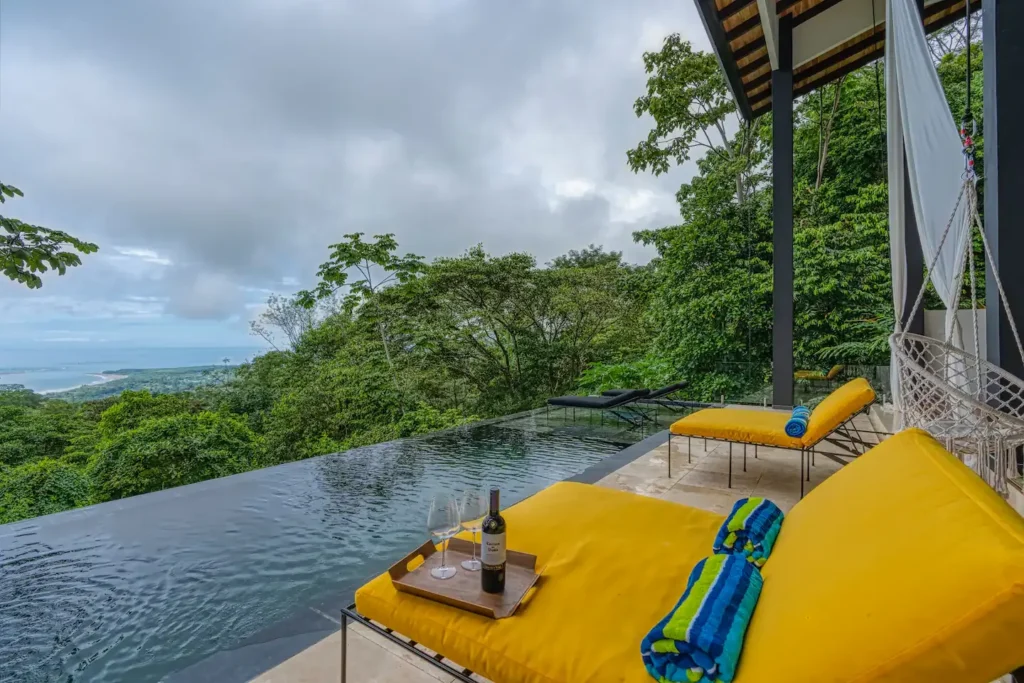
- Central and South Pacific. Manuel Antonio, Dominical, Uvita and Ojochal. Many lots are steep, forested and face the ocean, so access, drainage and foundations drive the budget. Our Rainforest Ocean-View Villa is in Manuel Antonio.
- Central Valley. Escazú, Santa Ana and San José. We check land use rules, access and utility connections as on any lot.
- Arenal and the Caribbean. La Fortuna, Puerto Viejo and Limón. We check drainage, materials and roof design for the local conditions.
We build anywhere in the country. If you already own a lot, see our guide to building on your own land.
Mistakes to avoid when building in Costa Rica
- Buying before the water letter. A lot without a water letter is a lot you cannot get a permit for. Make the letter a condition of purchase.
- Using the seller's lawyer. Hire your own lawyer and use escrow for the money.
- Skipping the survey and soil study. Without them, the design and the budget are guesses, especially on a hillside.
- Not checking the builder. Search the CFIA company directory by name or corporate ID; only the status "Inscrita" authorizes a company to work (CRIE, September 2026). See our checklist for choosing a builder.
- Changing the design after the permit. Finish design properly first. Changes later mean revised drawings and new filings.
- Budgeting only the price per square meter. Design, contingency, the pool, studies, permits and connections sit on top.
- Planning without the rain. The rainy season runs from May to November, and owners report delays from it (Two Weeks in Costa Rica, October 2025). Plan the schedule so the roof is on before the heaviest months.
- Forgetting the taxes after handover. Municipal property tax is 0.25% of the registered value each year, and the solidarity tax applies to many finished custom homes (Tico Times, September 2026).
- A vague contract. Ask for payment stages tied to finished milestones, a change order process and a clear list of what is included (CRIE, September 2026).
How we work with you
We are a design-build company: land consulting, architecture with a CFIA-licensed architect, permits, construction, pools and handover under one contract. Counting projects delivered under our previous CFIA-registered company, our team has completed 50+ residential and commercial projects, with 10+ years building internationally and 6 in Costa Rica.
- Before you buy: our land and construction consulting checks title, land use, water, access and slope. The consulting fee is credited to construction if you go ahead with us. Topographic surveys, soil studies and other studies are paid separately and are not credited.
- Design: see architectural design.
- A finished home: see turnkey homes and our portfolio.
- Financing: available through a third-party lending partner for qualified clients.
Our minimum construction budget is $350,000 USD, before land. Message us on WhatsApp at +506 8733-2930, email info@decentrahomes.com or visit our showroom in Altos de Flamingo, Playa Flamingo, Guanacaste.